The sound of an olive grove splintering is something no news ticker can capture. It is a sharp, organic crack, followed by the heavy, mechanical grind of a Merkava tank’s treads crushing soil that has been tilled by the same families for generations. When the border moves, it doesn’t move on a map first. It moves in the vibration of a windowpane in a kitchen in Metula, or the sudden, terrifying silence of a birdsong in a village near Tyre.
The headlines will tell you that Israel has extended its ground incursion into Southern Lebanon. They will use words like "strategic depth," "infrastructure dismantlement," and "containment." But those are sterile words for a visceral reality. This is a story of two sides of a jagged line, where the history is as thick as the smoke rising from the Litani River.
The Ghost of the Blue Line
Imagine a man named Elias. He is a hypothetical composite of the thousands who live in the border towns of Southern Lebanon, but his fear is entirely real. Elias knows the "Blue Line" isn't a wall; it’s a ghost. It’s a United Nations-demarcated boundary that exists in the minds of diplomats and on the screens of drone operators. For Elias, the expansion of this conflict means the horizon is no longer a place where the sun sets. It is a place where the fire starts.
He watches the hills. He knows that Hezbollah has spent years weaving itself into the very limestone of these mountains. They are not just an army; they are a subterranean architecture. When the Israeli Defense Forces (IDF) announce they are pushing deeper, they aren't just walking across a field. They are entering a labyrinth.
On the other side, in the northern Israeli towns that have been ghost cities for months, there is a different kind of desperation. Consider Sarah, a mother who hasn't slept in her own bed in Kiryat Shmona since October. For her, the "extension" of the incursion isn't an act of aggression—it’s the only way she can imagine ever going home. She sees the rockets arching over the border like lethal calligraphy. To her, the ground move is a desperate attempt to erase the launchpads that have made her life a permanent evacuation.
The Mathematics of Escalation
The logic of a ground war is a cruel arithmetic. To stop the short-range Katyusha rockets and the sophisticated anti-tank missiles, you have to control the high ground. To control the high ground, you have to clear the villages. To clear the villages, you have to move the people.
Israel’s stated goal is to push Hezbollah forces back beyond the Litani River, roughly 18 miles from the border. This isn't a new number. It’s a ghost of the 2006 war, a return to the unfinished business of Resolution 1701. But the ground has changed. Hezbollah is no longer the ragtag militia of the 1980s. They are a battle-hardened force with a decade of experience in the Syrian civil war and a stockpile of precision-guided munitions that would make some European nations envious.
When the IDF units move past the initial "taming" of the border, they hit the second line of defense. This is where the war stops being about artillery and starts being about the "mouse hole"—the tunnels, the hidden shafts, the booby-trapped basements.
The Invisible Stakes
Why does it matter if a tank moves three miles or five?
In the high-stakes poker of Middle Eastern geopolitics, every yard of Lebanese soil claimed by Israel is a chip on a table that includes Tehran and Washington. This is the invisible weight that hangs over every soldier’s shoulder. The deeper the incursion, the higher the pressure on Iran to prove that its "Axis of Resistance" isn't just a rhetorical flourish.
There is a psychological threshold in Lebanon. For many, a limited raid to destroy a specific tunnel is a catastrophe they have seen before. But an "extension"? That word carries the scent of occupation. It triggers a cultural memory of the 18-year Israeli presence in the south that ended in 2000. It turns a tactical maneuver into a national cause. It feeds the very recruitment cycles that the IDF is trying to break.
The Cost of the Buffer
The human cost of "strategic depth" is measured in displacement. Over 100,000 Israelis are living in hotels, their children in temporary schools, their businesses gathering dust. In Lebanon, the number is even more staggering, with hundreds of thousands fleeing the south as the strike zone widens.
War is often described as a chess match, but chess pieces don't bleed. They don't have memories of the 1948 borders or the 1982 invasion. In this landscape, the dirt is soaked in narrative. Every time a house is leveled because it sat atop a weapons cache, a family’s history is erased. Every time a northern Israeli orchard is charred by a Hezbollah drone, a farmer loses his future.
The complexity of the current push lies in the "grey zone." Israel is trying to perform a surgical operation with a sledgehammer. They want to remove the threat without triggering a regional conflagration that would bring the Mediterranean to a boil. But in the mountains of the Levant, there is no such thing as a clean cut.
The Echo in the Valley
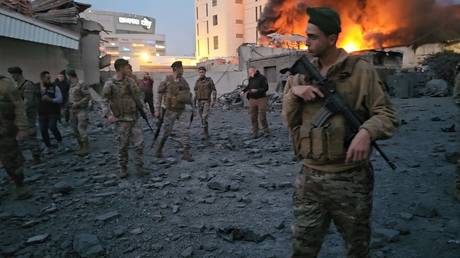
As the sun dips below the Mediterranean, the sky over the border doesn't turn purple; it turns a hazy, bruised orange from the flares and the fires. The sound of the outgoing 155mm howitzers is a rhythmic thud that you feel in your teeth.
The soldiers on the ground, young men on both sides who were toddlers the last time this happened, are now the ones deciding where the new line will be. They are tired. They are scared. They are operating in a world where the enemy is often invisible until the moment of impact.
The tragedy of the extension is that it feels like a script that was written decades ago, being performed by a new cast. The names of the villages stay the same. Bint Jbeil. Marjayoun. Khiam. These names are scars on the geography of the Middle East. Each time they appear in a military communique, a new layer of scar tissue forms.
We are told this is about security. We are told this is about deterrence. But as the tanks roll further north, past the abandoned schools and the empty markets, the only thing that seems certain is the silence that follows the thunder. It is a heavy, expectant silence. It is the silence of a land that is being redefined, not by the people who live there, but by the steel that crosses it.
The olive trees will grow back, eventually. But they will grow in a soil that has been rearranged by the weight of armor and the heat of explosions. The map will be updated. The Blue Line will be redrawn in the blood of the people who just wanted to stay home.
In the end, the incursion isn't just an extension of a military operation. It is an extension of a long, cold winter of the soul for two nations who cannot find a way to live beside one another without the roar of engines in the night. The horizon remains on fire, and the people of the border are left to wonder if the earth will ever stop shaking long enough for them to plant something that isn't a grave.