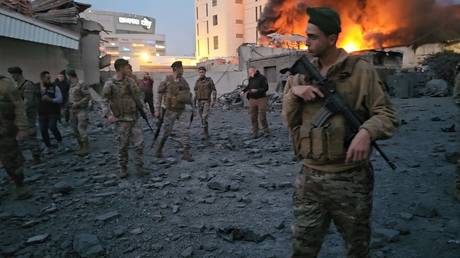
The humanitarian industrial complex is mourning its own obsolescence, and they are calling it a "siege." When you hear career bureaucrats lament the "dismantling of global aid," what they are actually mourning is the loss of their own relevance. They see a "year of destruction." I see a year of long-overdue corrections.
The architecture of hope was never built for the people it claimed to serve. It was built for the comfort of the donor. For decades, the global south has been treated as a laboratory for failed Western social theories and a dumping ground for excess grain. The recent pullback of international funding isn't a catastrophe; it is an eviction notice for a system that thrived on perpetual dependency.
The Myth of the Funding Gap
Every major NGO is currently screaming about a "funding gap." This is a statistical sleight of hand. They measure success by inputs—how many billions were pledged at a summit in Davos—rather than outcomes. If you spend $50 billion and the poverty rate remains stagnant, you didn't have a funding gap. You had a plumbing problem.
I have spent fifteen years watching these "interventions" from the inside. I’ve seen $2 million "capacity building" programs where the only capacity being built was the local luxury hotel’s ability to host mid-day buffets for consultants. When the money stops flowing, the consultants leave. The people stay. And for the first time in a generation, those people are being forced to build systems that actually have to work because there is no "emergency appeal" coming to bail out a broken local policy.
The "siege" the critics talk about is actually the market finally demanding efficiency. In any other sector, a 40-year track record of marginal results would lead to a total liquidation. In the aid world, it leads to a bigger marketing budget.
Aid Is a Geopolitical Opiate
We need to stop pretending aid is a moral imperative and start seeing it for what it is: a sedative.
By subsidizing the failures of corrupt regimes, global aid has historically acted as a pressure release valve. It prevents the very friction necessary for political evolution. Why would a government invest in its own healthcare infrastructure when they know Médecins Sans Frontières will pick up the slack? Why fix the local agricultural supply chain when the UN will ship in free rice every time there’s a hiccup?
This isn't "helping." It’s "stunting."
Consider the "Dutch Disease" of the NGO sector. When a country is flooded with foreign aid, the brightest minds—the doctors, the engineers, the innovators—don't go into private enterprise or civil service. They go to work for the UN or a massive international NGO because that’s where the high salaries and the air-conditioning are. We are literally stealing the human capital of developing nations to staff the offices of their "benefactors."
The Counter-Intuitive Truth of Scarcity
The sudden withdrawal of traditional aid is forcing a shift from charity to investment. This is the nuance the "Hope Under Siege" crowd misses. They see a lack of grants as a net loss. They fail to see the rise of indigenous capital and regional trade blocks filling the void.
When the US or the UK cuts its foreign aid budget, it creates a vacuum. In that vacuum, local entrepreneurs find opportunities.
- Local Production: When food aid drops, local farmers can finally compete on price because they aren't being undercut by "free" imports.
- Accountability: When the money comes from local taxpayers instead of a foreign treasury, the people start asking much harder questions about where it went.
- Sustainability: A bridge built with local tax revenue is maintained. A bridge built by a foreign grant is a monument that rusts the moment the ribbon-cutting ceremony ends.
The Data the NGOs Won't Show You
The most successful stories of poverty reduction in the last century had almost nothing to do with the global aid architecture.
- China: Lifted 800 million people out of poverty. They didn't do it with USAID grants. They did it with trade, manufacturing, and a brutal focus on internal economic policy.
- Vietnam: Transformed from a food-insecure nation to a global exporter. Again, this was a result of the Doi Moi reforms, not a surge in humanitarian "hope."
Compare this to countries that have received the highest per-capita aid over the last fifty years. Many are in a worse state now than they were in the 1970s. If aid worked the way the brochures say it does, the "Global South" would be the "Global North" by now.
The reality is that aid is often a transfer of wealth from poor people in rich countries to rich people in poor countries.
The Ethics of the Exit
Is there a human cost to this dismantling? Yes. It would be dishonest to say otherwise. In the short term, the withdrawal of funding for specific health programs or food distributions causes genuine pain.
But we must ask: What is more unethical? A sharp, painful transition toward self-sufficiency, or another century of managed misery?
The current "crisis" is actually a moment of liberation. It is the dismantling of a neo-colonial structure that kept the world divided into "givers" and "takers." The "Architecture of Hope" was a facade. It’s time to stop painting the ruins and start building on solid ground.
If you actually care about the "Global South," you should celebrate the end of the aid era. Stop donating to organizations that promise to "save" the world and start looking at companies that are actually building in it. Stop supporting "projects" and start supporting "policies."
The siege is over. The occupation by the "helpers" is finally ending. Now, the real work begins.
Burn the brochures. The era of the "white savior" is being dismantled by the one thing it couldn't survive: the harsh, beautiful reality of a world that no longer needs its permission to thrive.