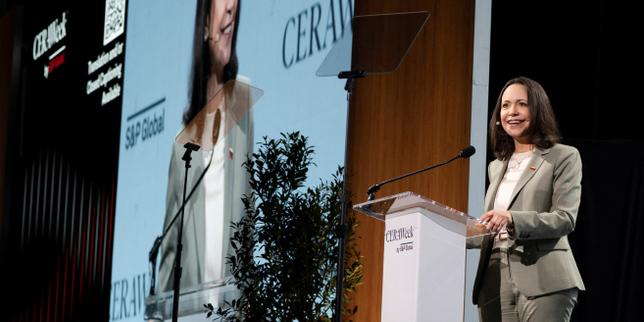
The air inside the George R. Brown Convention Center in Houston doesn’t smell like oil. It smells like expensive filtration, recycled nitrogen, and the faint, metallic tang of ambition. Thousands of executives move through the halls with the practiced gait of men and women who control the flow of the world’s most volatile liquid. They are here for CERAWeek, the "Woodstock of Oil," but this year, a specific, heavy silence hangs over the booths dedicated to Venezuela.
To understand why the most powerful CEOs in the world are currently looking at a map of South America with a mixture of hunger and profound exhaustion, you have to look past the spreadsheets. You have to look at the rust.
Imagine a pumpjack in the Zulia state, standing like a skeletal bird against a bruised sunset. It hasn't moved in years. The grease has turned to a crust of salt and grit. This machine sits atop the largest proven crude oil reserves on the planet—300 billion barrels of "black gold." Yet, it is silent. The tragedy of Venezuelan oil isn't that it ran out. It's that the world learned how to live without it, and now, the path back is paved with more "maybe" than "yes."
The Houston Hesitation
In the polished suites of downtown Houston, the talk isn't about geology. It’s about the "General License 44." This is the bureaucratic tether held by the U.S. Treasury. For a brief moment, the leash was loosened, allowing American companies like Chevron to begin coaxing that heavy, viscous sludge back out of the ground. But the tether is fraying. With elections looming in both Caracas and Washington, the giants—Shell, BP, TotalEnergies—are playing a high-stakes game of musical chairs.
They want the oil. They need the oil. But nobody wants to be the one caught holding a multi-billion dollar contract when the sanctions snap shut again like a steel trap.
Consider a mid-level analyst at a firm like ConocoPhillips. Let’s call him Elias. Elias spends his days staring at satellite imagery of the Orinoco Belt. He sees the potential for a resurgence that could stabilize global markets and lower prices at a thousand gas stations in the Midwest. But he also sees the decaying infrastructure. He knows that to bring Venezuela back to its 1990s glory of 3 million barrels a day, it would take an investment of roughly $10 billion a year for a decade.
That is not "repair" money. That is "rebuilding a civilization" money.
The Invisible Stakes of Heavy Crude
The oil in Venezuela isn't the light, sweet stuff you find in the Permian Basin of Texas. It is thick. It has the consistency of molasses on a cold morning. To move it, you need diluents—lighter fluids that act as a lubricant for the journey through miles of pipeline.
This technical reality creates a bizarre geopolitical irony. To get their oil out, Venezuela has to import fluids from the very people they are often at odds with. It is a symbiotic relationship born of desperation. During the panels in Houston, the language used is "operational stability" and "regulatory clarity."
But the reality is much more visceral. It’s about the engineers who fled the country during the collapse, the "brain drain" that left the national oil company, PDVSA, as a shell of its former self. You can buy new valves. You can buy new pipes. You cannot easily buy back twenty years of lost institutional knowledge.
The Shadow of the Dragon and the Bear
While Western companies hesitate, others do not. The vacuum left by the retreat of American and European majors wasn't just filled by silence; it was filled by interests from Beijing and Moscow. In the corridors of the Houston summit, there is an unspoken anxiety that if the West doesn't commit soon, the Orinoco will become a permanent subsidiary of Eastern energy interests.
This isn't just about corporate profits. It’s about the map of the next century.
If Venezuela remains a pariah, the global supply remains brittle. We saw what happened when the taps in Russia were turned off; the shockwaves hit every kitchen table in Europe. Venezuela is the ultimate insurance policy for the global energy grid. But the premium for that insurance is currently priced in political concessions that neither side seems ready to make.
The Human Cost of a Dry Well
Think of a family in Maracaibo. Thirty years ago, they were the middle class of South America. Their lives were fueled by the dividends of the earth. Today, they watch the flares of gas in the distance—energy literally being burned into the atmosphere because there isn't the equipment to capture it—while their own stoves sit cold.
The executives in Houston talk about "carbon intensity" and "ESG goals." They argue that Venezuelan oil is "dirty" because of the energy required to extract and refine the heavy crude. It’s a valid point in a world trying to decarbonize. But for the person standing in a bread line in a country that should be the wealthiest in the region, "carbon intensity" feels like a luxury problem for people who have already eaten.
The doubt on display in Houston is a specialized kind of grief. It is the realization that the era of "easy oil" is over, and the era of "complicated oil" is deeply, painfully expensive.
The Ghost in the Boardroom
The real "gold" in Venezuela isn't just the liquid under the soil. It's the possibility of a return to the global community. Every time a Chevron tanker leaves a Venezuelan port, it carries more than just cargo. It carries a signal.
Is the signal loud enough to drown out the noise of political instability? Probably not. Not yet.
The giants are waiting. They are watching the calendar. They are counting the days until the next Treasury Department announcement. They are checking the maintenance logs of refineries on the Gulf Coast that were specifically designed to "crack" that heavy Venezuelan crude—refineries that are currently running at sub-optimal levels because their favorite "diet" is stuck behind a wall of diplomacy and debt.
The Orinoco doesn't care about elections. The oil sits there, silent and massive, exerting a gravitational pull on the global economy that no amount of green energy transition can yet ignore. We are tethered to this ghost.
As the lights go down on the final day of the Houston conference, the booths are packed away. The private jets prepare for takeoff at Hobby Airport. The maps are rolled up. But the question remains, vibrating in the humid Texas air.
We know where the oil is. We know how to get it. We just don't know if we can afford the price of the handshake required to touch it.
The pumpjack in Zulia remains still. It is waiting for a world that can’t decide if it’s ready to face its own dependencies, or if it would rather let the most valuable resource on earth slowly turn to salt in the sun.
The silence is the loudest thing in the room.