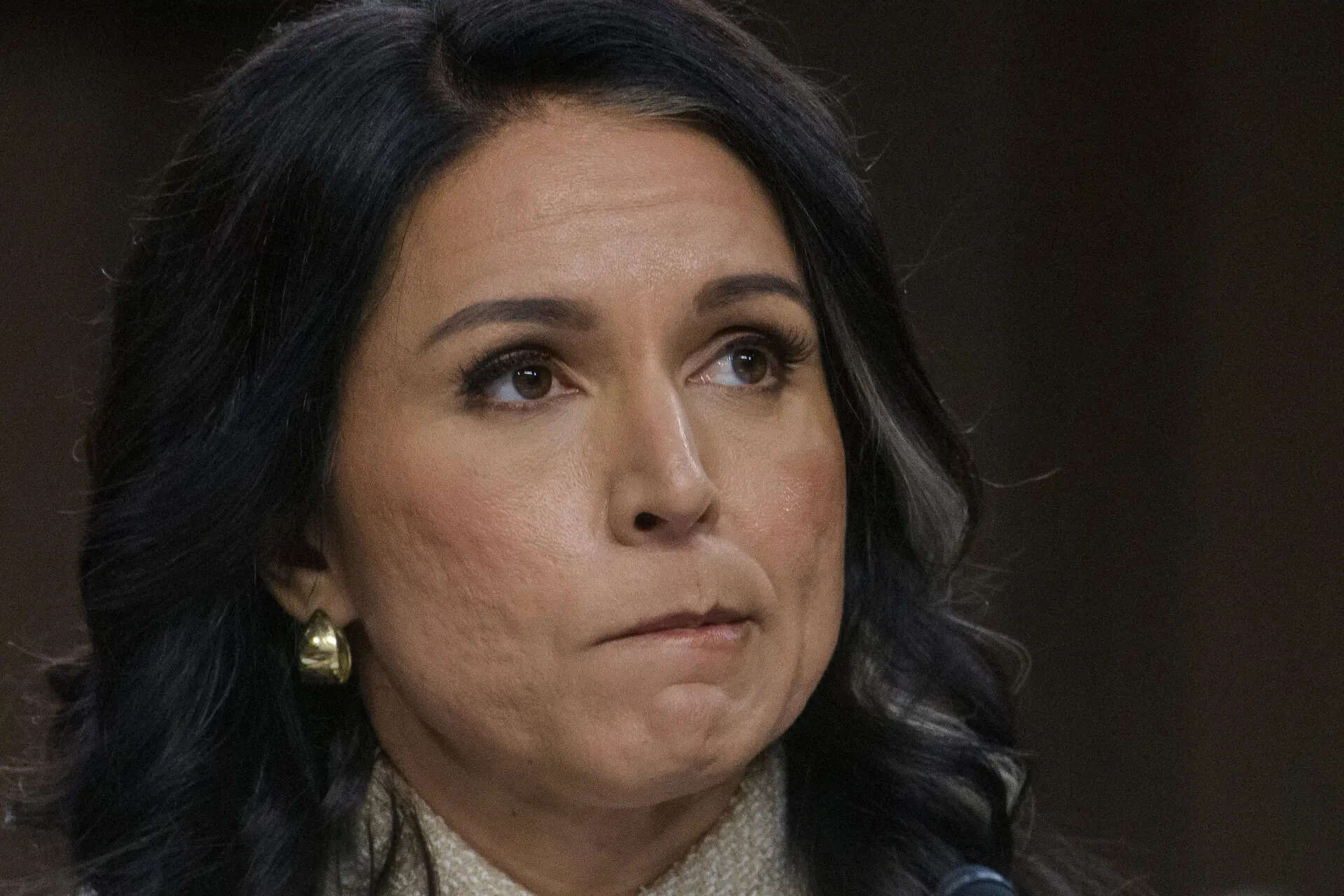
The question of whether Iran posed an "imminent threat" prior to the 2020 assassination of Qasem Soleimani remains a jagged shard in American foreign policy. It was the central tension during Tulsi Gabbard’s high-stakes testimony before the Senate, where the former congresswoman and current intelligence figure faced a grueling interrogation regarding her past skepticism of executive war powers. The debate was never just about a single drone strike. It was about the definition of "imminence" and who gets to decide when the fuse is lit.
Gabbard has long positioned herself as a critic of "regime change wars," a stance that has earned her both a dedicated following and fierce institutional pushback. During the proceedings, senators pressed her on whether she accepted the intelligence community's assessment that Soleimani was planning active attacks on American assets. Her struggle to provide a binary "yes" or "no" answer highlighted a much deeper, more systemic crisis in Washington. It revealed the widening gap between traditional intelligence interpretations and a new wave of skepticism that questions the very foundation of pre-emptive military action.
The Elasticity of Imminence
In the world of international law and military engagement, "imminence" is a term of art that has been stretched to the breaking point. Historically, it meant an attack was literally seconds or minutes away—the proverbial gun to the head. However, since the early 2000s, the United States has adopted a much more flexible interpretation. This "expanded imminence" allows for strikes against actors who are believed to be in the middle of planning phases, even if a specific date or location for an attack hasn't been locked in.
Critics argue this flexibility is a legal loophole that grants the Executive Branch a blank check for extrajudicial killings. When Gabbard sat before the Senate, she was being asked to validate this expanded definition. Her hesitation was not merely a political stumble. It was a refusal to ignore the historical baggage of "intelligence" used to justify previous conflicts, most notably the Iraq War. For a veteran like Gabbard, the word of the intelligence community isn't a holy script; it's a product that requires rigorous cross-examination.
The Intelligence Gap and the Burden of Proof
One of the most striking moments of the hearing involved the specific nature of the threat. Senators pointed to "exquisite" intelligence—often code for intercepted communications or high-level human assets—that supposedly proved Soleimani was the architect of an impending "wave" of attacks. Gabbard’s rebuttal focused on the lack of transparency. She pointed out that if the threat was truly imminent, the administration should have been able to brief the "Gang of Eight" with enough specificity to build a consensus.
That consensus never arrived. Even some Republican senators at the time, such as Mike Lee, described the initial briefings as "insulting" and "the worst briefing I've had on a military issue." This context is vital to understanding why Gabbard’s defense appeared to be a "struggle." She wasn't just defending Donald Trump’s decision; she was attempting to navigate a political minefield where questioning the timing of a strike is often equated with defending the target of that strike.
The Ghost of 2003
You cannot discuss the Iran threat without mentioning the specter of weapons of mass destruction in Iraq. The intelligence community’s failure in 2003 changed the DNA of American skepticism. It created a generation of policymakers who view "imminent threat" as a marketing term rather than a tactical reality. Gabbard belongs to this school of thought. Her skepticism is rooted in the belief that the bureaucracy of war has a self-sustaining momentum.
During the hearing, the tension was palpable because the senators were using a 20th-century framework to judge a 21st-century problem. In the modern era, threats are asymmetric. They involve cyber warfare, proxy militias, and encrypted coordination. Proving imminence in this environment is objectively harder. But the legal requirement for it remains the same. This creates a friction point where the government feels it must act on "vibes" and "patterns of behavior" rather than "smoking guns."
A Shift in Power Dynamics
The interrogation of Gabbard also signaled a shift in how the Senate views its own role in war-making. For decades, Congress has effectively abdicated its Article I power to declare war, allowing the White House to use the 2001 and 2002 Authorizations for Use of Military Force (AUMF) as a legal Swiss Army knife. Gabbard’s career has been built on the premise that these authorizations must be repealed or strictly limited.
When senators asked her to defend the Trump administration’s actions, they were essentially asking her to choose between her loyalty to the person who appointed her and her stated political philosophy. It was a classic Washington trap. If she supported the strike, she betrayed her anti-war base. If she condemned it, she looked like a liability to the administration she was joining.
The Methodology of Skepticism
To understand the "why" behind Gabbard's performance, one has to look at her methodology. She often utilizes a "trust but verify" approach that leans heavily on the "verify" side. This is particularly problematic in a Senate hearing where the evidence being discussed is classified. The public only sees the stuttering and the pivots; they don't see the classified folders that might support a more cautious interpretation of the data.
This lack of public evidence creates a vacuum filled by partisan rhetoric. To the hawks, any hesitation is a sign of weakness or, worse, alignment with an adversary. To the doves, any defense of the strike is a betrayal. Gabbard tried to find a third path—an argument that the strike was legally permissible under a broad interpretation of self-defense, even if the "imminence" was not presented in a way that met her personal standard for clarity.
The Technological Evolution of the Threat
We must also consider the role of technology in these decisions. Drone warfare has lowered the "cost" of intervention. When a strike can be carried out with zero risk to American personnel, the threshold for what constitutes an "imminent" enough threat to justify action naturally drops. This is a dangerous trend. It makes the "big" decisions feel like "small" ones.
Soleimani was not a hidden insurgent; he was a high-ranking state official traveling in a third country. Killing him was a massive escalation. The intelligence used to justify it wasn't just about a bomb in a suitcase; it was about a geopolitical strategy he was supposedly executing. If "strategy" now counts as "imminence," then every major military leader in the world is a legitimate target at any time. This is the logical extreme that Gabbard’s critics seem comfortable with, and it is the one she has consistently pushed back against.
Behind the Closed Doors
The most revealing parts of these hearings are often what is left unsaid. There is a deep-seated resentment within the intelligence agencies toward anyone who questions their "objective" findings. Gabbard’s history of meeting with Bashar al-Assad and her frequent appearances on heterodox media outlets make her a persona non grata in certain hallways of the CIA and NSA. The Senate questioning was as much about her "fitness" to join that community as it was about the specific facts of the Iran threat.
The struggle observed in the hearing was the sound of two different worldviews colliding. One worldview believes that the experts in the "basement" are the ultimate arbiters of truth and that the executive should have the latitude to act on their advice. The other worldview believes that these experts are often wrong, sometimes biased, and always in need of a civilian check.
The Credibility of the Defense
Was the defense of the strike successful? Not in a traditional sense. Gabbard did not manage to convince her detractors that the threat was imminent, nor did she satisfy those who wanted a full-throated condemnation of the strike. Instead, she reinforced the idea that she is an outlier. In a town that values "lanes," she is a lane-straddler.
This position is inherently unstable. It requires a level of nuance that the modern political landscape rarely tolerates. When the question is "Was there a threat?", the expected answer is a definitive "Yes" to justify the blood and treasure spent. By leaning into the gray areas, Gabbard inadvertently highlighted the fragility of the legal justifications used for the Soleimani strike.
The Precedent Set
What happens the next time a "threat" is detected? If the standard for imminence remains as blurry as it was during the 2020 strike, the potential for miscalculation is immense. The Senate hearing served as a post-mortem for a decision that had already been made, but it also served as a warning for the future.
The struggle Gabbard faced is the same struggle the American public faces: trying to determine truth in an era of "managed" information. When intelligence is used as a tool for political justification rather than a neutral basis for decision-making, the entire system loses credibility. The "imminent threat" becomes a Rorschach test. You see what your politics tell you to see.
The Path Forward for Accountability
The path to fixing this isn't found in a better Senate hearing or a more charismatic witness. It is found in a return to strict, transparent definitions of military necessity. If the government cannot define "imminent" in a way that the average citizen can understand, then the government should not have the power to act on it without explicit Congressional approval.
Gabbard’s testimony, while awkward at times, forced this conversation into the open. It made people look at the fine print of the legal memos. It reminded us that the "fog of war" isn't just something that happens on the battlefield; it's something that is manufactured in briefing rooms in Northern Virginia. The real threat isn't just an adversary abroad; it's the slow erosion of the checks and balances that are supposed to prevent the executive from becoming a monarch.
The debate over the Soleimani strike is far from over. It will be cited in law school textbooks and military academies for decades. But the lesson for today is clear: "imminence" is a word that should be used with extreme caution. Once you expand it to cover everything, it effectively covers nothing. It becomes a justification for whatever the person holding the drone remote wants to do.
The struggle in that Senate room was the sound of the old guard trying to maintain its grip on the narrative while a newer, more skeptical force tried to pull the curtain back. Whether Gabbard is the right person to lead that skeptical force is a separate question, but the questions she raised about the "how" and "why" of intelligence-backed warfare are more relevant than ever.
Demand that your representatives define their terms. Ask for the evidence before the strike, not the justification after the smoke clears. If we accept "vague imminence" as a standard, we accept a state of permanent, unchecked conflict. The burden of proof must always rest on those who wish to pull the trigger.