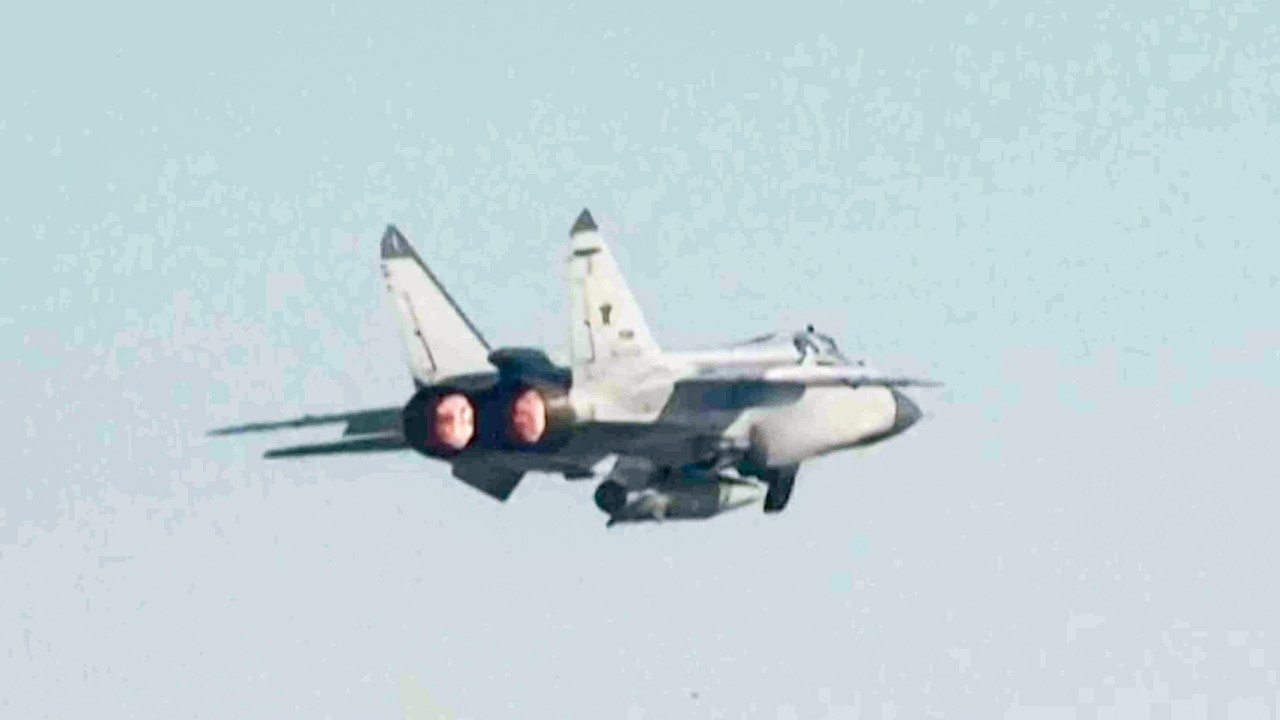
On March 17, 2026, the radar screens at the Japan Air Self-Defense Force (JASDF) command centers flickered with a signature that has become the new, terrifying baseline for Pacific brinkmanship. Russian MiG-31K interceptors, the heavy-lift thoroughbreds of the Aerospace Forces, banked hard over the Sea of Japan. Slung beneath their bellies were Kh-47M2 Kinzhal missiles—weapons Moscow claims can liquefy any air defense network on the planet.
This was not a mistake or a routine navigation error. It was a calculated message delivered at Mach 10. By flying these "hypersonic" assets within striking distance of the Japanese coast just forty-eight hours before Prime Minister Sanae Takaichi’s high-stakes arrival in Washington, the Kremlin signaled that the era of "thinly veiled" threats is over. This is overt military blackmail. If you enjoyed this post, you might want to read: this related article.
The Myth of the Routine Flight
The Russian Ministry of Defense was quick to label the sortie as a "planned flight over neutral waters." To the seasoned analyst, this is a hollow script. While the aircraft technically remained in international airspace, the inclusion of mid-air refueling tankers and the public release of high-definition cockpit footage suggest a massive logistical rehearsal for a long-range strike.
The Kinzhal is a peculiar beast. It is essentially an Iskander ballistic missile modified for air-launch, allowing it to bypass the grueling initial boost phase and maintain extreme velocities throughout its flight. While Ukrainian Patriot batteries have proven the Kinzhal is not the "invincible" phantom Vladimir Putin once described, its presence near Japan changes the math for Tokyo. In the crowded, high-speed environment of the Sea of Japan, the reaction time for a Kinzhal launch is measured in seconds, not minutes. For another look on this story, see the latest coverage from Reuters.
Takaichi and the American Shadow
The timing of this "buzzing" is the real investigative lead. Prime Minister Sanae Takaichi is currently navigating a political minefield. Her administration has moved aggressively to dismantle the remnants of Japan’s post-war pacifism, pushing for record-breaking defense budgets and closer integration with NATO.
Moscow sees this as an existential pivot. For decades, the Kuril Islands dispute—which Japan calls its Northern Territories—was a frozen conflict, a diplomatic stalemate that both sides managed with polite friction. That ended when Japan joined the global sanctions regime following the invasion of Ukraine. Today, the Kremlin views Japan not as a sovereign neighbor, but as a "frontline unsinkable aircraft carrier" for the United States.
By flaunting the Kinzhal now, Russia is testing the structural integrity of the U.S.-Japan alliance. The message to Takaichi is clear: If you deepen your commitment to the American "security umbrella," you do so under the shadow of a hypersonic spear that can reach Tokyo before your cabinet can reach the bunker.
The Persistence of the Surveillance Gap
While the world watches the hypersonic glitz, a more dangerous reality is unfolding in the "surveillance gap" of the Pacific. Japan has scrambled its fighters over 448 times in the last nine months—a staggering operational tempo that is wearing out airframes and exhausting pilots.
The strategy is one of attrition. Russia and China are coordinated in this effort. While Russian bombers and hypersonic jets probe the north, Chinese carrier groups are pushing east of the "second island chain" near Guam. Japan is being squeezed in a geographical vice. The Ministry of Defense has responded by planning the deployment of upgraded Type 03 surface-to-air missiles to Yonaguni Island, specifically designed to track hypersonic glide vehicles. However, those systems are years away from operational status.
Hard Truths of the New Cold War
We must acknowledge a uncomfortable reality. Japan's "Three Non-Nuclear Principles"—not possessing, not producing, and not permitting the introduction of nuclear weapons—are looking increasingly fragile. As Russia moves tactical nuclear-capable systems like the Kinzhal into the Far East, the domestic debate in Tokyo is shifting.
There is a growing, quiet consensus among some Japanese hawks that conventional deterrence is no longer sufficient against a neighbor that uses hypersonic nuclear threats as a standard diplomatic tool. Russia knows this. Their recent flights are intended to trigger a domestic backlash in Japan, hoping that fear of a "Second Russo-Japanese War" will force Takaichi to blink.
But Takaichi isn't blinking. Instead, Japan is leaning into the friction. The decision to reinforce air bases on Ioto (Iwo Jima) and permanent stationing of fighters on remote outposts indicates that Tokyo has accepted the end of the long peace.
The Logistics of Intimidation
The use of MiG-31Ks specifically, rather than the older Tu-95 "Bear" bombers, marks a generational shift in how Russia conducts its "show of force." The Tu-95 is a relic—a slow, loud prop-driven giant that is easily shadowed and serves primarily as a nostalgic reminder of the old Cold War.
The MiG-31K is different. It is an interceptor designed for speed, capable of hitting Mach 2.8 just to get into position. When it carries a Kinzhal, it is not a "patrol" aircraft; it is a dedicated strike platform. The fact that Russia is now willing to burn through precious engine hours and high-grade fuel for these missions in the Pacific—while its forces are bogged down in Eastern Europe—proves that Moscow considers the Japanese front equally vital to its global standing.
The Sea of Japan has become a laboratory for high-speed escalation. Every time a Russian pilot toggles his radar into combat mode near Japanese airspace, the risk of a kinetic "accident" grows exponentially. In the high-stakes game of hypersonic chicken, the first one to flinch usually loses more than just face.
Would you like me to analyze the specific technical capabilities of the Type 03 Chu-SAM upgrades Japan is developing to counter these hypersonic threats?