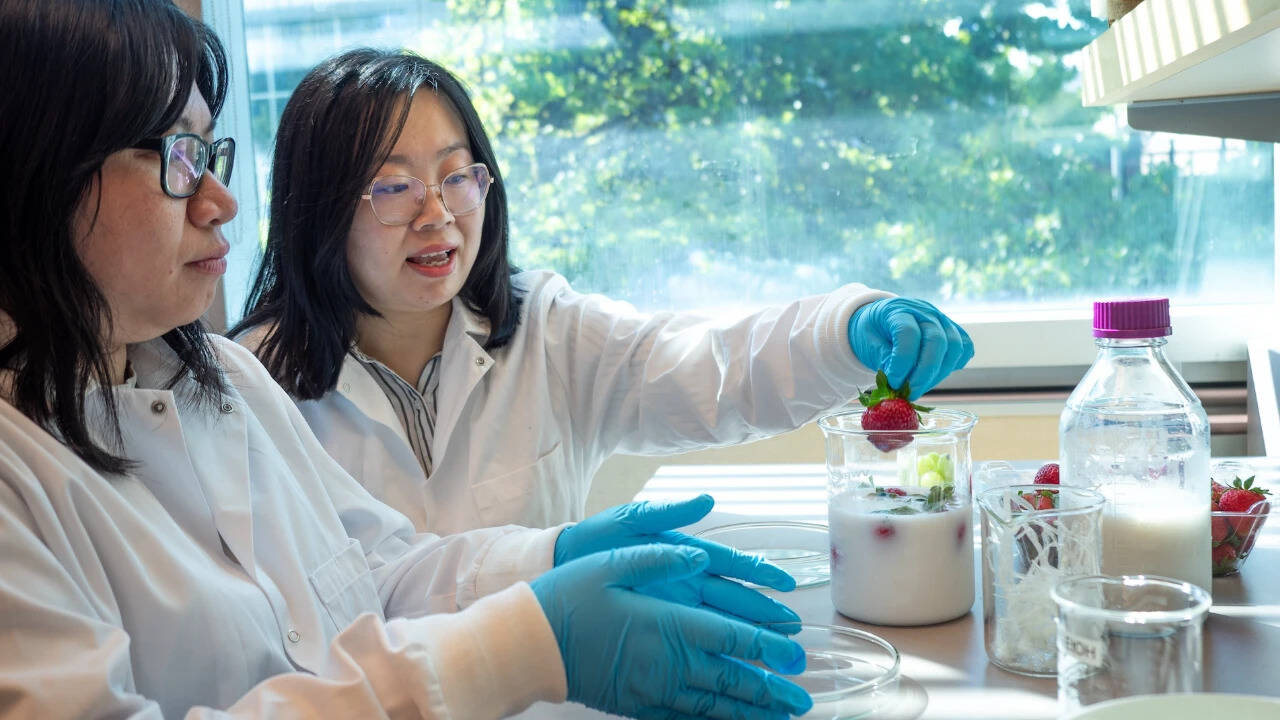
Every year, billions of pounds of fresh produce rot before ever touching a human palate. Strawberries sit near the top of that waste pile. Soft-skinned, highly perishable, and prone to rapid fungal colonization, the fruit has long tested the limits of modern supply chains. University of British Columbia scientists have developed a new mixture designed to keep strawberries fresh significantly longer, targeting a vulnerability that costs the agricultural sector billions annually.
This protective coating is not a genetic modification or a chemical pesticide. It is a specialized formulation meant to target the root biological causes of post-harvest decay. To understand why this matters, you have to look past the grocery store display and examine the mechanics of food waste.
The Decay Economy
Food waste is rarely an accident of logistics. It is an economic design flaw. When a farmer harvests a hectare of strawberries, a countdown begins immediately. The fruit breathes, releases ethylene gas, absorbs ambient moisture, and invites microscopic mold spores to feast. Botrytis cinerea, commonly known as gray mold, operates with ruthless efficiency on soft fruit.
Most commercial attempts to delay this process rely on modified atmosphere packaging. Companies flush shipping containers with nitrogen or carbon dioxide to slow cellular respiration. While effective for apples or potatoes, strawberries reject this heavy-handed approach. They turn mushy, lose their aromatic compounds, and taste like cardboard by the time they reach a consumer's kitchen counter.
Cold chain management offers another line of defense. Keep the temperature hovering just above freezing, and biological processes slow down. Yet the cold chain breaks constantly. A refrigerated truck door opens on a tarmac in July. A pallet sits on a loading dock for an hour too long. The moment the temperature fluctuates, condensation forms on the fruit surface. Moisture transforms into an incubator. The mold takes over, turning a pint of bright red berries into a fuzzy, gray hazard within days.
University of British Columbia researchers approached this decay economy from a materials science perspective. Instead of trying to alter the atmosphere of an entire shipping container, they decided to armor the individual fruit.
Inside the Formulation
The UBC team engineered a protective coating using natural, food-safe ingredients designed to form a microscopic shield over the strawberry epidermis. Think of it as a second skin that breathes just enough to prevent internal suffocation while blocking external threats.
The mixture relies on biocompatible polymers. When dipped into or sprayed with the solution, the strawberry receives an ultra-thin barrier. This barrier achieves three critical objectives simultaneously.
First, it reduces transpiration. Strawberries lose water rapidly after picking, which causes the skin to wrinkle and the cell walls to collapse. The coating locks in internal hydration without trapping excess surface moisture.
Second, it acts as a mechanical deterrent against fungal hyphae. Spores floating through the air land on the fruit, but they find a surface hostile to germination. They cannot penetrate the polymer layer to tap into the nutrient-rich sugars beneath.
Third, the mixture modulates gas exchange. By slowing down the rate at which oxygen enters and carbon dioxide exits, the fruit enters a mild state of suspended animation. Cellular respiration drops. The ripening clock ticks slower.
None of this requires expensive capital investments from growers. The application process fits neatly into existing post-harvest wash lines. Berries pass through a bath or a spray tunnel, dry in minutes, and proceed to packaging.
The Commercial Reality Check
Invention in a university laboratory is easy. Survival in the commercial market is brutal. Agtech innovations face a steep uphill battle against razor-thin profit margins and entrenched supply chain habits.
Producers operate on volumes, not margins. If a new coating costs more than the percentage of fruit it saves, farmers will reject it. The UBC team understood this financial constraint early. The ingredients chosen for the mixture are inexpensive and globally abundant. They do not require rare earth metals or proprietary chemical synthesis.
Scale presents the next major hurdle. A formulation that performs brilliantly on three flats of strawberries in a controlled academic setting must perform identically across fifty thousand pounds of fruit packed by high-speed machinery in a commercial packing house. Bruising during transit remains a factor. If the underlying fruit tissue is crushed by careless handling, no surface coating can save it. The physical integrity of the berry depends on harvest timing as much as post-harvest treatment.
Retailers add another layer of friction. Supermarket buyers care about appearance, shelf life, and regulatory approval. Even if a substance is composed entirely of food-grade elements, regulatory bodies move slowly. Getting clearance from food safety authorities requires extensive safety trials, toxicity testing, and residue analysis.
Beyond the Strawberry Patch
The implications of this research extend far beyond a single summer fruit. Soft berries represent the worst-case scenario for agricultural shelf life. If a protective mixture can stabilize strawberries, it can likely adapt to raspberries, blackberries, and cherries.
Consider the carbon footprint of fresh produce. Air freight is frequently deployed for high-value, highly perishable berries to ensure they arrive at distant markets before spoiling. Shipping fruit by air burns vastly more fuel than moving it by ocean freight or rail. Extending shelf life by even a few extra days opens the door to slower, greener shipping methods. A strawberry that can survive an extra week in transit transitions from an air-freight luxury to a standard ocean-cargo commodity.
At the consumer end, the behavioral impact could be equally profound. The average household throws away a significant portion of purchased fresh produce simply because it spoils before consumption. Multiply that loss across millions of kitchens, and the aggregate waste represents a staggering misallocation of agricultural labor, water, and land.
The researchers at the University of British Columbia did not invent a miracle cure for aging. They engineered a practical, physics-based buffer against decay. The real test will not happen in the laboratory, but on the loading docks, inside the refrigerated trucks, and on the back shelves of grocery stores where the true cost of our food system is measured in pulp and mold.