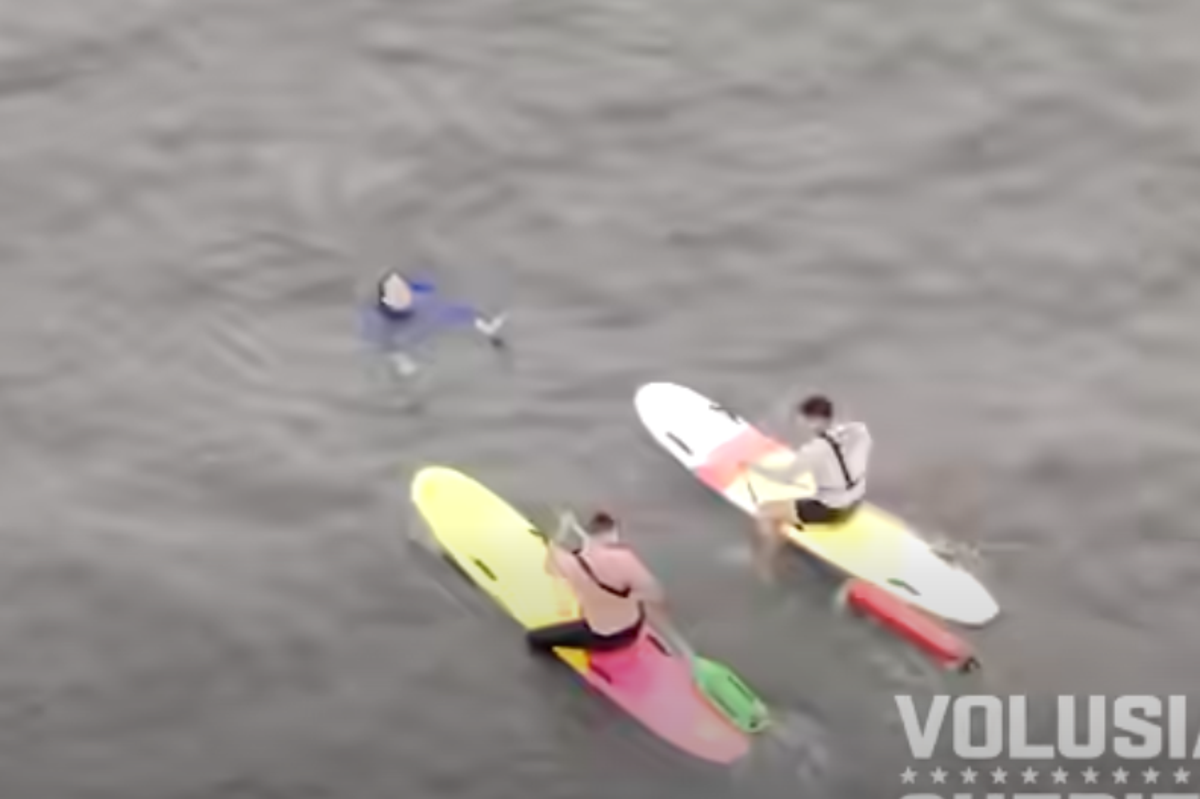
The efficiency of a law enforcement pursuit is determined by the alignment of the pursuit vehicle’s operational envelope with the environmental constraints of the escape corridor. When a suspect transitions from land to water, they typically create a "mobility gap"—a period where standard terrestrial patrol units are rendered obsolete while specialized marine assets (cutters, RHIBs, or jet skis) are still being dispatched. The recent utilization of Stand-Up Paddleboards (SUPs) by police to apprehend a suspect who entered a body of water represents a shift from high-power, high-latency response to low-power, high-agility interdiction. This incident exposes a critical evolution in littoral policing: the prioritization of immediate deployment over raw speed.
The Physics of the Aquatic Interdiction Gap
The suspect’s decision to enter the water is based on a perceived friction differential. On land, the suspect faces the combined kinetic advantages of police cruisers and the endurance of multiple officers. In the water, the suspect assumes that the police's "Drag Coefficient" increases to a point of parity or advantage for the swimmer.
Most maritime police responses suffer from Deployment Lag. A standard police boat requires a trailer launch or a specific dock location, creating a multi-minute window where the suspect can reach a "Dead Zone"—an area too shallow for deep-draft boats but too deep for wading officers.
The SUP enters this tactical vacuum by offering:
- Draft Minimization: An SUP can operate in as little as three inches of water, allowing officers to pursue suspects through reeds, sandbars, and rocky shallows where traditional propellers would cavitate or sustain damage.
- Visual Command: Unlike a swimmer, whose line of sight is roughly four inches above the waterline, an upright officer on an SUP has a 360-degree vantage point from an elevation of approximately six feet. This height differential allows the officer to track submerged movements and anticipate the suspect’s trajectory toward the shoreline.
- Silent Approach: The acoustic signature of a 200-horsepower outboard motor alerts a suspect to the direction and distance of the pursuit. A paddleboard operates near the noise floor of the environment, enabling a "Stealth Intercept" where the officer can close the distance before the suspect can pivot to a different escape vector.
The Energy Expenditure Ratio: Swimmer vs. Operator
The success of the paddleboard pursuit is rooted in the biological "Cost of Transport" (CoT). A human swimming in a high-stress, flight-or-fight state experiences rapid glycogen depletion and lactic acid buildup. The mechanical efficiency of a human swimmer is notoriously low, with much of the energy dissipated as heat and turbulent flow.
In contrast, the officer on an SUP leverages a mechanical advantage through the paddle. The paddle acts as a lever, converting core and upper-body strength into forward thrust with a significantly higher displacement-to-effort ratio than a treading swimmer.
- The Fatigue Wall: A suspect swimming in street clothes or under the influence of adrenaline typically reaches peak exhaustion within 5 to 10 minutes.
- The Stability Platform: Once the officer reaches the suspect, the SUP serves as a mobile floating platform. This is a critical safety component; an officer attempting to make an arrest while swimming (water-rescue style) is at a severe tactical disadvantage and at risk of being pulled under by a struggling suspect. The board provides a physical barrier and a stable base from which to deploy verbal commands or non-lethal deterrents.
Strategic Infrastructure of Urban Waterways
Modern urban design often incorporates "Soft Edges"—canals, decorative lakes, and drainage basins—which serve as unintended escape routes for suspects fleeing foot patrols. Standardizing SUP units within patrol vehicles (using inflatable high-pressure drop-stitch technology) transforms every patrol car into a potential maritime interceptor.
The "Three Pillars of Low-Draft Interdiction" define this strategy:
- Portability: The transition from trunk to water in under 120 seconds.
- Versatility: Ability to navigate urban debris that would foul a jet pump or propeller.
- Visibility: Enhancing the officer's presence to discourage the suspect from further resistance through psychological dominance.
The Risk of Tactical Overextension
While the SUP provides a solution for the littoral gap, it introduces specific vulnerabilities that command staff must mitigate. The most significant is the Platform Instability Risk. In choppy water or high-wind scenarios, the high center of gravity of an upright officer makes them susceptible to being knocked off balance by a desperate suspect.
Furthermore, the lack of ballistic protection on a paddleboard means this tactic is strictly reserved for non-armed suspects or scenarios where the suspect's movement is already severely constrained by exhaustion. An officer on a board is a highly visible, slow-moving target. The logic of the SUP pursuit relies on the assumption that the suspect is unarmed and focused entirely on the physical exertion of staying afloat.
The "Equipment-to-Environment Fit" must be evaluated in real-time. If the water body features high-velocity currents or significant boat traffic, the SUP's lack of propulsion power becomes a liability rather than an asset. The officer risks being swept away from both the suspect and the shore, necessitating a secondary rescue operation.
Integrating Adaptive Mobility into Modern Policing
The transition from traditional patrol methods to adaptive platforms like the SUP indicates a maturation of police strategy. It moves away from the "One Size Fits All" response—which often relies on heavy, expensive machinery—toward a "Scalable Force" model.
To optimize this, agencies should implement:
- Modular Patrol Kits: Inflatable SUPs integrated into standard vehicle loadouts for units patrolling near waterfronts.
- Cross-Training: Basic water safety and paddle technique integrated into standard academy curriculums for urban precincts.
- Inter-Agency Communication: Real-time coordination between the SUP "Interceptor" and land-based "Containment" units to ensure the suspect is funneled toward a controlled extraction point.
The maritime pursuit of a suspect on a paddleboard is not a novelty; it is a clinical application of fluid dynamics and energy management. By closing the "Mobility Gap" through low-cost, high-agility tools, law enforcement can neutralize the perceived advantage of the aquatic escape.
Agencies should prioritize the procurement of high-visibility, professional-grade inflatable SUPs for all littoral patrol sectors. These units must be deployed as a primary pursuit option for shallow-water environments where traditional boat transit times exceed five minutes. The objective is to force the suspect into a "High-Exertion/Zero-Gain" loop, ensuring that by the time physical contact is made, the suspect’s capacity for resistance is biologically minimized.