The 72% collapse in Chinese arms imports over the last five-year period is not a sign of military contraction, but the terminal phase of a decades-long technology transfer cycle. Beijing has successfully transitioned from a "Buyer’s Model" of defense procurement to an "Integrated Innovation Model," where the reliance on foreign platforms has been replaced by the internal production of high-value components. This shift represents a fundamental realignment of the global arms trade, signaling that China has moved past the "imitation plateau" and into a self-sustaining cycle of domestic military-industrial development.
The data provided by the Stockholm International Peace Research Institute (SIPRI) reflects a specific structural shift: the obsolescence of Russian-designed hardware within the People’s Liberation Army (PLA) force structure. As China achieves 90% or higher self-sufficiency in key areas such as fighter jet propulsion, naval turbine manufacturing, and precision-guided munitions, the logic for foreign procurement vanishes. The reduction in imports is a quantifiable metric of China's success in closing the "technological gap" with Western and Russian counterparts.
The Triad of Indigenous Substitution
The sharp decline in defense imports is driven by three distinct strategic pillars. Each pillar addresses a specific historical vulnerability that China has systematically liquidated through massive capital investment and intellectual property acquisition.
1. The Propulsion Breakthrough
Historically, the primary bottleneck for Chinese aerospace was the inability to produce reliable, high-thrust turbofan engines. This forced a continuous reliance on Russian AL-31F and RD-93 engines for the J-11, J-15, and J-10 fighter fleets.
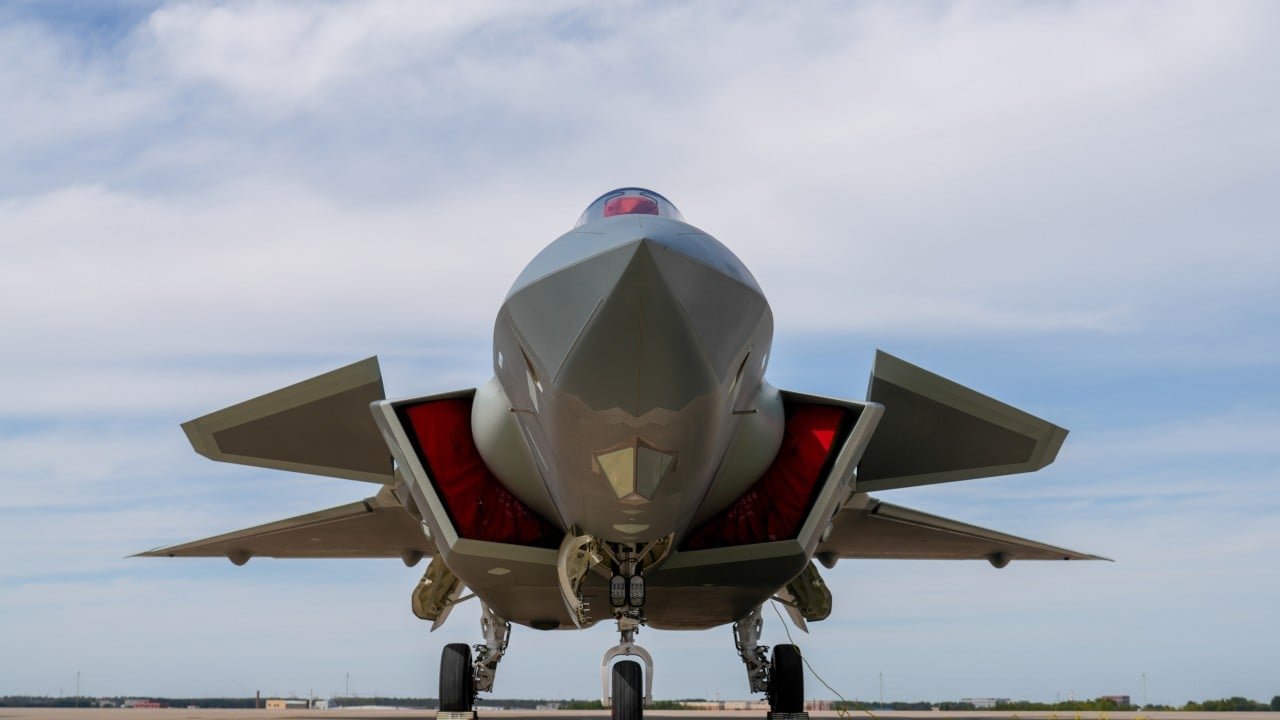
The introduction and mass production of the WS-10 "Taihang" family, followed by the WS-15 for the J-20 stealth fighter, has effectively severed this umbilical cord. When the domestic supply chain can deliver engines that meet 85% to 95% of the performance specifications of their foreign rivals, the strategic risk of dependency on a foreign supplier (like Russia) outweighs the marginal performance gains of the import. This substitution alone accounts for a massive percentage of the drop in import volume.
2. High-End Material Science and Semiconductor Sovereignty
The transition from importing complete weapon systems to importing nothing at all is predicated on the mastery of materials. This includes carbon-fiber composites for airframes and gallium nitride (GaN) for Active Electronically Scanned Array (AESA) radars.
China’s investment in the domestic semiconductor industry has allowed for the creation of proprietary fire-control systems that are now superior to the legacy export versions of Russian systems. By internalizing the production of the "brain" and the "eyes" of the platform, the need to purchase a foreign "body" (the hull or airframe) disappears. The cost-benefit analysis has shifted: it is now more efficient to design a bespoke airframe around a domestic sensor suite than to modify a foreign platform to fit Chinese requirements.
3. Naval Power and the Gas Turbine Pivot
The PLA Navy (PLAN) was once heavily dependent on Ukrainian and Russian gas turbines to power its surface combatants. The development of the QC-280 gas turbine, based on the Ukrainian GT-25000 but significantly modified for durability and output, has enabled the rapid expansion of the Type 052D and Type 055 destroyer classes without a single foreign-sourced power plant. This creates a feedback loop: as production scales up, unit costs drop, further disincentivizing the consideration of foreign alternatives.
The Cost Function of Dependency vs. Autonomy
The decision to cease imports is not merely a matter of national pride; it is a calculated response to the "Dependency Risk Premium." For a superpower-tier military, the cost of a foreign-sourced part is not its price tag, but the risk that the supplier might withhold support during a conflict.
- Political Vulnerability: Foreign systems often come with "end-user certificates" and monitoring that China finds unacceptable for its most sensitive operations.
- Integration Friction: Modern warfare is centered on "system-of-systems" connectivity. Integrating a Russian Su-35 into a Chinese data-link network that uses proprietary encryption and sensor-fusion protocols creates a technical bottleneck.
- Maintenance Cycles: Relying on a foreign supply chain for spare parts creates a "Mean Time To Repair" (MTTR) that is outside of the PLA’s direct control.
By eliminating these three variables, China has optimized its "Defense Utility Function." Even if a domestic tank or jet is 5% less capable than a foreign equivalent, its 100% availability and seamless integration into the domestic digital theater make it the superior strategic choice.
Deconstructing the 72% Metric: The "Russia Problem"
The collapse in imports is almost entirely a collapse in the Sino-Russian arms trade. Historically, Russia provided the high-tech "top cover" for the PLA. Today, that relationship has inverted. Russia’s defense industry is increasingly consumed by the high attrition rates of the war in Ukraine, leading to a "Supply-Side Constraint" where Moscow cannot export what it needs for its own front lines.
Simultaneously, China has reached a point where Russian technology is no longer "state of the art" compared to Chinese domestic alternatives. In areas like UAV technology, satellite imagery, and cyberwarfare tools, China is now a net exporter. The 72% drop is a lagging indicator of Russia’s descent into a junior partnership role, where it provides raw materials (oil, gas, minerals) while China provides the high-tech industrial base.
The Logic of Selective Importation
It is a mistake to assume China will never import arms again. Instead, the strategy has shifted to "Targeted Technology Extraction." China now only imports what it cannot yet replicate or what it needs for "reverse-engineering benchmarks."
- S-400 Triumf: Imported not just for its range, but to study the signal processing and radar integration of a peer-level air defense system.
- Su-35 Flanker-E: Purchased in small numbers to analyze the 3D thrust-vectoring nozzles and the "Irbis-E" radar performance against low-observable targets.
These are not "procurement" programs in the traditional sense; they are "R&D shortcuts." Once the data is harvested and the technical principles are understood, the import program is terminated.
The Strategic Pivot: From Importer to Dominant Exporter
The same forces that drove the 72% decline in imports are now fueling a surge in Chinese defense exports to the Global South. China offers a "Complete Defense Ecosystem" that includes:
- Low-Cost Precision: J-10C fighters and Wing Loong drones that offer 80% of the capability of US or European systems at 40% of the price.
- No Strings Attached: Unlike US sales, Chinese exports do not require human rights compliance or intrusive monitoring.
- Industrial Offsets: China frequently bundles arms sales with infrastructure projects (Belt and Road Initiative), creating a "Synthetic Market" where defense procurement is part of a larger economic package.
This creates a new "Arms Trade Paradox": as China becomes more isolated from Western technology, it becomes more integrated with the defense requirements of the developing world. The decline in imports is the necessary precursor to this global expansion.
Mapping the Future Defense Landscape
The PLA has entered the "Refinement and Scale" phase of its development. The next five years will not be characterized by new imports, but by the mass production of the current generation of domestic hardware. We should expect:
- The Drone Saturation Strategy: A pivot toward low-cost, high-volume autonomous systems that leverage China's dominance in commercial electronics.
- Hypersonic Proliferation: Having mastered the physics of boost-glide vehicles, China will focus on scaling the production of the DF-17 and its variants.
- AI Integration: The focus of "imports" will move from hardware to "Human Capital" and "Data Access," seeking to dominate the software layer of the modern battlefield.
The 72% drop in imports is a permanent structural change. It signifies that the era of the "Soviet-style PLA" is over. What remains is a self-contained, high-tech industrial power that is no longer shopping for tools, but building the factory.
The strategic imperative for global observers is to stop measuring Chinese military strength by what they buy and start measuring it by what they no longer need to buy. The absence of a transaction is often more telling than the presence of one. Beijing has cleared the hurdles of basic and intermediate manufacturing; it is now iterating on the frontier of military science. Any strategy based on the assumption that China can be "choked off" from critical defense technology must now account for a domestic supply chain that has already demonstrated its ability to survive—and thrive—in isolation.