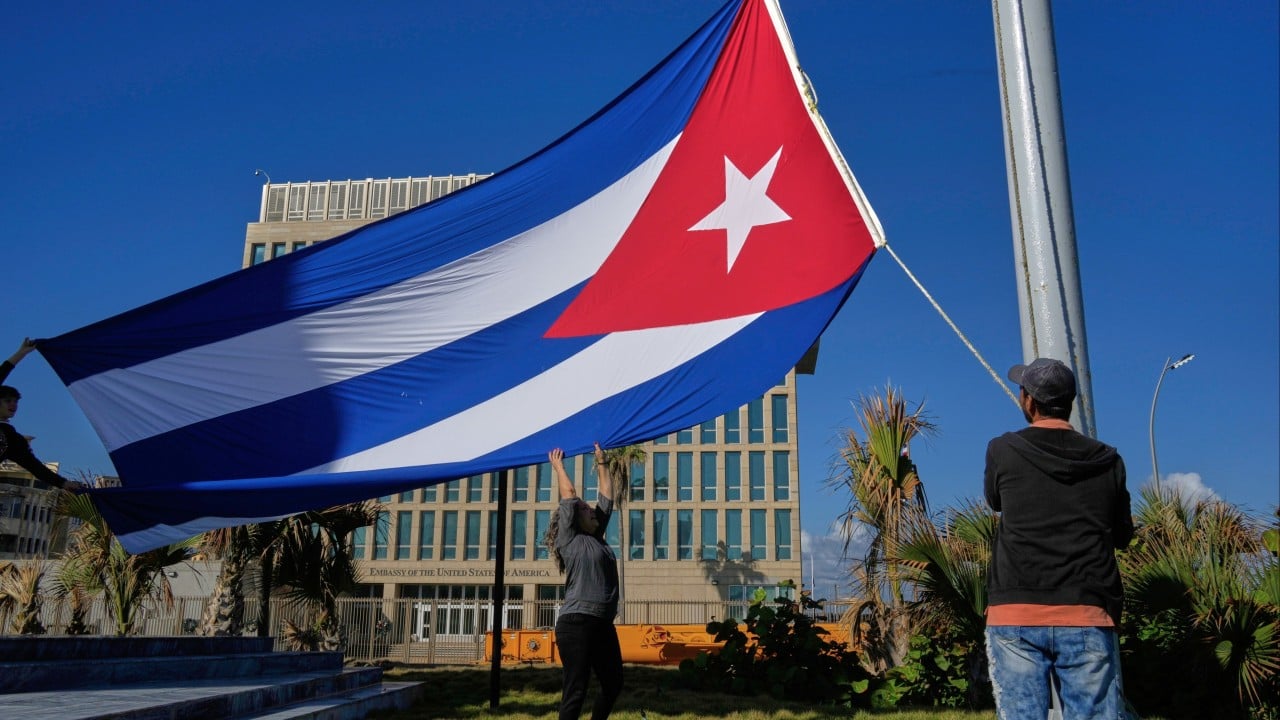
The recent "respectful" dialogue between Cuban officials and a visiting United States delegation represents a calculated recalibration of bilateral tension rather than a fundamental shift in geopolitical trajectory. This engagement serves as a pressure valve for two administrations facing divergent domestic constraints and shared regional instability. To understand the function of these talks, one must move beyond the diplomatic veneer of "mutual respect" and analyze the specific operational channels—migration, security, and economic survival—that dictate the rhythm of the Havana-Washington corridor.
The Triad of Functional Necessity
Bilateral relations between the United States and Cuba are currently governed by three functional pillars. These are not aspirational goals but structural necessities that force interaction despite a lack of formal normalization.
- Migratory Equilibrium: The primary driver of immediate cooperation. Uncontrolled migration creates domestic political liabilities for the U.S. executive branch and drains human capital from the Cuban state.
- Transnational Security Coordination: Both nations share a geographic interest in policing the Florida Straits against narcotics trafficking and human smuggling.
- Economic Subsistence and Remittance Flows: For Havana, access to the U.S. dollar and humanitarian carve-outs in the embargo is a requirement for regime stability; for Washington, these flows serve as a tool of soft power and a mechanism to prevent total state collapse on its doorstep.
The Migration Feedback Loop
The most urgent component of the recent talks centers on the 1994 and 1995 Migration Accords. The logic of these agreements is a zero-sum game of containment. When the Cuban economy enters a period of hyperinflation or energy failure, the migratory pressure increases. If the U.S. shuts down legal pathways, it incentivizes irregular maritime crossings, which are high-risk and politically costly for the U.S. Coast Guard.
The "respectful" nature of the talks likely refers to the technical coordination of repatriation flights. Following a hiatus, the resumption of these flights signals a return to a "standard operating procedure" where Cuba agrees to accept its nationals deported from the U.S. in exchange for the processing of a minimum of 20,000 immigrant visas annually at the U.S. Embassy in Havana. This is a transactional exchange: Havana provides "orderly" removal of its citizens, and Washington provides a controlled safety valve for Cuban internal dissent.
Decoupling the SSOT Designation from Functional Diplomacy
A significant bottleneck in these negotiations is Cuba’s presence on the State Sponsors of Terrorism (SSOT) list. While the Cuban delegation repeatedly identifies this designation as the primary obstacle to economic recovery, the U.S. delegation views it as a strategic leverage point.
The mechanism of the SSOT is more financial than military. It triggers "de-risking" by international banks, effectively cutting Cuba off from the global SWIFT system even for transactions that are legally permitted under the U.S. embargo. This creates an asymmetric cost for Cuba. The U.S. maintains the designation not necessarily because of current operational terrorist activity, but because the political cost of removal—specifically regarding the electoral map in South Florida—outweighs the diplomatic benefits of a cleaner bilateral slate.
The Cost Function of the Embargo
The U.S. embargo (or el bloqueo) is often discussed in moral or ideological terms, but in a strategic context, it functions as a targeted economic constraint with a decaying rate of return.
- Fixed Costs: The administrative and enforcement overhead of the Office of Foreign Assets Control (OFAC).
- Variable Costs: The loss of market share for U.S. agricultural exporters, who must navigate complex "cash-in-advance" requirements to sell to Cuba.
- Externalities: The vacuum created by U.S. economic withdrawal is filled by adversarial actors—specifically China and Russia—who provide credit lines and infrastructure investment in exchange for intelligence-gathering outposts or maritime access.
The recent talks indicate a U.S. preference for "micro-adjustments"—allowing support for the nascent Cuban private sector (MSMEs) while maintaining the macro-economic squeeze on state-run enterprises (GAESA). This strategy attempts to foster a middle class independent of the Communist Party, though the effectiveness of this approach is limited by the fact that many MSME owners are well-connected former officials or relatives of the elite.
Security Coordination as a De-escalation Tool
Beyond migration, the technical delegations focused on law enforcement cooperation. This is the least publicized but most consistent area of bilateral contact. The "respectful" tone is a byproduct of professionalized interactions between the U.S. Coast Guard and the Cuban Border Guard. These agencies share a common operational language.
When the U.S. delegation meets in Havana to discuss "combating terrorism and transnational crime," they are essentially conducting a gap analysis on maritime surveillance. If Cuba fails to police its northern coast, the burden falls entirely on the U.S. Seventh District. Therefore, even under administrations that are rhetorically hostile to Havana, the technical necessity of sharing radar data and vessel tracking remains constant.
The Asymmetry of Strategic Objectives
The failure to reach a "grand bargain" is the result of fundamentally incompatible end-states.
- The Cuban Objective: To achieve the lifting of the SSOT and the embargo while maintaining a single-party socialist system. Havana seeks the "Vietnam Model"—economic integration without political liberalization.
- The U.S. Objective: To utilize economic pressure and diplomatic engagement to force "democratic opening" and human rights concessions. Washington seeks a transition model that mirrors the post-Soviet Eastern Bloc.
Because neither side is willing to concede on their core systemic survival, the talks are relegated to "process-oriented" outcomes. "Respectful talks" do not mean "productive talks" in terms of policy shifts; they mean the channels remain open to prevent a total communication breakdown that could lead to an unintended kinetic escalation or a mass-migration event.
Identifying the Bottlenecks in Normalization
Several structural hurdles prevent these "respectful" meetings from evolving into a policy shift.
- The LIBERTAD Act (Helms-Burton): This 1996 legislation codified the embargo into law, stripping the Executive Branch of the power to lift it without a transition government in Havana that excludes the Castro family and Miguel Díaz-Canel.
- Property Claims: The outstanding $2 billion (unadjusted for interest) in certified claims by U.S. citizens and companies for property seized in 1959. No administration can fully normalize relations without addressing this massive financial liability.
- Human Rights and Political Prisoners: For the U.S., the detention of protesters from the July 11, 2021, demonstrations is a hard-line domestic political barrier. Without a significant release of prisoners, any concession by the Biden-Harris administration would be perceived as a strategic retreat.
The Role of Regional Actors and Third-Party Influence
The U.S.-Cuba relationship no longer exists in a vacuum. The presence of Russian naval vessels in Havana harbor and Chinese investment in the port of Mariel changes the cost-benefit analysis for Washington. If the U.S. remains disengaged, it cedes a strategic "pivot point" in the Caribbean to global competitors. This creates a "Security Dilemma": tightening the embargo may weaken the Cuban state, but it also forces the state to lease its territory and sovereignty to U.S. rivals for survival.
Strategic Forecast and Recommendation
The current trajectory of "managed hostility" will persist through the mid-2020s. We should expect a continuation of high-level technical meetings focused on narrow, non-political sectors: maritime safety, oil spill response, and health cooperation (e.g., cancer research).
Strategic actors should monitor the following indicators for any genuine change in the status quo:
- Indicator A: Changes in OFAC regulations regarding the "U-turn" transactions, which would allow Cuban citizens to use the U.S. banking system for third-country trade.
- Indicator B: The removal of Cuba from the list of countries "not cooperating fully" with anti-terrorism efforts, a separate and less politically charged designation than the SSOT.
- Indicator C: The volume of charter flights vs. commercial flights, which serves as a proxy for the U.S. government's willingness to allow "people-to-people" contact.
The optimal strategy for the U.S. is not a total lifting of the embargo—which is legislatively impossible—but the expansion of specific General Licenses that target the Cuban digital economy and private entrepreneurship. By bypassing the state-run GAESA conglomerate and directly funding the private sector, Washington can create the economic conditions for political change without the risk of a chaotic state collapse. Havana, conversely, will continue to use these "respectful talks" as a PR tool to signal international legitimacy while offering the bare minimum of cooperation required to keep the migration safety valve open.
Expect the next round of talks to follow this exact blueprint: high technical specificity, extreme rhetorical caution, and a total absence of movement on the fundamental ideological divide. The "success" of these talks is measured not by what is built, but by what is prevented.


:strip_icc()/pic2513216.jpg)