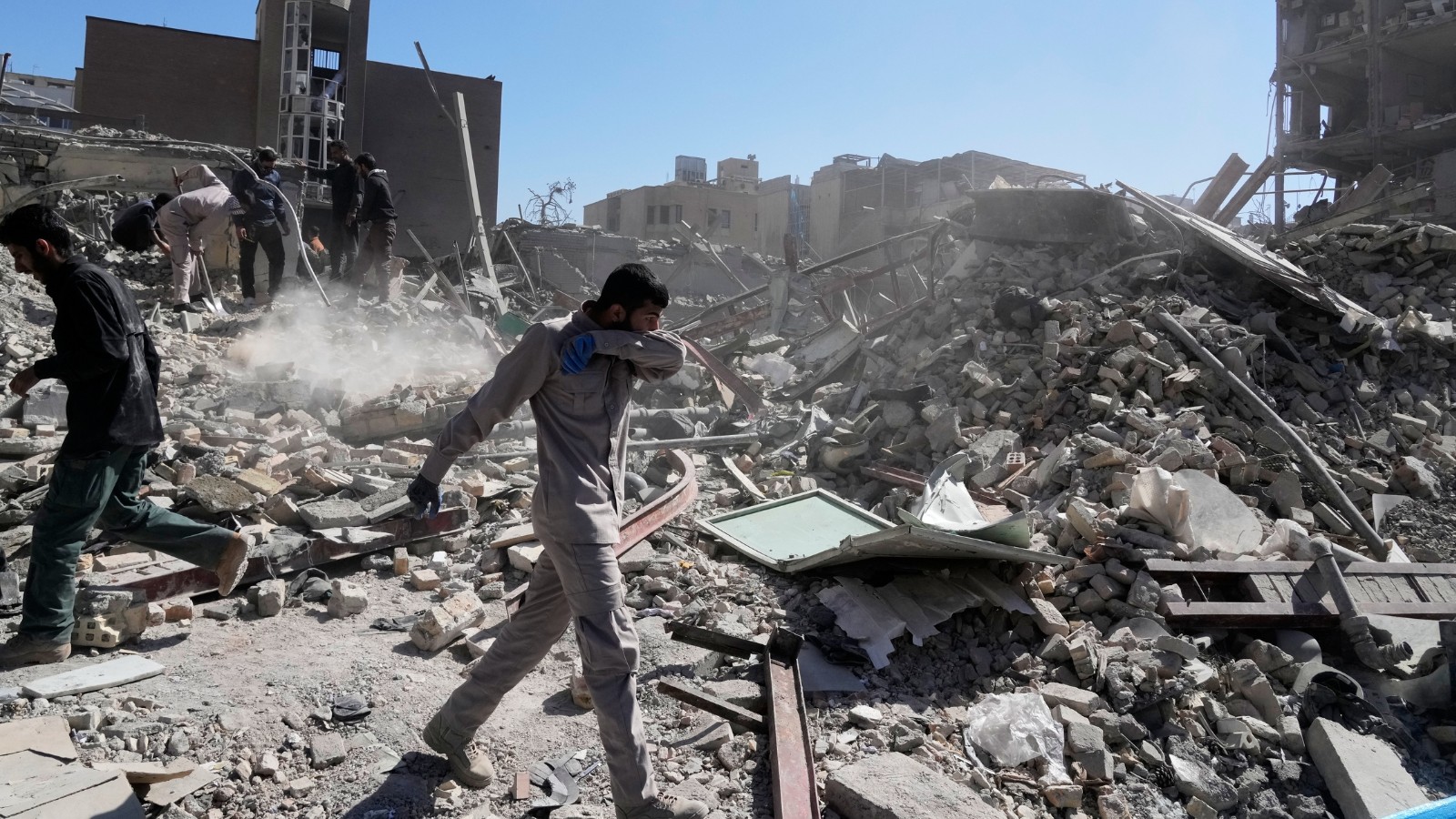
The strike on the Golestan Palace marks a point of no return in the escalating conflict between the United States, Israel, and Iran. While military briefings focus on payload accuracy and the neutralization of command centers, the physical destruction of a UNESCO World Heritage site represents a different kind of casualty. It is a strategic error masked as collateral damage. By hitting the heart of the Qajar era’s architectural crowning jewel, the offensive has moved beyond the dismantling of the Islamic Revolutionary Guard Corps (IRGC) infrastructure and into the systematic erasure of Persian identity. This is not just a headline about a building falling down. It is a report on the death of diplomacy through the destruction of shared human history.
The Strategy of Cultural Attrition
Military analysts often argue that in high-density urban warfare, proximity to historical sites is unavoidable. They claim the IRGC embeds communication nodes within the shadows of these palaces. Even if that were true, the decision to drop ordnance on the Golestan complex suggests a shift in the rules of engagement. We are seeing a transition from surgical strikes on hardware to psychological warfare aimed at the collective memory of a nation.
The Golestan Palace is not a military bunker. It is a sprawling complex of gardens, marble carvings, and 19th-century tilework that survived revolutions, coups, and the grueling eight-year war with Iraq. When a missile pierces the roof of the Marble Throne hall, it doesn't just kill technicians. It shatters the very symbols that Iranians—regardless of their feelings toward the current regime—hold as sacred markers of their civilization.
Why GPS Precision Does Not Excuse the Impact
Western defense officials have spent years bragging about the "low-collateral" nature of their current arsenal. They talk about $R9X$ Hellfire missiles and GPS-guided munitions that can hit a specific window from thousands of miles away. This technical prowess makes the damage to the palace look intentional rather than accidental.
If the technology is as good as the Pentagon says it is, then the damage to the Sun Throne or the Main Hall was a choice. To hit a target 200 meters from a UNESCO site is to accept the high probability that shockwaves, debris, and structural vibrations will bring down ancient masonry. The rubble in Tehran today is the result of a calculated risk where the value of a temporary tactical gain was weighed against the permanent loss of a global treasure. The tactical gain won.
Beyond the Dust of the Qajar Dynasty
The destruction of Golestan follows a dark historical pattern. We saw it in the looting of the Baghdad Museum in 2003 and the demolition of Palmyra by extremists. However, when state actors with sophisticated militaries engage in this behavior, it carries a different weight. It signals to the world that the international conventions protecting cultural property during armed conflict are now suggestions, not laws.
- The 1954 Hague Convention: This treaty explicitly forbids the targeting of cultural heritage unless it is being used for military purposes.
- The Burden of Proof: So far, no evidence has been produced to show that the Hall of Mirrors was housing ballistic missile components.
- The Blowback: Destroying Iranian history does not weaken the regime; it provides them with a potent propaganda tool to unify a fractured population against a "barbaric" foreign invader.
The Economic and Diplomatic Void
For decades, the Golestan Palace served as a bridge. Even during the darkest periods of sanctions, it was the one place where international scholars and travelers could witness the intersection of Persian tradition and European influence. It was a physical manifestation of Iran’s desire to engage with the world during the 1800s.
By turning this site into a combat zone, the coalition has effectively burned the bridge. The tourism industry in Iran, which many hoped would be the engine for a post-regime economic recovery, is being systematically dismantled. You cannot rebuild a 200-year-old mosaic with a federal grant. Once those specific glass fragments are pulverized, the history they represent is gone.
The Failure of International Oversight
UNESCO’s response has been characteristically toothless. A "deep concern" expressed in a press release from Paris does nothing to stop the next sortie of F-35s. The international community has failed to create a "no-strike" protocol that actually holds weight. This lack of accountability creates a dangerous precedent. If the Golestan Palace is fair game today, what happens to the ruins of Persepolis or the mosques of Isfahan tomorrow?
Military planners often view these sites as obstacles on a map. They see coordinates and heat signatures. But an investigative look at the ground reality reveals that these buildings are the anchors of society. When they are destroyed, the social fabric of the city doesn't just tear; it dissolves. People lose their sense of place.
The Mechanics of Modern Destruction
It isn't just the direct hit that causes the damage. The modern "bunker buster" is designed to penetrate deep into the earth before detonating. This creates a localized earthquake. Ancient foundations, built on compacted earth and brick, cannot withstand the seismic stress of a 2,000-pound bomb exploding nearby.
- Vibrational Collapse: The intricate mirror-work in the palace is held together by aging plaster. A blast half a mile away can cause the entire ceiling to shed its skin.
- Structural Shifting: Arches that have stood for centuries rely on precise tension. Shift the ground by three inches, and the entire structure enters a state of terminal failure.
- Secondary Fires: Modern munitions are incendiary. In an old palace filled with wooden beams and silk carpets, a small spark from a nearby strike can lead to a total loss.
The Intelligence Gap
There is a glaring disconnect between the intelligence used to justify these strikes and the cultural reality on the ground. Sources within the Iranian Ministry of Cultural Heritage have long complained that the IRGC does not consult them when moving equipment. However, the assumption that every historic building is a shield for a "high-value target" is a convenient narrative for those who want to avoid the messy work of urban diplomacy.
We have reached a stage where the "war on terror" or "regional stabilization" has become an excuse for a scorched-earth policy. This isn't the first time an empire has burned the library of its rival to prove a point. It is, however, the first time it has been done with such terrifying precision and then broadcast in real-time to a global audience.
The Silence of the West
The most damning part of this development is the relative silence from Western cultural institutions. Where are the museum directors? Where are the historians? Their hesitation to condemn the destruction of the Golestan Palace for fear of sounding "pro-Iran" is a betrayal of their own mission. History is not partisan. A Qajar tile belongs to the story of humanity, not to the current occupants of the government buildings in Tehran.
The current trajectory of this conflict suggests that the Golestan Palace is only the beginning. As the air campaign moves further into the Iranian heartland, more sites are at risk. The "collateral damage" list is growing longer than the list of neutralized military targets.
Stop viewing these updates as mere casualty counts or strategic wins. Start looking at what is being left behind in the smoke. When the dust finally settles and the last missile is fired, there will be a government to rebuild and a military to restructure. But the shattered glass of the Golestan Palace cannot be put back together. The history of the world is being rewritten by the hand of an operator in a control room thousands of miles away, and he isn't checking the UNESCO registry before he pulls the trigger.
Investigate the satellite imagery yourself. Look at the perimeter of the palace before and after the February 28th raids. The scars on the landscape are deep, and the cracks in the walls of the palace are a testament to a strategy that values the destruction of the present more than the preservation of the past. If you want to know how this war ends, look at the ruins of what we used to cherish.
Demand a transparent audit of the "No-Strike" lists provided to Central Command.



:strip_icc()/pic2513216.jpg)