The theater of security comfort is a billion-dollar industry, and its latest production is playing out right now in Washington State.
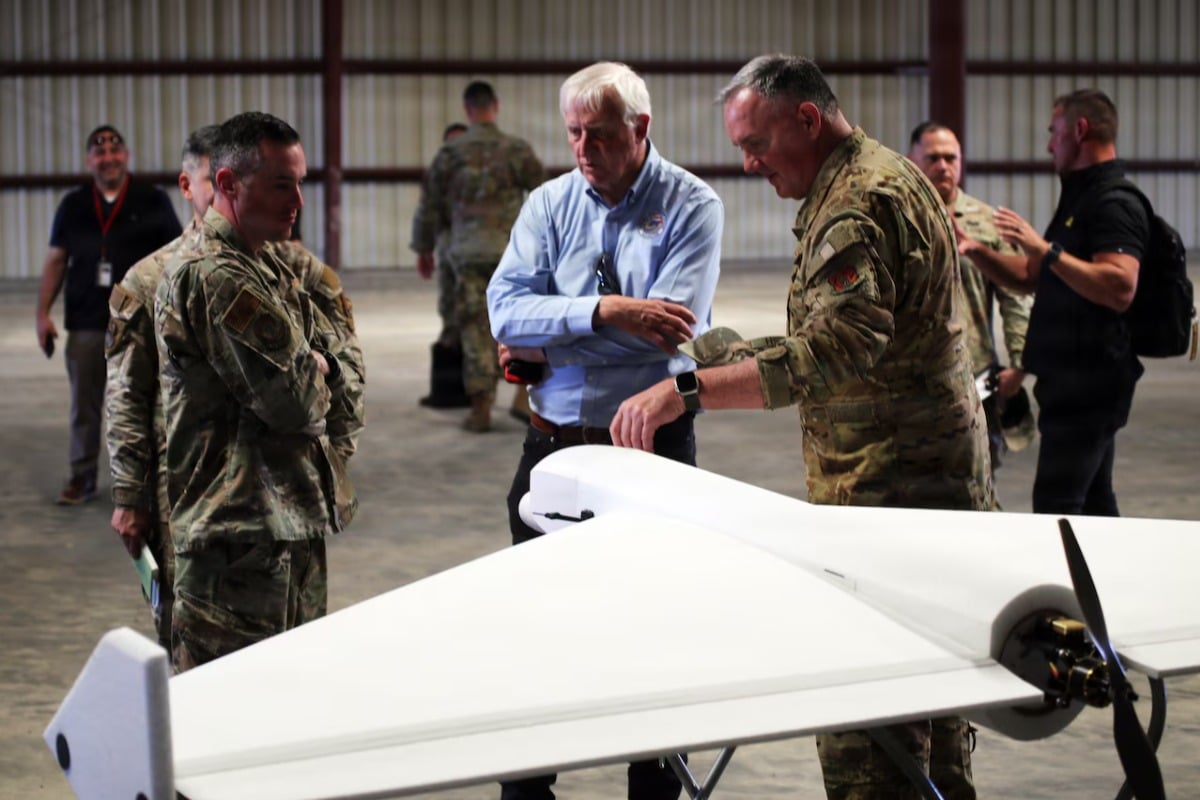
Recently, the Washington National Guard gathered a massive multi-agency cohort at the Yakima Training Center. The FBI was there. The Civil Air Patrol showed up. Local sheriffs and active-duty military units stood around in the desert to watch handheld radio-frequency jammers, interceptor drones, and "render-safe" protocols. The stated goal? Building a regional schoolhouse to save the 2026 FIFA World Cup crowds in Seattle from the modern airborne menace: the commercial drone.
The headlines write themselves. Bureaucrats get to look proactive. Defense contractors sell high-margin RF jamming rifles. The public feels a warm, fuzzy sense of safety believing that a national guardsman is going to zap an unauthorized quadcopter out of the sky before it hovers over Lumen Field.
It is a complete illusion.
The current playbook for domestic counter-Unmanned Aerial Systems (c-UAS) is fundamentally broken, built on tactical assumptions that are already obsolete on the modern battlefield. We are preparing to fight the hobbyist of 2018 while the threat landscape has moved entirely to autonomous, un-jammable systems. If a coordinated attack occurs during the World Cup, the current multi-agency tech stack will not stop it. It will merely record it in high definition.
The Frequency Jamming Lie
The core of the Washington National Guard’s demonstrated strategy—and indeed the strategy of the FBI and Department of Homeland Security—relies heavily on radio frequency (RF) mitigation. The logic seems sound on paper: a drone flies into a restricted zone, a security operator points a directional jamming antenna at it, cuts the signal between the pilot and the aircraft, and the drone either lands safely or flies home.
This fails to account for the immediate reality of electronic warfare.
Anyone who has spent time looking at technical data from modern conflict zones knows that modern threats do not rely on a continuous, vulnerable analog or digital command link. Cheap, off-the-shelf microcontrollers now run lightweight computer vision algorithms natively on the aircraft.
Imagine a scenario where an adversary launches a drone pre-programmed to fly to a specific GPS coordinate, switch to optical tracking when it sees a stadium structure, and execute a payload drop. It does not transmit data. It does not look for a pilot's signal. It is entirely passive and autonomous.
When you pull the trigger on a multimillion-dollar RF jammer against a drone running automated optical guidance, nothing happens. The drone does not care that you jammed the 2.4 GHz or 5.8 GHz spectrum. It does not care if you jam GPS via spoofing, because it is using inertial odometry and visual tracking to find the target.
By relying on RF jamming as a primary mitigation pillar, domestic security agencies are effectively bringing a knife to a laser fight. They are optimizing for the accidental rule-breaker—the overenthusiastic fan who wants a cool aerial shot of the stadium—while remaining completely exposed to anyone with a basic understanding of modern robotics.
The Kinetic Chaos of Urban Interception
The second flaw in the current consensus is the fantasy of physical mitigation over dense crowds. Let us look at the mechanics of the solutions being tested: kinetic interceptors (drones that shoot nets or ram other drones) and physical takedowns.
Consider the physics of an interception over an open-air venue like Lumen Field or the surrounding FanFest areas, which security officials admit are "soft targets" causing them sleepless nights.
If a security team successfully deploys an interceptor drone or a kinetic projectile to hit a target aircraft directly over a crowd of 60,000 tightly packed people, what happens next? Gravity takes over.
You have now created a secondary hazard. A ten-pound chunk of lithium-polymer batteries, carbon fiber, and potentially hazardous payload is now free-falling into a panicked stadium. The kinetic energy of a small object falling from several hundred feet is more than enough to cause severe injury or fatal stampedes in a crowded environment.
Worse, if the target drone is carrying a hazardous liquid, chemical agent, or improvised explosive mechanism, crashing it into the crowd via a physical interception achieves the exact outcome the attacker intended.
Our current domestic legal framework and tactical training are obsessed with "interception" because it looks decisive in a desert training environment like Yakima. In a concrete jungle surrounded by high-rise buildings and millions of civilians, it is an operational nightmare that creates as many casualties as it prevents.
Jurisdictional Paralysis at 400 Feet
Even if the technology worked perfectly, the bureaucratic framework guarantees failure. The recent exercises boasted about bringing together the National Guard, the Civil Air Patrol, state defense forces, and local police. In reality, this multi-layered hierarchy is a recipe for catastrophic delay.
Under current federal law, the authority to disrupt or destroy an airborne drone inside the United States is incredibly restricted. Only a handful of federal agencies—primarily the DHS, DOJ, and Energy Department—have clear legislative carve-outs to legally mitigate a drone threat. Your local police department or a state National Guard unit operating under state status generally cannot legally jam a drone's signal due to Federal Communications Commission (FCC) regulations regarding spectrum interference and Federal Aviation Administration (FAA) laws regarding the destruction of aircraft.
This creates a deadly loop of cross-talk and hesitation:
- A local police officer spots an anomalous drone approaching a soft target outside the stadium perimeter.
- The local officer does not have the legal authority or the equipment to jam it.
- The threat is kicked up the command chain to a regional federal asset or a specialized FBI team.
- By the time the federal agency verifies the threat, confirms they have the legal jurisdiction to act in that specific airspace block, and spins up their equipment, the event is already over.
A commercial quadcopter travels at 45 miles per hour. It can cover the distance from an anonymous vehicle outside the security perimeter to the center of a stadium in under 30 seconds. A decentralized, multi-agency committee cannot make a tactical decision in 30 seconds.
Redefining Drone Defense
We must abandon the reactive model of trying to swat drones out of the sky at the stadium gates. The entire premise of hunting the aircraft is flawed. Instead, security strategy must pivot to a proactive, asymmetric model focused on the ground.
1. Shift the Focus to Pilot and Launch Site Interdiction
Stop looking at the sky. Look at the perimeter. Drones do not materialize from thin air; they require a launch point within a relatively predictable radius.
Instead of spending millions on speculative laser and jamming technology that fails against autonomous systems, investment must flow into ubiquitous, automated RF direction-finding arrays designed solely to locate the controller signal on the ground instantly. When a non-autonomous drone takes off, its position and the pilot's position are broadcast immediately.
Security forces should not waste time trying to shoot down the craft; they must use rapid-response ground teams or automated ground monitoring to neutralize the operator within seconds of telemetry detection. For autonomous systems that do not broadcast, the focus must shift to aggressive physical perimeter security, acoustic sensors, and optical monitoring at likely launch points within a two-mile radius of the venue.
2. Hardening the Architecture, Not the Airspace
If a drone cannot be reliably shot down or jammed without risking a crowd catastrophe, the venue itself must be the line of defense.
This means implementing passive overhead protection architectures for vulnerable entry points, open-air concourses, and soft transition zones where crowds bottleneck. It means designing modern stadium infrastructure with localized, automated overhead netting or rapid-deployment canopy systems that can catch physical debris or payloads before they impact human targets.
It is far cheaper, legally simpler, and mathematically safer to catch a falling object with structural engineering than it is to engage in electronic warfare over the heads of civilian populations.
3. Legal Decentralization
The federal government must immediately delegate clear, conditional mitigation authority to local law enforcement entities for high-profile events. If the Seattle Police Department has to wait for an FBI sign-off to deploy a localized countermeasure during a crisis, the system has failed before the match even begins. Local agencies need clear, bright-line legal protection to operate localized, non-destructive mitigation tools inside a strictly defined temporary flight restriction (TFR) zone.
The current strategy of holding summits, hosting field days in the desert, and patting ourselves on the back for "building partnerships" is an expensive distraction. It satisfies the need to appear prepared while ignoring the reality of automated consumer robotics. We are running out of time to stop admiring the problem and start fixing the structural flaws that make us vulnerable.
The next threat won't be a hobbyist looking for a view from the nosebleeds, and it won't care about a radio jammer.