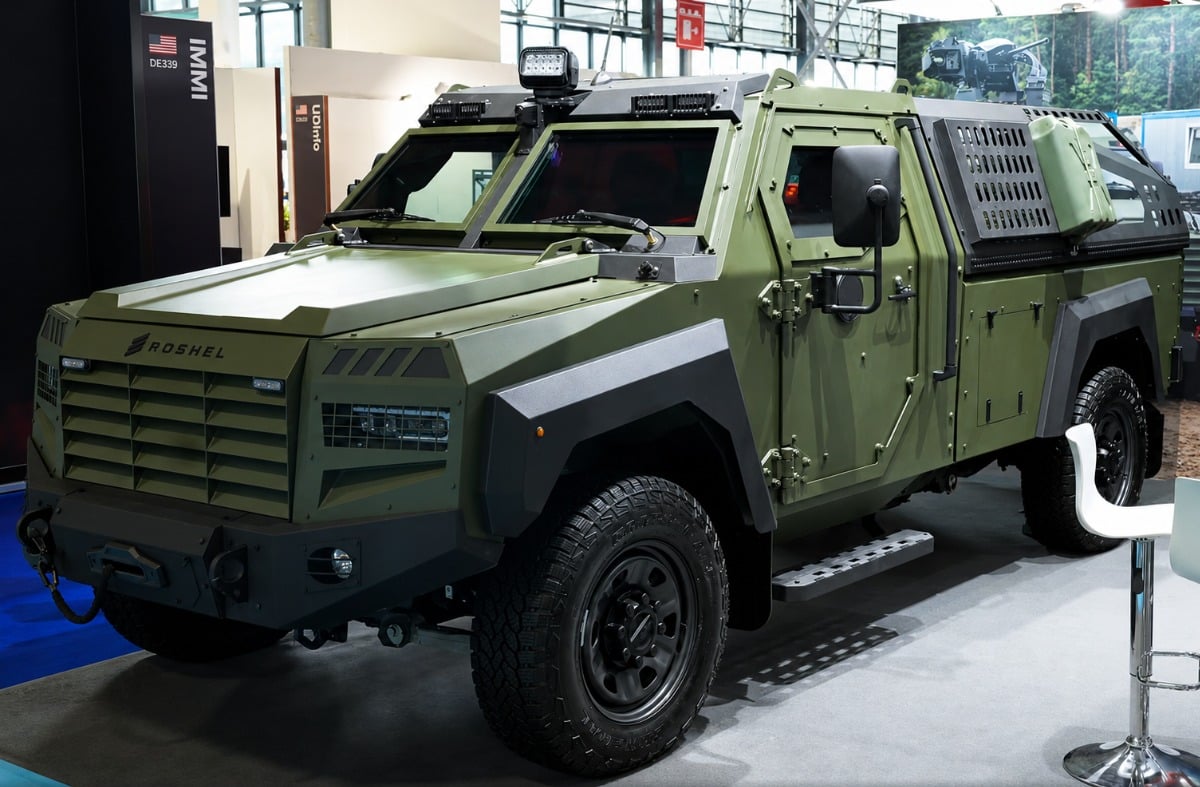
The intersection of compressed procurement cycles, platform familiarity, and structural armor configuration defines the contemporary light armored vehicle market. Procurement failures in asymmetric conflict zones often stem from a mismatch between exotic military hardware and the local technical capacity required to maintain it. The Roshel Captain Armored Personnel Carrier (APC) addresses this discrepancy by integrating a localized commercial platform with a military-grade armored envelope. By isolating the engineering vectors of survivability, industrial scalability, and mechanical lifecycle management, an analysis of this platform reveals the shifting economic and tactical priorities of modern internal security and border defense fleets.
Structural Engineering and Capsule Integration
Traditional armoring methodology for commercial-chassis vehicles relies on a body-on-frame configuration. In that conventional approach, armor plating is bolted or welded directly to the original equipment manufacturer (OEM) body panels and frame rails. This introduces severe structural vulnerabilities, as the added mass forces mechanical stress onto joints and frame sections that were never engineered for high-density loads. Under kinetic impact or blast overpressure, these bolted interfaces act as stress-concentration points, leading to catastrophic structural failure. Expanding on this topic, you can also read: Why Meta’s Eighteen Billion Dollar Settlement Changes Teen Age Verification Forever.
The architecture of this platform rejects the body-on-frame approach in favor of an integrated V-shaped monocoque protective capsule. This structural cell serves as the load-bearing framework of the vehicle. By shaping the underbody into a distinct V-profile, the vehicle redirects the kinetic energy of an explosive blast away from the crew compartment.
- Energy Dissipation: High-velocity gases from an under-vehicle blast expand upward. A flat hull absorbs this kinetic energy perpendicular to its surface, maximizing structural deformation and accelerating the cabin floor into the occupants' feet. The V-hull forces the gaseous front to split and vent outward along the angled surfaces, reducing the total vertical acceleration vector transferred to the chassis.
- Payload Deflection: The monocoque design eliminates the weight of a redundant commercial cab structure, redistributing that weight allowance into thicker ballistic steel and higher payload capacity. The entire vehicle geometry becomes a rigid torsion box, resisting the twisting forces encountered during off-road tactical maneuvers.
The material composition of the capsule is certified by independent third-party testing laboratories to meet specific international standards. Specifically, it achieves STANAG 4569 Level 1 ballistic protection and Level 2 blast protection. Observers at Wired have shared their thoughts on this matter.
STANAG 4569 Protection Metrics
┌─────────────────────────────────┬─────────────────────────────────┐
│ Metric Type                     │ Threat Profile Specification    │
├─────────────────────────────────┼─────────────────────────────────┤
│ Kinetic Energy (Level 1)        │ 7.62×39mm API BZ at 30 meters   │
│                                 │ Velocity: 695 m/s               │
├─────────────────────────────────┼─────────────────────────────────┤
│ Artillery Fragmentation         │ 155 mm High Explosive at 80 m   │
│                                 │ Azimuth: 360°; Elevation: 0–22° │
└─────────────────────────────────┴─────────────────────────────────┘
By engineering the capsule to withstand armor-piercing incendiary rounds at close range, the platform mitigates the primary threats encountered during high-risk urban interventions and border security patrols.
Powertrain Dynamics and Environmental Fuel Tolerances
The mechanical baseline of the vehicle utilizes the Toyota Land Cruiser 70 series architecture. This selection directly affects the operational availability of the vehicle in remote theatres. The primary propulsion unit is a 2.8-liter four-cylinder turbocharged diesel engine generating 201 horsepower at 3,400 rpm and 370 Nm of torque from 1,600 rpm.
Powertrain Efficiency Profile
Maximum Power: 201 hp @ 3400 rpm
Maximum Torque: 370 Nm @ 1600 rpm
Drivetrain: Selectable 4x4
Transmission: 6-speed automatic / manual options
This specific torque curve is critical for armored applications. The maximum twisting force is available low in the engine's operating range, allowing the vehicle to overcome inertia and accelerate rapidly from a dead stop under the burden of added armor mass. The powertrain connects to a six-speed automatic transmission and a selectable four-wheel-drive system, maintaining off-road mobility across varied terrains.
A primary failure point for modern common-rail diesel engines deployed in developing regions is fuel quality. Ultra-low sulfur diesel (ULSD) is standard in North America and Europe, but many operational zones only distribute high-sulfur fuel contaminated with particulates and water. High-sulfur diesel rapidly degrades modern emissions control systems, causing exhaust particulate filters to clog and forcing engines into low-power safe modes.
The fuel system of this platform is engineered with specific fuel-subsystem tolerances to allow continuous operation on high-sulfur diesel without mechanical degradation. This fuel-blind capability prevents logistical bottlenecks, ensuring that fuel can be scavenged from local commercial sources during extended operations without risking engine failure. A fuel tank capacity of up to 180 liters extends the operational radius, minimizing the frequency of high-risk refueling operations in unsecured territory.
Industrial Scalability and Supply Chain Optimization
The strategic value of an armored vehicle platform is bounded by its production velocity. Bespoke military vehicles frequently suffer from protracted manufacturing timelines due to specialized components, proprietary casting methods, and single-source defense supply chains. If a state actor or law enforcement agency requires rapid fleet expansion during a sudden security crisis, conventional defense manufacturing cannot scale up instantly.
The production model for this platform achieves a turnaround time of two weeks, supported by a manufacturing capacity of up to 120 units per month. This velocity is made possible by a dual-layer industrial strategy.
- Substructure Commonality: By utilizing the globally distributed Toyota Land Cruiser 70 series chassis, the manufacturer eliminates the lead times associated with casting custom axle housings, machining transfer cases, and fabricating steering linkages. These components are sourced through high-volume commercial automotive supply chains that are insulated from defense-sector constraints.
- Lifecycle Maintenance Simplification: Fleet sustainability hinges on parts availability. If a specialized military vehicle damages an axle in a remote border region, the vehicle remains non-operational until a proprietary replacement part is shipped from a defense depot. In contrast, components for the Land Cruiser platform exist within global commercial inventories. Local mechanics can service the drivetrain using standard tools, bypassing specialized defense logistics pipelines.
Tactical Mobility and Strategic Deployment Enablers
Operational utility requires that an APC be rapidly deployable across long distances without relying exclusively on slow ground transportation. The dimensional envelope of the vehicle (5354 mm length, 2261 mm width, 2490 mm height, and a 3180 mm wheelbase) is explicitly optimized for standard intermodal transport infrastructure.
The physical dimensions allow the vehicle to fit cleanly into standard ocean freight containers. This enables secure, low-profile shipping via commercial maritime networks, concealing the movement of tactical assets from public observation. For immediate strategic re-positioning, the platform is certified for transport via standard tactical airlift assets.
- Fixed-Wing Cargo Transport: The vehicle can be driven directly into the cargo hold of a C-130 Hercules transport aircraft without requiring structural disassembly or fluid drainage.
- Rotary-Wing Sling Loading: The total curb weight falls within the hook-capacity thresholds of heavy-lift rotary assets like the CH-47 Chinook. This allows air-assault or extraction teams to insert the vehicle into austere environments devoid of functional runways or improved roads.
Inside the capsule, ergonomics are adjusted to support operational endurance. The interior configuration accommodates up to eight personnel, who can be seated on standard benches or specialized mine-protected seats. These specialized blast seats are decoupled from the vehicle floor and suspended from the roof or walls instead. This structural separation prevents the shockwave of an under-vehicle explosion from traveling directly through the seat base into the occupant's spinal column, minimizing non-line-of-sight personnel casualties.
Operational Limitations and Tactical Trade-offs
An objective engineering assessment requires mapping the absolute limitations of the vehicle architecture. No armored platform offers total protection across all threat spectrums without incurring penalties in weight, agility, or cost.
The reliance on a commercial platform chassis creates a ceiling for growth potential. While the monocoque capsule optimizes weight distribution, the underlying axles, wheel bearings, and suspension pick-up points remain bound by the ultimate physical tolerances of the commercial platform design. Upgrading ballistic protection beyond STANAG Level 1 or adding heavy remote weapon stations would push the gross vehicle weight rating near its mechanical yield point. This would cause rapid tire wear, premature brake fading, and accelerated suspension fatigue under sustained off-road use.
The high center of gravity inherent to V-hull armored capsules increases the risk of vehicle rollover during high-speed, sharp cornering maneuvers or lateral traverses on steep inclines. Operators must be trained specifically to manage the altered roll dynamics of a vehicle that carries significant armor mass high above its roll center.
Fleet Deployment Recommendations
For procurement agencies evaluating fleet integration, this vehicle operates most effectively when deployed within a specific tier of the threat matrix. It is not an infantry fighting vehicle designed to challenge heavy mechanical formations or survive heavy anti-tank guided missile strikes.
The optimal application for this platform is within low-to-medium intensity operations, including border interdiction, anti-terror operations, urban tactical law enforcement, and convoy security. In these roles, the primary hazards are small-arms ambushes, improvised explosive devices, and fragmentation. The combination of rapid production scalability, commercial maintenance lines, and certified capsule survivability allows security forces to maximize operational readiness while controlling total lifecycle ownership costs. Agencies should deploy this asset in regions where the commercial support infrastructure already exists, maximizing operational availability from day one.