Western foreign desks treated Russia's autumn State Duma elections with predictable yawns. Headlines rolled out the standard copy-paste template about a rubber-stamp parliament, the disqualification of anti-war remnants like Yabloko, and Vladimir Putin tightening his iron grip amidst a grinding war of attrition.
It is a lazy, comforting narrative. It allows observers to dismiss the entire exercise as a Soviet-style farce where the ballots are fake and the outcome is printed before the polls even open.
That perspective misses the forest for the trees.
If you view a managed autocracy through the romantic lens of Western liberal democracy, you will always misread the signals. You look for ballot-box surprises where none can exist. You wait for a sudden popular uprising sparked by a legislative contest. When nothing happens, you shrug and call it a non-event.
I have watched analysts and corporate risk consultants blow millions of dollars misinterpreting Russian political mechanics because they treat the Duma like a Western legislature. It is not a legislature. It is a closed-circuit board of directors for a nuclear-armed conglomerate. And when the board meets to divvy up seats during a wartime economy, the knives come out in the dark.
The Myth of the Monolithic Rubber Stamp
The fundamental error in standard reporting is the assumption that United Russia's supermajority implies total internal harmony. Pundits see United Russia hauling in over three hundred seats and assume the machine runs on oil, fear, and absolute obedience.
Reality is far more fractured.
A one-party-dominant system does not eliminate internal competition; it merely drives it underground. When you ban external opposition, you concentrate all political ambition, greed, and survival instinct inside the ruling coalition and its approved corporate satellites. The Communist Party of the Russian Federation, the Liberal Democratic Party, and New People are not independent opposition groups, but they are distinct financial lobbies representing rival industrial, security, and regional cartels.
Every single seat in the State Duma represents a lucrative franchise. A Duma mandate buys parliamentary immunity, control over regional state-budget flows, regulatory capture for allied construction or defense contractors, and a protected seat at the trough of state procurement.
When the Kremlin adjusts seat distribution or shifts district boundaries—such as the massive redistricting ahead of the 2026 cycle—it is not an aesthetic exercise. It is a violent re-negotiation of tribute. Regional governors and oligarchic clans fight vicious proxy wars over candidate lists months before a single voter steps into a booth.
The Annexed Territories Are a Fiscal Black Hole
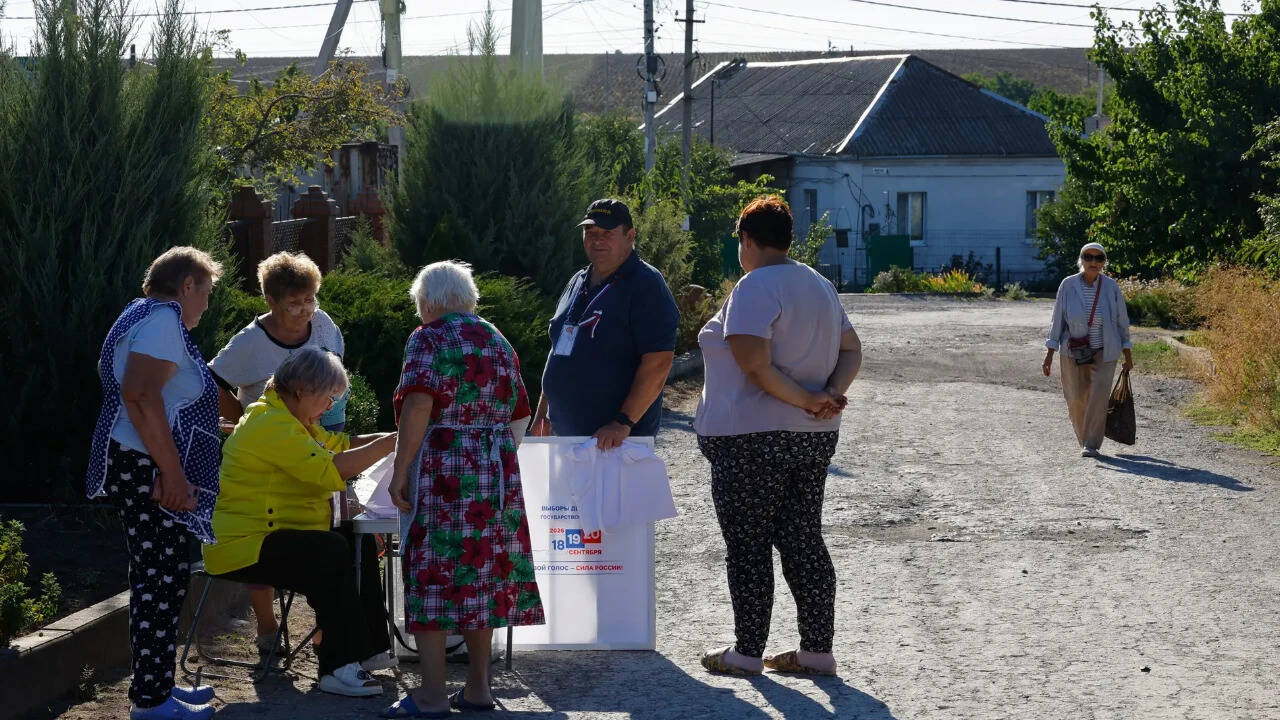
Consider the most publicized novelty of the 2026 parliamentary cycle: the inclusion of voting districts across occupied Ukrainian territories, including Donetsk, Luhansk, Kherson, and Zaporizhzhia.
Mainstream commentators framed this strictly as an imperial land-grab designed to legitimize the occupation on paper. That is true, but it is only half the story.
From an administrative standpoint, forcing a parliamentary vote across pulverized, heavily militarized front-line zones is a nightmare of logistical and financial fabrication. Local political bosses and appointed Gauleiters were given impossible quotas: manufacture high turnout and landslide pro-Kremlin margins while managing active drone strikes, shattered infrastructure, and a hostile local populace.
Instead of consolidating power, these newly minted voting regions act as a permanent financial drain and a zone of acute administrative corruption. Billions in federal subsidies earmarked for post-conflict reconstruction vanish into black holes managed by connected contractors. Regional governors are held personally responsible for delivering clean electoral numbers from territories where the electrical grid is held together by duct tape and prayer.
By tying their political survival to the management of these occupied zones, the Kremlin has effectively chained its regional administrators to an anchor. If the front line buckles or administrative corruption triggers a local riot, the blowback hits the very power vertical meant to project invulnerability.
How the Systemic Opposition Monetizes Silence
To understand why the system does not crack, you have to look closely at the economics of the so-called systemic opposition. Parties like the LDPR or A Just Russia survive not because they challenge the Kremlin, but because they provide a pressure-release valve for disgruntled voters who refuse to back United Russia.
It is a sophisticated co-optation market.
These minor parties are allocated specific niches. The Communists scoop up nostalgic pensioners and anti-establishment leftists. The nationalists capture the radical pro-war fringe. They bark loudly during parliamentary debates, vote predictably in lockstep with the Kremlin when real money is on the line, and collect state funding proportional to their vote share.
In the recent elections, this balancing act grew intensely fragile. With the war straining national budgets, the pie available for political rent-seeking shrank. The smaller factions fought fiercely not to overthrow the regime, but to preserve their share of state subsidies and protection privileges.
When the Supreme Court disqualified Yabloko—the lone remaining anti-war token allowed near the ballot—it wasn't just an act of routine authoritarian hygiene. It was a preemptive strike to prevent any unauthorized faction from siphoning off protest votes that rightfully belonged to the controlled opposition. The Kremlin cannot afford unauthorized alternative revenue streams or independent political brands when every ruble and every column must be accounted for under wartime mobilization laws.
The Weaponization of Voter Apathy
Western journalists love to point out low voter enthusiasm, empty street campaigns, and the widespread cynical detachment of the Russian public. They interpret this apathy as a ticking time bomb—proof that the population hates the regime and is merely waiting for an opening to revolt.
This is a profound misread of how authoritarian survival works.
Totalitarian states crave passionate mobilization; authoritarian states prefer quiet exhaustion. For decades, the social contract between the Kremlin and the average citizen has been simple: stay out of high politics, keep your head down, and we will leave your private life alone.
Wartime pressures tested this compact, but voter apathy remains a functional pillar of regime stability. When citizens treat elections as an irrelevant bureaucratic ritual, they are not failing to do their civic duty; they are participating in a mutual disengagement pact. The average Russian does not believe the Duma will change their standard of living, but they also do not believe that rioting in the streets will bring a better alternative.
The state does not need love; it needs passive compliance. By engineering an election cycle that feels gray, boring, and inevitable, the regime successfully depresses the political energy that might otherwise coalesce into dangerous opposition movements.
The Technocrats Versus the Siloviki Behind Closed Doors
Beneath the veneer of electoral uniformity lies a relentless, high-stakes turf war between two dominant factions within the Russian elite: the siloviki security hardliners and the technocratic economic managers.
The technocrats—headed by central bankers and fiscal ministers—are tasked with keeping the macroeconomy afloat under crushing sanctions, managing inflation, and securing supply chains. The siloviki want total resource mobilization, state-directed industrial planning, and unconditional priority for the military-industrial complex.
The State Duma is the arena where these two camps negotiate the legal framework ofلیسی the wartime economy. Every tax tweak, every corporate asset nationalization decree, and every budget allocation must pass through legislative committee rooms where lobbyists for both factions battle for supremacy.
The election results cemented a legislature heavily tilted toward aggressive state intervention. Technocrats who previously preached fiscal conservatism found their influence curtailed as defense spending crowded out civilian budgets. By engineering a parliament entirely subservient to executive wartime demands, the leadership has removed institutional friction, but it has also eliminated its own early-warning system. When policy can no longer be challenged inside the room, mistakes compound silently until they manifest as systemic shocks.
The Danger of Mistaking Control for Stability
The core danger of watching Russian politics from the outside is confusing absolute control with long-term structural stability.
A system that eliminates all legal safety valves, criminalizes dissent, and reduces parliamentary politics to an internal auction among loyalist oligarchs looks unbreakable right up until the moment it fractures. There are no moderate reformers left in the building to negotiate a soft landing if economic fatigue or military friction reaches a breaking point.
When you design a political machine where power is concentrated entirely at the top and every lower-tier institution is reduced to a hollowed-out shell, you remove the shock absorbers. A car driving at high speed doesn't need to steer around every obstacle if it has good suspension; but if you strip the suspension away, the first minor pothole flips the vehicle.
Russia's wartime parliamentary election was never about democracy, choice, or popular mandate. It was an internal audit of a wartime cartel, a ruthless accounting of who gets to loot what while the borders remain sealed and the economy is placed on permanent military footing.
Stop looking for a democratic awakening where none can grow. Start watching the silent, bruising fights over cash, resources, and bureaucratic survival taking place behind the iron curtain of the regime's own making. That is where the actual future of the state is being decided.