A digital artist in a cluttered studio in Chengdu clicks a mouse. Thousands of miles away, a policy analyst in Washington D.C. feels a phantom chill. Between them lies a vast, electrified ocean of data where the next world war is already being fought, though not with steel or lead. It is being waged with fables.
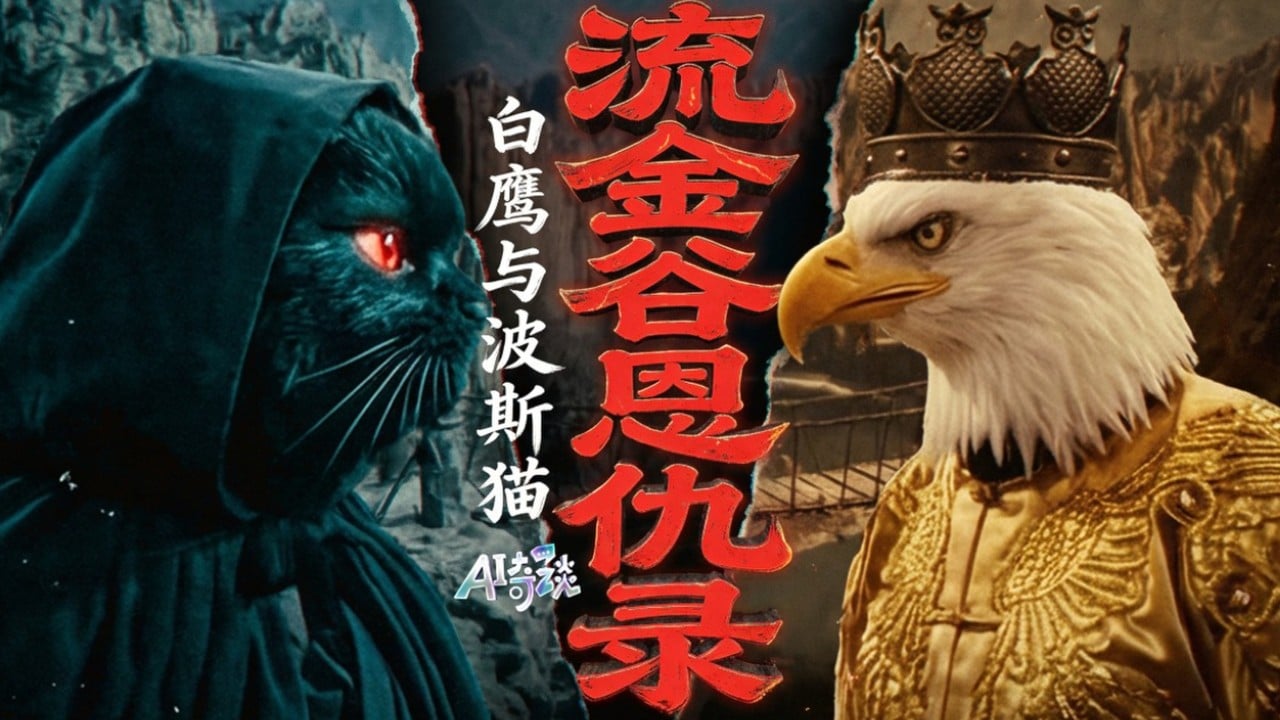
The images started appearing on Weibo and X like a fever dream. You might have seen them: majestic white eagles, feathers gleaming with a cold, metallic sheen, soaring over ancient ruins. Facing them are Persian cats—elegant, stoic, and strangely unbothered. The eagles represent the United States; the cats, Iran. This is the new language of global tension. It isn't a diplomatic cable or a televised briefing. It is an AI-generated satire, a visual shorthand that bypasses the brain’s logic centers and goes straight for the gut.
China’s internet users have discovered a potent weapon in the generative AI toolkit. They aren't just making memes; they are rewriting the narrative of global power dynamics while the West is still trying to figure out if the images are "real."
The Architecture of a Digital Myth
Consider a hypothetical user named Chen. Chen doesn't work for a government agency. He isn't a professional propagandist. He is a twenty-something with a high-end graphics card and a deep-seated cynicism about Western interventionism. Using tools like Midjourney or Stable Diffusion, Chen can manifest a complex political argument in seconds.
He types a prompt: American eagle, aggressive, talons out, attacking a peaceful Persian garden, cinematic lighting.
The machine grinds through its neural network, a digital soup of billions of human-made images, and spits out a masterpiece. It looks like a still from a high-budget Marvel movie. The eagle looks terrifyingly powerful but also—crucially—like a bully. The cat, representing Iran, looks like a victim with the dignity of a king.
This isn't just "fake news." It’s something more sophisticated. It is a mood.
When these images go viral, they don't carry the baggage of a long-winded editorial. They offer a vibe. They suggest that the United States is a restless predator, forever searching for a new sky to dominate, while the rest of the world simply wants to exist in its own sun-drenched courtyard. For a domestic Chinese audience, this reinforces a specific worldview: the U.S. is the "Great Disturber."
The Death of the Gatekeeper
In the old world, if a nation wanted to influence the public opinion of another, it needed a massive apparatus. You needed radio towers, printing presses, and a cadre of translators. You needed a seat at the table.
That table has been smashed to splinters.
Now, the barrier to entry is zero. This democratization of propaganda means that the "war of stories" is no longer controlled by state actors alone. It is a swarm. Thousands of individual creators are generating a tidal wave of content that mimics the aesthetic of professional media.
Wait.
Think about the weight of that. If anyone can produce an image that looks like a Pulitzer Prize-winning photograph, then the very concept of "witnessing" begins to erode. We are entering an era where the most persuasive story wins, regardless of its relationship to the truth on the ground.
The Chinese AI satire of a potential U.S.-Iran conflict isn't meant to be "true" in a literal sense. No one actually thinks there are giant eagles flying over Tehran. But the feeling it evokes—the sense of an impending, unjust clash—becomes a reality in the minds of millions who scroll past it.
The Emotional Calculus of the Eagle
Why the eagle? Because it is the ultimate symbol of American exceptionalism, and turning it into a caricature of its own strength is a stroke of narrative genius. In these AI-generated sequences, the eagle is often depicted as heavy, burdened by its own weaponry, or blind to the beauty below it.
The cat, by contrast, is nimble. It is ancient. It belongs to the soil.
This contrast taps into a deep, historical resentment toward Western hegemony. It reframes the geopolitical struggle as a fight between a soulless machine of war and a living, breathing culture. It’s an underdog story. Everyone loves an underdog, even if that underdog is a geopolitical entity with its own complex and often brutal reality.
The irony is thick. The very technology used to create these critiques—the underlying transformer models and diffusion techniques—largely originated in Western labs. We built the pens that are now being used to draw us as the villain.
The Invisible Stakes of the Scroll
We often talk about AI safety in terms of "alignment" or "existential risk"—the fear that a superintelligence might turn us all into paperclips. But the immediate, visceral risk is much more mundane and much more dangerous. It is the slow, steady poisoning of the well of public discourse.
When we can no longer distinguish between a grassroots meme and a state-sponsored influence operation, we stop trusting everything.
Total skepticism is just as dangerous as total gullibility.
If you believe nothing, you can be convinced of anything. This is the goal of the "Eagle and Cat" narratives. They don't necessarily want you to love Iran or China. They just want you to doubt the motives of the West. They want to create a world where every American move is seen through the lens of a predatory bird.
A Mirror Made of Silicon
The most uncomfortable part of this phenomenon is what it says about us, the viewers. Why do these images work? Why do they spread like wildfire while a well-researched white paper on Middle Eastern policy gathers dust?
Because we are wired for stories.
Our brains are not evolved to process data points; they are evolved to watch the horizon for threats and to gather around fires to hear legends. AI has figured out the "cheat code" to our evolutionary biology. It can generate the exact visual stimuli required to trigger fear, anger, or righteous indignation.
It is a feedback loop. The AI generates an image, we react to it, the algorithm sees our reaction, and it serves us more of the same. The "White Eagle" becomes a recurring character in our digital lives, a boogeyman that we start to see even when the screen is dark.
The Fragility of the Persian Garden
There is a specific image from the viral trend that haunts the periphery of the mind. It shows a Persian cat sitting quietly by a turquoise pool. In the reflection of the water, you can see the distorted shadow of a massive bird of prey circling above. The cat isn't looking up. It is looking at you, the viewer.
It is an invitation to empathy. It asks: Whose side are you on? The hunter or the hunted?
The image omits the complexities of the real world. It omits the nuclear ambitions, the human rights records, the proxy wars, and the decades of frozen diplomacy. It replaces the messy, gray reality of international relations with a high-contrast fable of good and evil.
This is the power of AI-driven satire. It simplifies the world until it is small enough to fit into a smartphone screen, and sharp enough to cut.
The New Front Line
We are looking for the "Red Line" in the sand. We are looking for troop movements and naval exercises. But the front line has moved into the pocket of every person with an internet connection.
The battle for the 21st century will not be decided by who has the most carriers or the fastest jets. It will be decided by who can tell the most compelling story about why those carriers and jets exist in the first place.
If the story of the White Eagle and the Persian Cat becomes the dominant lens through which the global south views the West, then the war is already over. No amount of soft power or traditional diplomacy can counter a narrative that has already been stitched into the collective imagination by a thousand anonymous prompts.
The technology is neutral, but the stories are not.
As the sun sets over the virtual ruins of a world we are still trying to understand, the eagle continues to circle, and the cat continues to watch. They are ghosts in the machine, but they have more power over our future than we might care to admit.
The pixel has become mightier than the sword.
Behind every viral image of a metallic bird of prey, there is a human intent, a hidden hand guided by a desire to reshape the world in its own image. We are no longer just consumers of media; we are the terrain upon which these digital deities fight for dominance.
The question is no longer whether we can believe our eyes. The question is whether we can still trust our hearts when they are being pulled by strings we cannot see.
The cat is still waiting for an answer.