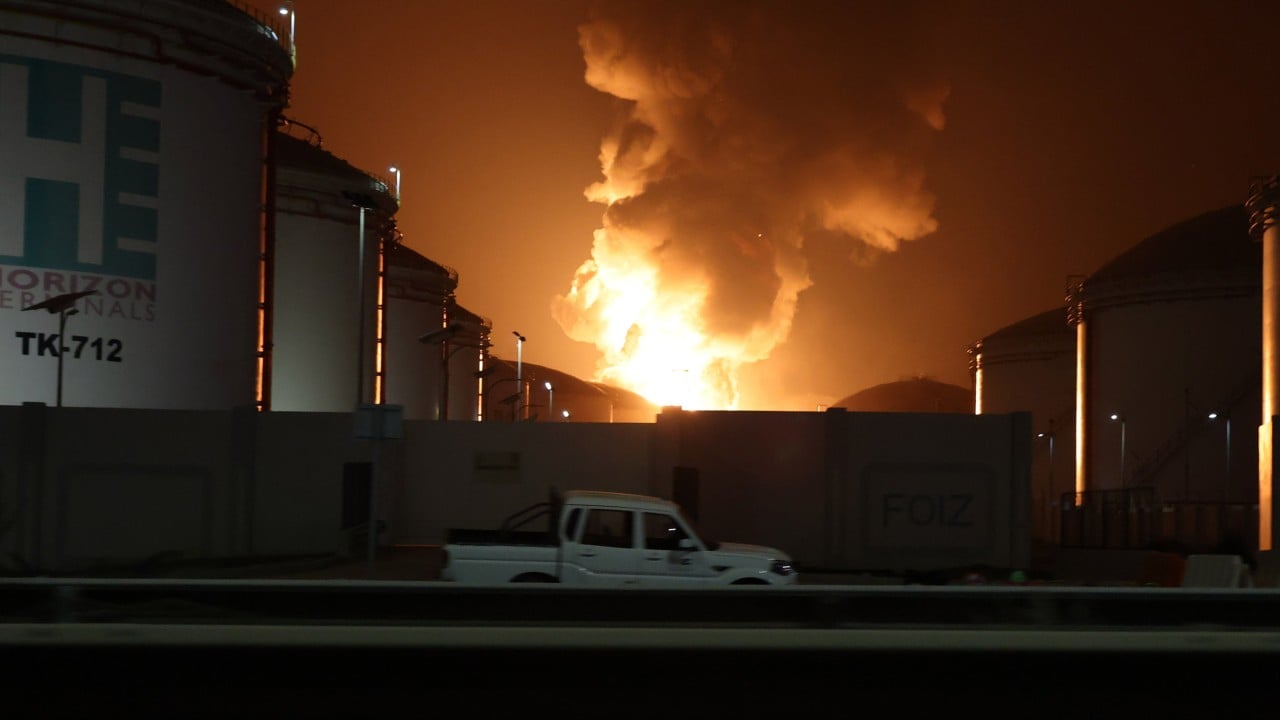
The headlines are screaming about a widening war. They want you to believe that a single tanker hit in the northern Persian Gulf is the spark that resets the global order and sends crude to $150. They are wrong. They are lazy. And they are likely losing money because they don’t understand the plumbing of the global energy trade.
Panic is a commodity. Right now, the "geopolitical risk premium" is being sold to you by analysts who couldn't tell a VLCC from a tugboat. The consensus view—that an escalation in the Gulf creates a permanent supply shock—is built on a fundamental misunderstanding of modern logistics, storage capacity, and the actual strategic goals of the players involved.
We aren't seeing a "widening war." We are seeing a theatrical performance designed to fleece retail investors and keep defense contractors in the black.
The Myth of the Chokepoint
Every time a shadow falls over the Strait of Hormuz, the same charts appear. You've seen them: the "X" marks the spot where 20% of the world’s oil supposedly gets held hostage.
The "chokehold" is a 20th-century ghost story. In 1980, if you blocked the Strait, the lights went out in Tokyo and Paris. In 2026, the world is a very different machine. Saudi Arabia and the UAE have spent decades building massive bypass pipelines to the Red Sea and the Gulf of Oman. These aren't theoretical projects; they are high-capacity arteries designed specifically for this moment.
When the media shouts about "supply disruption," they ignore the fact that the world is currently drowning in spare capacity. OPEC+ is sitting on millions of barrels of voluntary cuts. If a tanker goes down, the physical market barely flinches because the "missing" oil can be replaced by a few keystrokes in Riyadh or Midland, Texas.
The price spikes you see aren't based on a lack of oil. They are based on the fear of a lack of oil. There is a massive difference between a broken pipe and a nervous trader.
Why Iran Won’t Actually Close the Strait
The "lazy consensus" assumes Iran is a chaotic actor looking to blow up the global economy. This ignores the most basic rule of survival: don't burn down your own house.
Iran’s economy is a fragile web of gray-market exports. They rely on the same waters they are accused of wanting to close. Closing the Strait of Hormuz would be an act of economic suicide for Tehran. It would instantly alienate China—their biggest customer and only significant geopolitical lifelines.
I have watched desks at major hedge funds burn through millions of dollars betting on a "total regional shutdown" that never comes. Why? Because the actors in the region are smarter than the pundits on cable news. They engage in "calibrated escalation." You hit a tanker; I seize a vessel. You launch a drone; I jam your radar. It’s a violent dance, but it’s a dance with boundaries.
The goal isn't to stop the oil. The goal is to raise the price of the oil for a specific political objective. If you understand the theater, you stop paying for the ticket.
The Inventory Buffer Nobody Mentions
If you want to know the truth about oil prices, stop looking at the Gulf and start looking at the salt caverns.
The Strategic Petroleum Reserve (SPR) in the US and similar stockpiles in China and India are the ultimate dampers on volatility. In the old days, a tanker attack caused an immediate scramble for physical barrels. Today, we have "virtual barrels" in the form of massive strategic inventories and a sophisticated futures market that allows refineries to hedge their risk months in advance.
We are currently operating in an environment where global inventories are well-managed. The "widening war" narrative fails to account for the fact that a tanker being hit in 2026 is an insurance headache, not a global catastrophe. Most of these vessels are insured through P&I clubs that have already priced in these risks. The cargo is covered. The ship is replaceable. The flow continues.
The Hidden Winner The Permian Pivot
Every time the Persian Gulf gets "hot," the real winner isn't a Middle Eastern state. It’s a guy in a hard hat in West Texas.
The US is now the world’s largest producer of crude oil. Our "swing producer" status means that any geopolitical instability in the Middle East acts as a massive stimulus package for the American shale industry.
When prices tick up due to a "widening war" headline, capital flows back into the Permian Basin. Rigs that were sidelined suddenly become profitable. The more the media talks about the "fragility" of the Gulf, the more robust the American energy sector becomes.
The paradox is delicious: the fear of a Middle Eastern war makes the world less dependent on Middle Eastern oil. By pushing prices up, these "attacks" accelerate the transition to alternative suppliers and permanent energy efficiency.
Stop Asking "Will Prices Go Up?"
The "People Also Ask" sections are filled with the wrong questions. They ask: "Will gas prices hit $5?" or "Is WWIII starting in the Gulf?"
The question you should be asking is: "Who benefits from me believing this is a crisis?"
- Defense Contractors: Need a reason to sell more interceptor missiles to the GCC.
- Speculative Traders: Need volatility to make a profit in a flat market.
- Media Outlets: Need clicks to satisfy advertisers.
If you are an investor or a business leader, reacting to these headlines is the quickest way to erode your capital. I’ve seen portfolios gutted because someone saw a plume of smoke on Twitter and went long on oil at the absolute peak of the panic.
Physical reality always wins over narrative. And the physical reality is that there is too much oil, too many pipelines, and too much at stake for a "widening war" to actually happen.
The Logic of the Skirmish
We have entered the era of the "forever skirmish." This isn't the build-up to a total war; it’s the new baseline for regional competition.
Think of it like high-frequency trading, but with drones. Small, targeted strikes are the new diplomatic currency. They are used to send messages without crossing the "red lines" that would trigger a full-scale US intervention.
The competitor's article claims this "signals the war is widening." It doesn't. It signals that the war is maturing. It’s becoming a localized, controlled conflict designed to manipulate markets and leverage diplomatic concessions.
If you treat every tanker incident like the start of the Apocalypse, you are the mark in the room.
Your Action Plan for the Chaos
Stop reading the "breaking news" banners. They are designed to trigger your lizard brain, not your spreadsheet.
- Watch the Spreads: Look at the "Brent-WTI" spread. If it isn't widening significantly, the market doesn't actually believe the Gulf is closing.
- Follow the Tanker Tracking Data: Not the news reports. Use services like TankerTrackers.com to see if ships are actually stopping or diverting. Spoilers: they usually aren't.
- Bet on the Bypass: Watch the volume moving through the East-West Pipeline in Saudi Arabia. That is the real barometer of regional tension.
The northern Persian Gulf isn't a powder keg; it’s a boardroom where the negotiations are carried out with kinetic force. The "widening war" is a ghost story told to keep you from seeing the massive supply glut sitting just behind the curtain.
Don't buy the fear. It’s the only thing in the Gulf that’s actually overpriced.
Stop looking for the end of the world and start looking at the balance sheet.