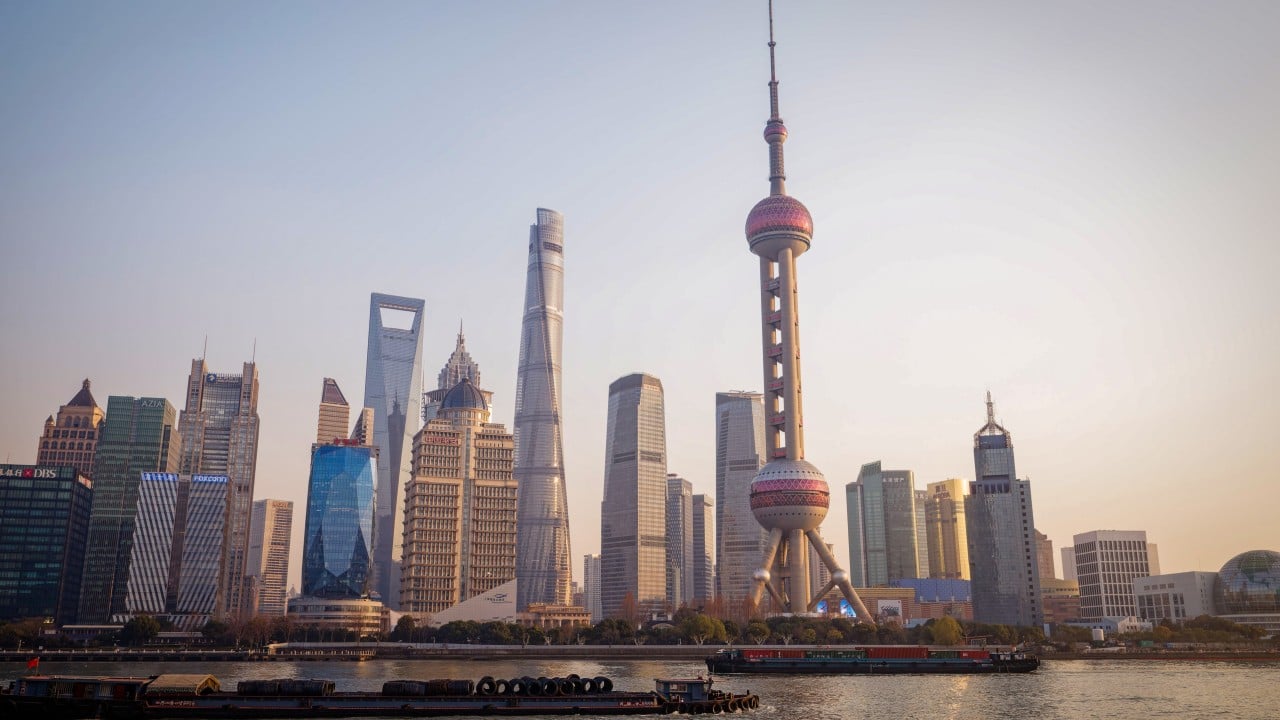
China’s retention of the title as the world’s billionaire capital is not a reflection of a stable economic equilibrium, but rather the result of high-beta equity market volatility and a structural shift in the sectors driving ultra-high-net-worth (UHNW) capital accumulation. The Hurun Global Rich List serves as a lagging indicator of liquidity events and market valuations. To understand the trajectory of global wealth, one must look past the aggregate headcount of billionaires and analyze the three specific levers currently dictating these rankings: the concentration of AI-driven equity gains, the diverging performance of domestic versus export-oriented Chinese enterprise, and the impact of currency depreciation on dollar-denominated wealth reporting.
The Valuation Multiplier and the Artificial Intelligence Pivot
The primary driver behind the recent swelling of the Hurun list is the disproportionate impact of a few specific technology verticals on public market valuations. We are witnessing a decoupling where traditional industrial manufacturing wealth is being cannibalized by the "AI Multiplier."
Wealth in this context is rarely a measure of liquid cash; it is a calculation of market capitalization multiplied by ownership percentage. When a company like Nvidia or its Tier-1 supply chain partners in Asia sees a tripling of their stock price, the "wealth" of the founders scales at a non-linear rate compared to the underlying GDP growth of their respective nations.
The concentration of new billionaires in the 2024-2025 cycle originates from three distinct layers of the technology stack:
- The Infrastructure Layer: Owners of semiconductor fabrication plants and data center REITs.
- The Model Layer: Founders of large language model (LLM) startups that have achieved "decacorn" status through private funding rounds.
- The Application Layer: Executives of existing SaaS and e-commerce platforms that successfully integrated AI to expand margins or capture new market segments.
This creates a "Winner-Takes-All" wealth distribution. In China specifically, the resurgence in billionaire count is heavily concentrated in the third layer—entrepreneurs who have optimized supply chains via algorithmic efficiency, such as those behind PDD Holdings and ByteDance.
The Divergence of the Chinese Wealth Engine
The narrative that "China is back" ignores the internal fragmentation of its billionaire class. The current list reveals a sharp divergence between two types of capital: Old Economy Debt-Heavy wealth and New Economy Asset-Light wealth.
The Erosion of Real Estate Capital
For over a decade, the Hurun list was dominated by property developers. The current data shows a terminal decline in this cohort. The mechanism here is a debt-deflation spiral. As property values stagnate and the Chinese government maintains its "Three Red Lines" policy, the equity value of these moguls has been wiped out to service debt obligations. This represents a permanent destruction of wealth rather than a cyclical dip.
The Rise of the Transnational Entrepreneur
Conversely, the billionaires driving the current surge are those whose revenue models are "China-plus-One." These individuals have successfully decoupled their wealth generation from the domestic Chinese consumer base. By capturing market share in Southeast Asia, Europe, and the United States, they have insulated their net worth from domestic deflationary pressures.
This creates a paradox: China remains the "billionaire capital" by nationality and headquarters location, but the underlying economic activity generating that wealth is increasingly global. This leads to a higher sensitivity to geopolitical risk and trade barriers, which now act as the primary cost functions for UHNW stability.
Currency Mechanics and the Dollar-Denominated Filter
A significant portion of the "growth" or "contraction" in global rich lists is an artifact of currency fluctuation. Because the Hurun Global Rich List is typically benchmarked in US Dollars (USD), the strength of the Renminbi (RMB) against the Greenback acts as a silent filter.
When the RMB depreciates, a Chinese billionaire’s net worth appears to shrink on the global stage even if their domestic purchasing power remains constant. The recent "swell" in the list suggests that the growth in equity valuations has finally outpaced the currency headwinds.
The second-order effect of this is "Wealth Flight Hedging." UHNW individuals in China are increasingly diversifying into offshore assets, including US Treasuries, Japanese real estate, and Singaporean family offices. This creates a leakage in the domestic investment cycle, as the capital generated by these billionaires is not necessarily being reinvested into the local economy, but is instead seeking "safe haven" status to preserve its position on the global rankings.
The Structural Fragility of the "Billionaire Capital" Label
Being the "billionaire capital" is a vanity metric that masks a high degree of "Churn Risk." The stability of the US billionaire class is largely built on institutionalized tech giants and long-standing financial services firms with deep moats. In contrast, the Chinese list exhibits much higher volatility.
Factors contributing to this instability include:
- Regulatory Pivot Risk: The sudden implementation of "Common Prosperity" initiatives or sector-specific crackdowns (as seen in the private education and gaming sectors) can erase billions in market cap overnight.
- Supply Chain Fragility: Many of the new entrants on the list are tied to the EV (Electric Vehicle) and Lithium-ion battery sectors. As global markets implement protectionist tariffs, the margins of these companies—and by extension, the wealth of their owners—are under immediate threat.
- Succession Bottlenecks: A large percentage of the current Chinese billionaire class is reaching retirement age without a proven model for intergenerational wealth transfer within the current legal and tax framework.
The Strategic Path Forward for UHNW Analysis
To derive actual value from the Hurun data, analysts must stop viewing it as a scoreboard and start viewing it as a heatmap of capital efficiency. The presence of a high number of billionaires in a specific geography indicates where the regulatory environment is currently permitting high-margin capture.
The strategic play is to monitor the "Velocity of Entry." Regions or sectors where new names are appearing at the fastest rate—currently AI and Renewable Energy Infrastructure—are the areas where capital is most productive.
However, for those looking to preserve wealth in this environment, the move is to transition from "High-Beta Growth" (stock-heavy wealth) to "Low-Volatility Preservation." This involves a shift toward private equity, direct infrastructure investment, and diversified currency holdings. The goal is not to be the person who gains the most spots on the list during a bull run, but the one who loses the least during the inevitable deleveraging of the "AI Bubble."
The current surge in the Hurun list is a signal of a temporary peak in liquidity. The focus should now shift toward identifying which of these billionaires have built "Antifragile" systems that can survive a contraction in global trade and a tightening of the AI-driven valuation premiums. The next phase of global wealth will be defined not by who can create the most paper wealth, but who can successfully convert that paper wealth into durable, cross-border institutional power.