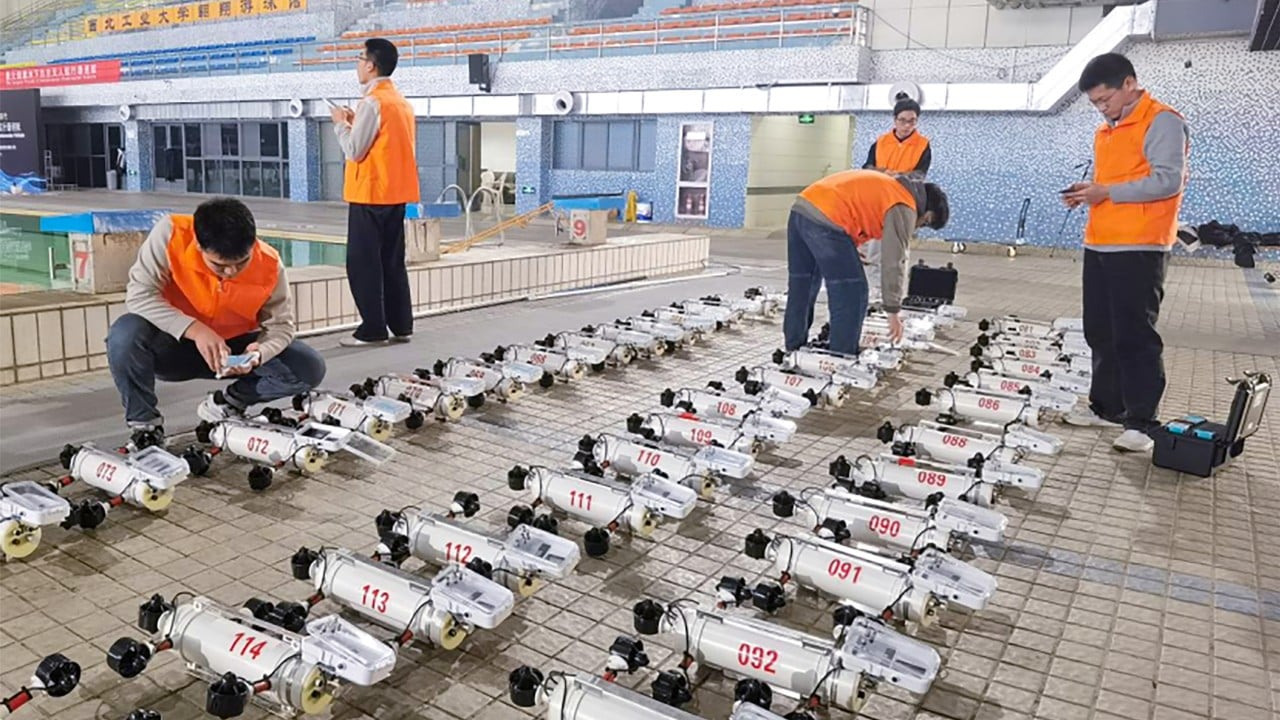
When a Chinese research collective recently coordinated a swarm of one hundred and sixteen autonomous underwater vehicles, the milestone represented far more than a numerical record. Operating machinery beneath the ocean surface demands solving physics problems that terrestrial drone swarms never face. Radio frequencies die within centimeters of salt water, forcing engineers to rely on acoustic modems characterized by sluggish propagation speeds and heavy signal interference. This deployment signals a major shift in maritime robotics, moving away from solitary, expensive military submarines toward distributed networks of disposable marine units.
For decades, naval architects and oceanographers operated under a simple rule. To see further underwater, you needed a bigger hull, a deeper crush depth, and a multi-billion-dollar price tag. Massive nuclear-powered submarines or sophisticated deep-submergence research vessels were the only tools capable of mapping trenches or conducting wide-area surveillance. That era is closing. When multiple small vehicles communicate locally and share spatial awareness without human intervention, the economics of ocean exploration and maritime warfare undergo a radical fracture.
The Acoustic Bottleneck That Defeats Simple Software
Aerial drone swarms showcased in public exhibitions rely on GPS signals and high-frequency radio links. Thousands of small quadcopters can stream telemetry simultaneously because the electromagnetic spectrum in air permits gigabit-scale data transfer over kilometers. Submerge those same quadcopters into the ocean, and the entire architecture collapses. Electromagnetic waves attenuate exponentially in saline environments. Salt water acts as a conductive shield, absorbing radio frequency energy almost instantaneously.
To coordinate one hundred and sixteen independent underwater units, engineers cannot stream real-time video feeds or centralized flight control commands. Acoustic communication is the only viable alternative, yet sound travels through water at roughly fifteen hundred meters per second—snail-paced compared to light speed. Worse, the underwater acoustic channel is plagued by multipath interference, temperature gradients, salinity shifts, and ambient noise from biological sources and commercial shipping lanes.
Acoustic modems drop data rates to mere bits per second over long distances. Consequently, a swarm operating at scale cannot rely on a shore-based pilot steering every motor. Each unit must possess onboard autonomy capable of calculating vector adjustments, collision avoidance, and mission replanning using decentralized local sensor data. When communication bandwidth is scarce, the intelligence must reside at the edge within every single titanium or composite hull.
Decentralized Coordination Versus Centralized Command
Building a large group of machines is straightforward; keeping them from destroying each other or scattering into the abyss is where engineering projects fail. Traditional military and scientific deployments utilized master-slave architectures. One primary vessel issued commands down a tether or an acoustic link, treating smaller sensors as dumb relays. If the master vessel suffered a failure, the mission ended.
True swarming technology rejects single points of failure. In a decentralized network inspired by schooling fish or flocking birds, individual nodes interact only with their immediate neighbors. If drone number forty-two loses contact with the rest of the formation due to an underwater thermal layer or acoustic shadow, it falls back on local behavioral rules. It maintains safe separation distances, estimates drift currents using inertial measurement units, and attempts to re-establish mesh connectivity once environmental conditions clear.
This architecture transforms vulnerability into resilience. If an adversary or a rogue ocean current disables a dozen units in a swarm of one hundred and sixteen, the remaining one hundred and four continue their operational pattern. They redistribute coverage sectors autonomously, filling spatial gaps left by lost components. Observers focusing solely on the peak number achieved in a controlled trial miss the underlying structural breakthrough. The achievement lies in fault tolerance under severe communication constraints.
The Dual Use Imperative in Contested Waters
Governments rarely fund massive autonomous marine initiatives purely for academic marine biology. While official releases highlight bathymetric mapping, environmental monitoring, and marine archaeology, the geopolitical reality of underwater swarms points directly toward naval combat and coastal defense.
Modern submarine detection relies heavily on passive sonar arrays and active pinging networks. A single quiet diesel-electric submarine resting on the continental shelf is notoriously difficult to locate. However, scattering dozens of low-cost autonomous listening posts across a strait or a shipping lane changes the probability calculus entirely. Instead of one expensive sonar receiver searching an area, a distributed mesh of small units creates a dense, overlapping detection net.
Furthermore, these platforms can carry modular payloads. Some units act as acoustic sources, pinging to illuminate targets while others listen for the return echo from safe distances, separating the emitter from the receiver to prevent counter-attack. Others can loiter on the ocean floor in a low-power sleep mode for months, waking only when acoustic signatures matching specific vessel classes pass overhead.
When nations deploy large numbers of inexpensive autonomous marine systems, traditional cost-exchange ratios in naval warfare break down. Firing a multi-million-dollar anti-submarine torpedo at a small drone worth a fraction of that amount is an economically unsustainable defense strategy. This asymmetry drives military planners worldwide to accelerate their own underwater swarm programs, sparking an invisible arms race beneath the surface.
Battery Chemistry and the Endurance Wall
Every conversation about marine robotics eventually collides with the laws of thermodynamics. While computational power and sensor miniaturization advance rapidly, battery energy density hits a stubborn wall. Lithium-ion cells provide adequate power for short sprints, but extended multi-week missions require managing every milliampere-hour with extreme precision.
Underwater vehicles face three major energy drains. Propulsion against ocean currents consumes the lion's share of battery capacity. Maintaining buoyancy control and ballast adjustments demands continuous mechanical work. Finally, running onboard processors and acoustic transceivers drains electrical stores even when the vehicle is stationary.
To achieve meaningful endurance, designers must incorporate adaptive power profiles. Units drift passively with ocean currents when not actively scanning, waking their propulsion systems only to correct course or execute high-priority data collection. Energy harvesting techniques, such as exploiting thermal gradients between different water depths or utilizing micro-turbines in tidal flows, remain experimental and unreliable for high-density operations. Until a breakthrough in portable marine power generation occurs, swarm endurance remains constrained to hours or days rather than months, limiting operational ranges unless docking stations or surface relay buoys are positioned nearby.
Supply Chain Realities Behind the Hull
Building advanced maritime hardware requires specialized manufacturing capabilities that extend far beyond writing clean control algorithms. Precision machining of pressure-resistant hulls, molding specialized acoustic transducer ceramics, and calibrating micro-electro-mechanical inertial sensors demand mature industrial ecosystems.
Access to high-purity rare earth elements for permanent magnets used in brushless thruster motors, coupled with radiation-hardened microcontrollers capable of surviving deep-sea pressure differentials, forms a critical bottleneck. Nations attempting to scale autonomous marine fleets without domestic foundries and specialized material science laboratories quickly discover that supply chain vulnerabilities can halt a program faster than software bugs.
Hypothetically, consider an engineering team attempting to source one hundred and twenty pressure housings rated for depths exceeding one thousand meters. A single microscopic flaw in the carbon fiber layup or titanium welding seam results in catastrophic hull collapse when subjected to crushing hydrostatic pressure. Quality control at scale separates laboratory prototypes from deployable industrial hardware.
The Shifting Horizons of Ocean Dominance
The successful coordination of large underwater drone formations marks an irreversible transition point in marine technology. As acoustic networking improves, battery chemistries evolve, and decentralized autonomy software matures, the oceans are becoming transparent to automated observation. The strategic implications will resonate across commercial shipping, environmental regulation, and naval defense strategy for decades to come. The surface of the sea no longer conceals what moves below.