The air in Paris always carries a faint scent of roasted coffee, exhaust fumes, and old stone. But on that Tuesday night, the air tasted entirely of collective sweat and static electricity.
If you looked at the official tickers, the data was sterile. France vs. Morocco. A semi-final clash in the 2026 World Cup. A scoreline that would eventually be etched into FIFA’s digital archives as a definitive, unyielding set of numbers. But numbers are terrible historians. They capture the result, but they completely miss the agony of the 84th minute, where an entire metropolis held its breath so tightly you could practically hear the ribs cracking from the Seine to the outer ring of the Périf.
To understand what happened in the French capital when the final whistle blew, you have to look away from the pitch. You have to look at the cafes along the Boulevard de Barbès, where the television screens cast a flickering blue light over faces that carried the dual weight of two empires, two homes, and one broken heart.
The Fault Lines of a Ninety-Minute War
Football is a game of geography played by people who defy it.
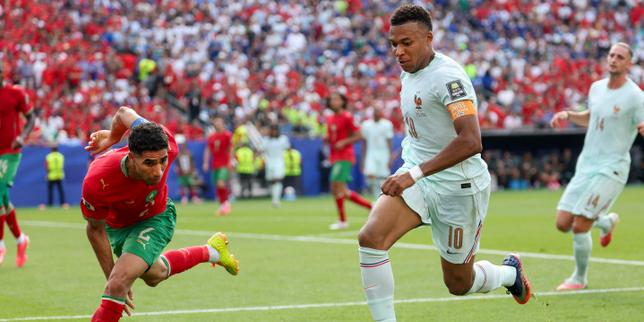
Consider a young man named Youssef. He is nineteen, wearing a red Morocco jersey but sporting a navy blue Paris Saint-Germain cap. He was born in the twentieth arrondissement. His grandfather arrived from Casablanca in the late 1970s to work in the automotive factories of Poissy. For Youssef, this match was not an entertainment product. It was a ninety-minute identity crisis broadcast in high definition. Every time Achraf Hakimi intercepted a pass, Youssef leaned forward so far his forehead nearly touched the laminated wood of the bar. When Kylian Mbappé burst down the left flank, Youssef winced, torn between the civic pride of his daily life and the ancestral blood that pounded in his ears.
This is the hidden reality of modern international sport. The media frames these matches as clean, patriotic battles between nation-states. Red versus blue. Anthem versus anthem.
The truth is messy. It is beautiful. It is exhausting.
The tension had been building for forty-eight hours. The police presence along the Champs-Élysées was not just a precaution; it was a physical manifestation of anxiety. Nearly two thousand officers stood under the shadows of the plane trees, their shields reflecting the neon signs of luxury boutiques. The city expected a riot. Instead, it received a secular liturgy.
When France scored the opening goal, the sound that erupted from the sports bars in the center of the city was not just a cheer. It was a release of immense pressure. A collective exhale. Yet, three blocks away, in a Moroccan-owned tea shop, the silence that followed was heavy, punctuated only by the aggressive clatter of a silver teapot against a glass.
The Physics of the Near Miss
Morocco did not play like an underdog. They played like owners of the pitch.
There is a specific kind of cruelty in football where the team that dominates the narrative logic of the game still loses the mathematical reality of it. The second half was a masterclass in tension. The ball spent what felt like an eternity bouncing inside the French penalty box. Every deflection was a miniature drama.
Imagine a spring being compressed over and over until the metal threatens to snap. That was the atmosphere in Paris. The city became a giant amplifier for twenty-two men running across grass thousands of miles away.
Then came the second French goal. It did not arrive with the spectacular flourish of a tactical masterstroke. It was a scrappy, opportunistic conversion, the kind of goal that feels like a sudden slap in the face after an hour of elegant dancing.
The red jerseys in the crowds slumped. The blue jerseys rose.
It is a strange human impulse, this desire to tie our personal joy to the physical trajectory of a leather sphere filled with compressed air. We know, logically, that a victory for eleven wealthy athletes does not pay the rent or fix the broken subway line at Gare du Nord. Yet, we barter our emotional sanity for it anyway.
The Aftermath on the Asphalt
When the referee blew the final whistle, sealing France’s progression to the final, the city split open.
The expected violence did not materialize in the way the sensationalist morning papers had predicted. Instead, something far more complex occurred. The Champs-Élysées filled with a sea of people within twenty minutes. Car horns began their rhythmic, maddening symphony—three short bursts, two long ones—a sonic signature of Parisian celebration that dates back decades.
But look closer at the crowd.
There were French flags draped over shoulders, yes. But there were also Moroccan flags tied around waists. In the middle of the avenue, under the cold white glow of the Arc de Triomphe, two men who had spent the last two hours screaming at opposite ends of a bar met in the middle of the street. One wore blue. One wore red. They did not fight. They embraced with the fierce, aggressive camaraderie of soldiers who had survived the same artillery barrage.
"You terrified us," the Frenchman said, his voice hoarse from cigarettes and shouting.
The Moroccan shrugged, his eyes bright with tears that could have been from grief or smoke flares. "We will win it next time. You still have to play the final."
The victory belonged to France, but the night belonged to the friction between who these people are and where they come from. Paris is a city built on contradictions, a metropolis that constantly struggles to define who belongs within its grand, Haussmann-style borders. For one night, the football match did not solve that struggle. It just made everyone admit it out loud.
As the clock crept toward three in the morning, the smoke from the red flares began to clear, drifting upward past the stone faces of the old monuments. The street sweepers were already starting their engines at the bottom of the avenue, their green plastic brooms ready to erase the physical remnants of the collective madness.
The horns grew sporadic. The flags were folded back into backpacks. Paris was returning to its default state—cold, expensive, and beautifully indifferent. But on the pavement outside a small grocery store near Belleville, a single Moroccan flag lay forgotten next to a discarded blue plastic cup. The wind from an incoming front caught the fabric, flipping it over so it lay perfectly flat against the wet asphalt, catching the reflection of the streetlights.