The international football press is lazy. When a historical powerhouse beats an underdog in a World Cup semi-final, the narrative writes itself before the referee even blows the final whistle. The headlines after France’s 2-0 victory over Morocco in Qatar followed a predictable, mind-numbing script. They called it a tactical clinic. They praised Didier Deschamps’ lethal attacking depth. They painted a picture of a French machine that systematically dismantled the tournament’s best defense.
It is a comforting story. It is also entirely wrong.
If you actually watch the tape instead of just reading the box score, you see a completely different match. France did not win because of an unstoppable frontline or a tactical masterclass. They survived. They stumbled into an early lead through a chaotic, deflected sequence, spent the next eighty minutes getting completely overrun in the center of the pitch, and benefited from Morocco running out of gas and healthy center-backs.
Calling this an attacking masterclass ignores the fundamental mechanics of what happened on the pitch. It rewards passive tactical regression and mistakes luck for design.
The Five-Minute Illusion That Saved Deschamps
Let’s dismantle the premise of France’s supposed offensive dominance. The narrative hinges heavily on Theo Hernandez’s goal in the fifth minute. The mainstream media treated this as the moment France unlocked the unbreakable Moroccan low block.
It wasn't. It was a pinball accident.
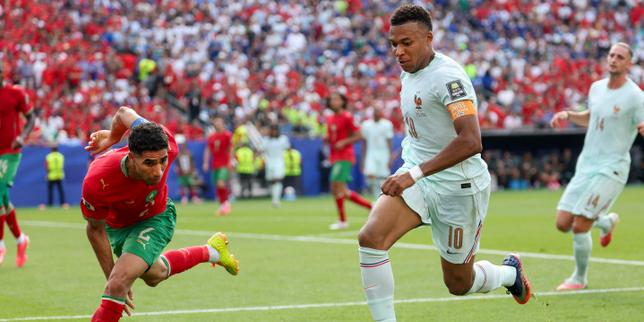
Antoine Griezmann didn't carve Morocco open with a visionary pass. Jawad El Yamiq made an aggressive, high-risk gamble to step up and intercept a ball, slipped, and left Kylian Mbappé with a chaotic window to shoot. The shot was blocked, ricocheted awkwardly off a defender, and looped into the path of an oncoming left-back.
That is not a tactical breakdown of an opponent. That is a fortunate bounce.
Had that ball bounced three inches to the left, Morocco stays in their defensive shape. They don't have to chase the game. They don't have to commit bodies forward. The entire tactical framework of the match changes. To credit Deschamps for an attacking breakthrough based on a random deflection is the definition of result-oriented bias.
The Midfield Ghost Town That Nobody Wants to Talk About
Once France got that lead, what did their world-class attacking force do? They evaporated.
For the next hour, Morocco—a team missing its starting center-back pairing within twenty minutes due to injury—completely dominated the ball. Walid Regragui’s midfield trio of Sofyan Amrabat, Azzedine Ounahi, and Selim Amallah did not just compete with France; they thoroughly outplayed Aurelien Tchouaméni and Youssouf Fofana.
Look at the underlying numbers that the mainstream match reports conveniently brushed under the rug:
- Morocco controlled 62% of the possession.
- Morocco completed 572 passes compared to France’s 364.
- Azzedine Ounahi alone completed more progressive passes into the final third than the entire French midfield combined.
France’s midfield was a ghost town. Adrien Rabiot’s absence due to illness exposed a massive vulnerability in Deschamps’ setup. Fofana looked lost, frequently caught between pressing Ounahi and dropping to cover the space behind Theo Hernandez. Tchouaméni was left completely isolated, forced to extinguish fires because his wingers refused to track back.
If you have watched elite football for more than five minutes, you know that letting a technically proficient team dictate the tempo in your own defensive third for sixty minutes is not a strategy. It is a crisis. France did not deliberately concede possession to hit on the counter; they were forced backwards because they could not win the ball.
The Mbappé Myth and the Left-Side Liability
We need to talk about Kylian Mbappé’s performance, because the adoration heaped upon him for the second goal is deeply misleading. Yes, his footwork in the box created the deflection that Randal Kolo Muani tapped in. But focusing solely on that five-second sequence ignores the massive tactical liability he created for eighty-five minutes.
Mbappé refused to defend. He did not track Achraf Hakimi. He did not help double-team Hakim Ziyech.
Regragui saw this immediately. Morocco spent the entire match targeting France’s left flank. Theo Hernandez was hung out to dry, forced to defend 2-on-1 situations repeatedly because Mbappé was hovering near the halfway line waiting for a long ball.
Sofiane Boufal and Hakimi routinely overloaded that side of the pitch. If Morocco had a clinical, world-class number nine instead of Youssef En-Nesyri—who touched the ball only three times in the entire first half—France would have conceded two or three goals down that exact channel.
This is the hidden cost of the superstar attacker. When your primary winger refuses to participate in the defensive phase, your entire defensive block has to shift. Griezmann was forced to play as a literal deep-lying central midfielder just to compensate for Mbappé’s lack of defensive output. It worked against a fatigued Moroccan squad, but it was a structural failure that Lionel Messi and Argentina brutally exposed just a few days later in the final.
Dismantling the People Also Ask Nonsense
Whenever this match comes up, the same flawed questions circulate online. Let’s address them with some blunt reality.
Did France’s experience win them the game?
No. Exhaustion and injuries won France the game. Morocco entered the semi-final having played grueling, high-intensity matches against Croatia, Belgium, Spain, and Portugal. Romain Saïss was playing on one leg and had to be subbed off after twenty minutes. Nayef Aguerd was injured in the warm-up. Noussair Mazraoui was subbed off at halftime. France didn't out-think Morocco; they simply faced a team that had literally run themselves into the medical tent.
Was Griezmann’s performance the best midfield display of the tournament?
Griezmann was excellent, but calling it a midfield masterclass misses the point of why he was there. He was playing out of position because Deschamps failed to fix the structural gap between the frontline and the defense. Griezmann saved France with his work rate, but using your best creative attacker as a makeshift box-to-box destroyer because your actual midfielders are getting bypassed is an indictment of your system, not a triumph.
The Danger of Rewriting Defensive Panic as Composure
I have analyzed elite football tactics for over a decade, and nothing frustrates me more than when defensive desperation is rebranded as "tactical maturity."
In the second half, I watched Ibrahima Konaté make three desperate, last-second sliding blocks inside the six-yard box. I watched Hugo Lloris make a sprawling save on a bicycle kick from El Yamiq. I watched Jules Koundé clear a ball off the goal line in the dying minutes.
That is not a team in control. That is a team hanging on by a thread.
When a elite squad with a billion dollars worth of talent is reduced to desperate goal-line clearances against an African nation missing its entire starting central defense, you do not praise the victor's "firepower." You question why they allowed the game to devolve into a chaotic survival exercise.
The competitor's article wants you to believe that France won because they were an offensive juggernaut. The reality is far more sobering. France won because they scored early off a fluke, retreated into a low block, got completely outplayed in midfield by an exhausted opponent, and capitalized on a single late defensive lapse when Morocco was pushed entirely out of shape.
Stop praising the lazy consensus. France did not march into the final. They escaped into it.