History isn't always written in textbooks. Sometimes, it is whispered in a language that an enemy cannot break, even if that same language was once beaten out of children in government boarding schools.
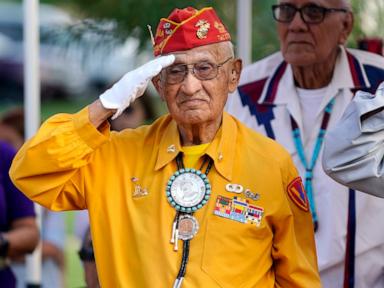
On August 14, crowds gather in Phoenix to mark National Code Talker Day. Among them is 101-year-old Thomas H. Begay, one of the last two living Navajo Code Talkers who helped shift the tides of World War II. If you want to understand why these men matter, you have to look past the sanitized bronze statues and examine the raw, uncomfortable reality of what they achieved.
The Secret Language That Broke the Axis Powers
During World War II, the United States Marine Corps recruited hundreds of Navajo men to build a military communications cipher using their unwritten native tongue. Standard encryption was constantly intercepted or decoded by Japanese intelligence. The Navajo language provided an unbreakable barrier.
It wasn't just a matter of direct translation. The code talkers created a complex system of military terms substitution. A submarine became a "iron fish," a plane became a "bird," and tanks were "tortoises." Between 1942 and 1945, these men transmitted thousands of tactical messages across the Pacific theater without a single error.
Military historians point out that campaigns like Iwo Jima would have dragged on much longer—or ended differently—without their rapid communication. Dawn Manuelito, granddaughter of one of the original 29 code talkers, puts it bluntly: the U.S. was struggling, and that code changed the trajectory of the war.
Living With a Massive Historical Contradiction
You can't talk about the code talkers without facing the deep irony of their service. Many of these men, including Begay, were sent to boarding schools as children where authorities explicitly punished them for speaking Navajo.
Arizona poet laureate Laura Tohe, whose father served as a code talker, notes the profound contradiction. The government tried to strip away their native identity, only to turn around and demand they use that exact identity to save the nation. Despite a dark and complicated relationship with the federal government, hundreds of Native Americans volunteered. They stepped up because they felt a deep responsibility to protect their homelands.
When they returned home after V-J Day, they couldn't even tell their families what they had done. The entire program remained strictly classified until 1968. For decades, these veterans carried a monumental secret while living quietly in their communities.
The Fight to Keep the Legacy Alive
Recognition came slowly. President Ronald Reagan signed a proclamation in 1982 designating August 14 as National Code Talker Day, honoring not just the Navajo, but members of the Choctaw, Chippewa, Creek, Sioux, and other tribes who deployed similar linguistic strategies across global conflicts.
Yet, institutional memory remains fragile. Recent administrative missteps by the Defense Department—which scrubbed online pages honoring minority and female veterans due to sweeping executive orders before partially restoring them after public outcry—show how easily this history can be sidelined. Memory requires active defense.
Today, only two Navajo Code Talkers remain: Thomas H. Begay and Peter MacDonald. MacDonald enlisted at fifteen by lying about his age and later became a prominent figure in Navajo politics. With their generation slipping away, the responsibility falls on communities, families, and institutions to preserve the truth. Plans are currently underway to establish a dedicated museum in Farmington, New Mexico, aiming to give these veterans the permanent home their history demands.
If you are in Phoenix for the commemorations, or simply reading about the milestone today, take a moment to look past the ceremony. Understand the weight of a language that saved thousands of lives, built an unbreakable defense, and survived an active attempt at cultural erasure. Support native-led historical preservation efforts, read the oral histories of tribal veterans, and make sure this chapter is never lost to administrative oversight or passing time.