Thesis: The High-Cost Logic of Synthesized Authenticity
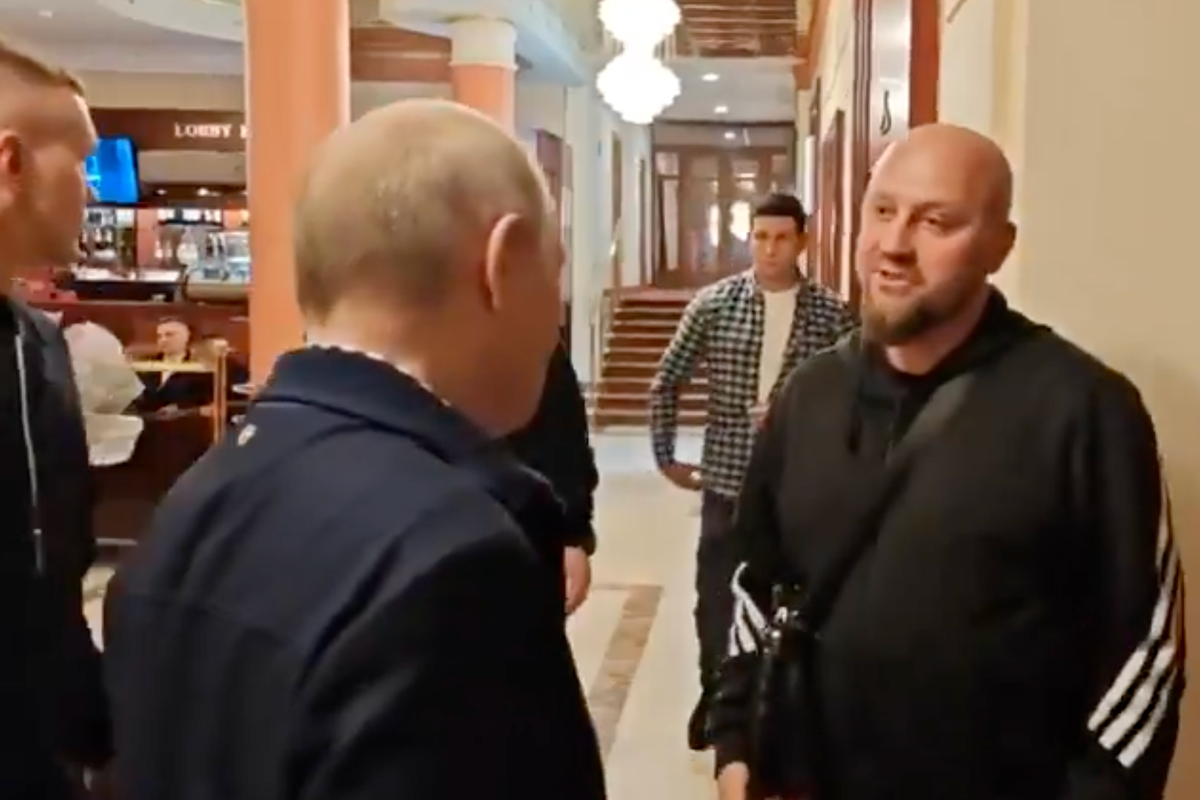
The recent circulation of video content depicting Vladimir Putin in a seemingly spontaneous, informal engagement with the Russian public operates on a calculated logic of "managed authenticity." In autocracies where centralized control over the media landscape is absolute, the production of "casual" or "dressed-down" encounters serves as a critical counter-weight to the perceived rigidity of the state apparatus. These events are not errors in judgment or bizarre anomalies; they are deliberate applications of the Visibility-Accessibility Paradox.
The paradox posits that as a leader accumulates more centralized power, they must work exponentially harder to appear accessible to the base of the power pyramid to mitigate the risk of elite-populace decoupling. The "bizarre" nature often noted by Western observers stems from a mismatch between the intended domestic signaling and the external perception of the artifice. By deconstructing the staging, the participant selection, and the semiotics of the "dressed-down" aesthetic, we can map the structural goals of the Kremlin’s internal communication strategy.
The Triple-Layer Framework of Controlled Public Engagement
To understand why a world leader would engage in a clearly choreographed "informal" video, one must evaluate the three primary operational layers of the Kremlin's PR machine.
1. The Proximity Signal
The first layer is purely functional: proof of physical presence and cognitive vitality. In a political system where the leader’s health is a matter of national security and market stability, high-definition video of "random" interaction acts as a proof-of-life protocol. The choice of a "dressed-down" appearance (often involving expensive but understated western-style leisure wear) signals a relaxed confidence. This is a deliberate shift from the "Strongman" archetype toward the "Stabilizer" archetype.
2. The Filtered Feedback Loop
Authentic public sentiment is volatile. The "staged" encounter creates a controlled vacuum where the leader can be seen "listening" to the grievances of the populace without the risk of an unscripted confrontation. The participants in these videos typically represent specific demographic buckets:
- The Loyal Proletariat (factory workers or farmers)
- The Patriotic Youth (students or young professionals)
- The State-Dependent Elder (pensioners)
By using pre-vetted individuals—often identified by investigators as recurring "extras" or security personnel—the state ensures the "questions" asked are actually prompts that allow the leader to deliver pre-packaged policy wins.
3. The Deniability of Elitism
As the Russian economic landscape shifts under the weight of international sanctions and the redirection of capital toward the defense sector, the optics of the "Billionaire Tsar" become a liability. Dressed-down encounters are a tactical deployment of performative austerity. They attempt to bridge the gap between the Kremlin’s internal opulence and the reality of the Russian provincial experience.
Semiotic Analysis of the "Bizarre" Aesthetic
External observers frequently label these videos "bizarre" because they violate the conventions of democratic retail politics. In a democracy, a politician at a diner is judged by their ability to blend in. In the Russian model, the leader is never intended to blend in; he is intended to descend.
The spatial dynamics of these videos reveal the intent:
- The Buffer Zone: Even in "informal" settings, there is a measurable physical distance maintained between Putin and the public. This reinforces the hierarchy even while pretending to flatten it.
- The Reactionary Silence: The public participants often exhibit a frozen, reverent posture. This creates a visual tension that signals to the viewer that they are witnessing an audience with a sovereign, not a chat with a neighbor.
- The Lighting and Audio Divergence: Frequently, the audio quality of the leader is studio-grade, while the public’s audio is ambient and muffled. This technical discrepancy betrays the artifice, highlighting that only one voice in the room is meant to carry authority.
The Strategic Cost Function of Optical Artifice
The Kremlin accepts the "bizarre" label from the West as an acceptable cost for domestic stability. This decision-making process can be viewed through a Risk-Utility Matrix.
| Variable | Low-Risk (Staged) | High-Risk (Organic) |
|---|---|---|
| Information Control | Total: Scripts are followed. | Minimal: Potential for heckling. |
| Safety/Security | Guaranteed: All participants are vetted. | Compromised: Requires massive footprint. |
| Domestic Perception | High: Signal of stability and order. | Variable: Signal of potential chaos. |
| International Perception | Low: Seen as "fake" or "bizarre." | High: Seen as "brave" or "authentic." |
The Kremlin consistently prioritizes Information Control and Safety over International Perception. The utility of an organic encounter is near zero for a leader whose legitimacy is derived from the appearance of absolute control. Conversely, the risk of an organic encounter—where a citizen might ask about the human cost of the front lines or the price of groceries—is an existential threat to the narrative of "managed democracy."
The "Recurring Extra" Problem: A Breakdown of Systemic Failure
A significant point of failure in these videos is the repeated use of the same individuals across different geographic locations and events. This phenomenon is not necessarily a sign of incompetence, but rather a byproduct of Institutional Path Dependency.
Within the security apparatus (FSB/FSO), the primary KPI (Key Performance Indicator) is "Zero Incident Rate." To achieve this, the security detail utilizes "trusted civilians"—often off-duty officers or state employees—to fill the roles of "random citizens."
The logistical bottleneck occurs because:
- Trust is non-transferable: A citizen trusted in Moscow is not easily replaced by a "trusted" citizen in a remote province on short notice.
- The Vetting Lag: Properly vetting a truly random citizen takes weeks of surveillance and background checks, which is incompatible with the fast-paced news cycle of the modern era.
- Bureaucratic Inertia: Once a "pool" of reliable extras is established, the administrative path of least resistance is to reuse them, despite the high probability of digital identification by OSINT (Open Source Intelligence) researchers.
This creates a "uncanny valley" effect where the video feels real enough for the casual television viewer in a rural province but is immediately debunked by the digitally native urban population.
The Shift from "Action Hero" to "Paternal Caretaker"
Historically, Putin’s public image relied on the "Action Hero" trope: shirtless hunting, judo matches, and piloting aircraft. The transition to "dressed-down" public encounters reflects a shift in the state's Psychological Operations (PsyOps) strategy.
The "Action Hero" phase was designed to project strength to a post-Soviet nation seeking a savior. The current "Paternal Caretaker" phase is designed to project calm to a nation in a state of prolonged conflict. The informal video is the medium for this message. It suggests that despite the geopolitical storm, the leader is so comfortable that he can stop for a casual chat.
The mechanism at work is Affective Priming. By showing the leader in a soft-lit, informal setting, the state attempts to prime the viewer to feel a sense of normalcy. The "bizarre" elements—the stiff acting of the bystanders or the unnatural dialogue—are secondary to the emotional "vibe" of the scene.
Intelligence Implications of the Staged Video
For analysts, these videos are less valuable for what they show and more valuable for what they hide. By analyzing the frequency and location of these "staged" events, we can infer the Kremlin's internal polling data.
- Geographic Clustering: If "informal" videos are suddenly concentrated in a specific region, it indicates a perceived "enthusiasm gap" or rising dissent in that locale.
- Thematic Focus: If the leader is suddenly "spontaneously" discussing egg prices or housing subsidies with a "random" grandmother, it signals that the internal data shows these issues are reaching a boiling point among the populace.
- The Proximity of the Elite: The absence or presence of specific ministers in the background of these "casual" shots indicates who is currently in the "Inner Circle" and who is being distanced from the populist brand.
Strategic Recommendation: Countering the Managed Narrative
To effectively neutralize the impact of managed optics, the counter-strategy must focus on the Infrastructure of the Lie rather than the content of the video.
The tactical play is to aggressively map and publicize the identities of the "random" participants in real-time. By turning the "random citizen" into a "known state asset" via digital fingerprinting, the state’s attempt at performative authenticity is converted into a liability. Each "bizarre" video becomes a data point proving the leader's isolation.
The goal is not to convince the core supporters that the video is fake—they likely already suspect it—but to increase the Cynicism Coefficient of the undecided middle. When the public views every "casual" interaction through the lens of a production budget rather than a policy shift, the leader’s ability to use the populace as a rhetorical shield is effectively dismantled. The move is to force the Kremlin back into the "Strongman" silo, where they are more predictable and more easily categorized as an externalized threat rather than a domestic partner.