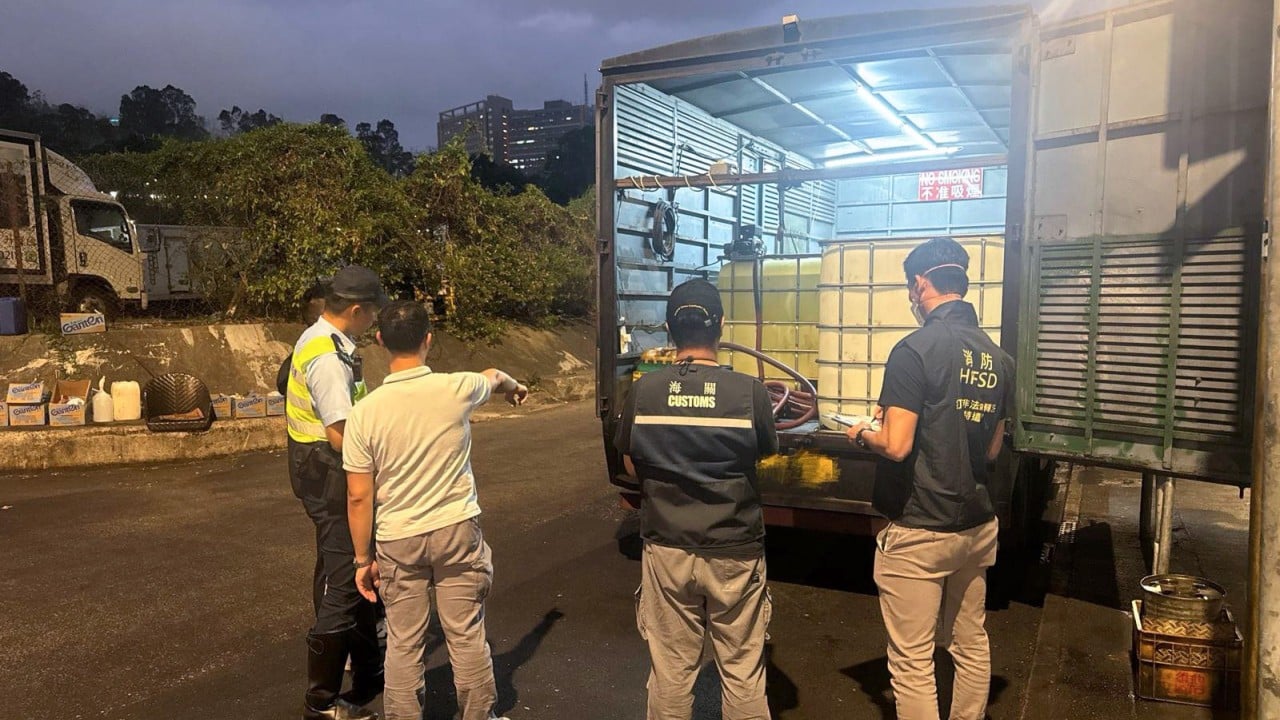
The seizure of 8,000 litres of illicit fuel in Hong Kong, valued at approximately HK$250,000, is not merely a localized criminal event but a symptom of a persistent price arbitrage market created by high taxation and specialized industrial demand. This specific intervention highlights a sophisticated "filling station on wheels" model designed to bypass the $HK$6.06$ per litre duty currently levied on leaded petrol and the regulatory oversight governing Euro V diesel and ultra-low sulfur diesel (ULSD). To understand the significance of this HK$250,000 bust, one must deconstruct the economic incentives, the technical distribution risks, and the regulatory framework that makes such high-volume transport a viable, albeit illegal, business model.
The Economic Engine of Fuel Smuggling
The illicit fuel trade operates on a fundamental Cost-Arbitrage Function. In Hong Kong, the pump price for diesel remains among the highest globally due to a combination of land costs, oil company margins, and government duties. The profitability of an 8,000-litre haul is calculated by the delta between the "marked oil" (industrial or marine diesel) or smuggled mainland diesel and the retail price of legal road-use diesel.
- The Duty Differential: Since industrial diesel (often referred to as "red oil" due to the dye added for identification) is either duty-free or taxed at a significantly lower rate, the profit margin per litre can exceed HK$5 to HK$8.
- The Volume Threshold: A seizure of 8,000 litres represents a gross market value of HK$250,000, but the operational cost—acquisition of the fuel, vehicle maintenance, and driver risk—is likely less than 40% of that value. This creates a high-reward environment where even frequent seizures are viewed as a "tax" on a highly lucrative shadow enterprise.
- The Capital Risk: The loss of the tank wagon and the arrest of the 40-year-old driver represent the primary capital hits to the syndicate. However, in these operations, the vehicle is often an older model with low book value, ensuring the sunk cost remains manageable relative to the potential turnover of multiple successful deliveries.
The Three Pillars of Illicit Distribution Logistics
The Hong Kong Customs and Excise Department’s intervention in the New Territories underscores a tactical shift toward mobile distribution. Syndicates have abandoned static, easily raided warehouses in favor of a dynamic supply chain.
1. Mobile Infrastructure Displacement
The use of a modified heavy vehicle as a mobile filling station serves a dual purpose: evasion and proximity. By positioning the vehicle near industrial estates or transport hubs, the syndicate reduces the "last-mile" risk for their customers—typically heavy goods vehicle (HGV) drivers or construction equipment operators looking to lower their overhead.
2. Technical Bypassing of Safety Standards
The 8,000 litres were not merely being transported; they were being dispensed using hidden pumping equipment. This equipment lacks the mandatory fire-suppression systems, vapor recovery units, and grounding mechanisms required at legal petrol stations. The technical risk involves:
- Static Discharge: The rapid flow of fuel through non-certified hoses creates a high probability of static buildup.
- Vapor Accumulation: In the humid, dense environment of Hong Kong’s industrial pockets, the lack of vapor recovery turns the distribution site into a literal powder keg.
3. Supply Chain Anonymity
Illicit fuel is often sourced through two primary channels: the diversion of "marked" oil intended for marine use and the cross-border smuggling of diesel from mainland China, where price caps and different tax structures create a permanent price floor lower than Hong Kong’s market rate.
The Fire Services Ordinance and Regulatory Friction
The arrest was made not only under the Dutiable Commodities Ordinance but also the Fire Services (Control of Dangerous Goods) Regulations. This dual-track enforcement strategy is critical for several reasons.
The Dutiable Commodities Ordinance focuses on the fiscal loss to the government. When 8,000 litres are seized, the government is essentially recovering a projected revenue loss of nearly HK$50,000 in unpaid duties (assuming a petrol-equivalent duty rate, though diesel rates vary based on sulfur content and specific use).
The Fire Services Ordinance addresses the public safety externality. Under Hong Kong law, any person storing or transporting "Category 5" dangerous goods (substances with a low flash point like diesel and petrol) exceeding the exempt quantity—typically 2,500 litres for diesel—without a valid license faces severe penalties. By exceeding this limit by over 300%, the syndicate shifted the offense from a financial crime to a significant public safety threat, which carries higher custodial sentences and more aggressive asset forfeiture possibilities.
Structural Vulnerabilities in the Monitoring System
The persistence of these "filling stations" suggests a bottleneck in the tracking of fuel from source to end-user. The mechanism of failure usually occurs at the wholesale level, where bulk fuel intended for legitimate industrial or marine use is "bled off" into the illicit market.
- The Decolorization Process: If the fuel was "red oil," it requires chemical stripping of the dye to pass a visual inspection by authorities. This process often involves the use of sulfuric acid, which leaves contaminants that can damage modern Euro VI engines.
- Detection Lag: Customs officials rely on intelligence-led operations because the physical footprint of a mobile tanker is indistinguishable from legitimate logistics until the dispensing equipment is deployed.
- The Economic Incentive for End-Users: For a logistics company operating a fleet of 20 trucks, saving HK$5 per litre across 8,000 litres represents a HK$40,000 reduction in weekly operating costs. This creates a powerful, recurring demand that ensures supply will reappear shortly after a seizure.
Quantifying the Environmental and Mechanical Impact
While the legal focus remains on duty evasion and fire safety, the hidden cost of this 8,000-litre seizure lies in environmental degradation and engine longevity. Illicit fuel rarely meets the Euro V or Euro VI standards mandated in Hong Kong.
- Sulfur Content: Smuggled or diverted fuel often has a sulfur concentration exceeding 50 parts per million (ppm), whereas Hong Kong’s legal limit for road diesel is 10 ppm.
- Particulate Matter: The combustion of sub-standard fuel increases the emission of $NO_x$ and particulate matter ($PM_{2.5}$), directly impacting the air quality of the densely populated New Territories.
- Engine Degradation: The absence of high-quality additives and the presence of residual dyes or acids from the "cleaning" process lead to fuel injector clogging and the premature failure of Selective Catalytic Reduction (SCR) systems in modern trucks.
Tactical Realignment for Enforcement
The seizure of HK$250,000 worth of fuel is a significant operational success, but it indicates a need for a shift from "seizure-at-rest" to "upstream-interdiction."
Customs must prioritize the digital auditing of "marked oil" wholesalers. By utilizing blockchain-based or high-security chemical markers that cannot be stripped by basic acid washes, the source of the 8,000 litres could be traced back to the specific terminal where the diversion occurred. Furthermore, increasing the penalties for the purchasers of illicit fuel—not just the drivers of the tankers—would dampen the demand side of the equation.
The current strategy of targeting the mobile distribution nodes is necessary for immediate public safety, but it addresses the symptoms rather than the arbitrage mechanism. Until the price delta between industrial and road-use fuel is narrowed, or the tracking of bulk fuel is digitized at every transfer point, the New Territories will remain a high-frequency zone for these mobile, high-risk enterprises.
The immediate tactical play for authorities is the expansion of the "Dangerous Goods" classification to include a broader range of modified vehicles, allowing for vehicle impoundment on suspicion of modification rather than waiting for the act of dispensing fuel to occur. This would increase the capital risk for syndicates, potentially pushing the cost-arbitrage function into a territory where the risk outweighs the HK$250,000 reward.