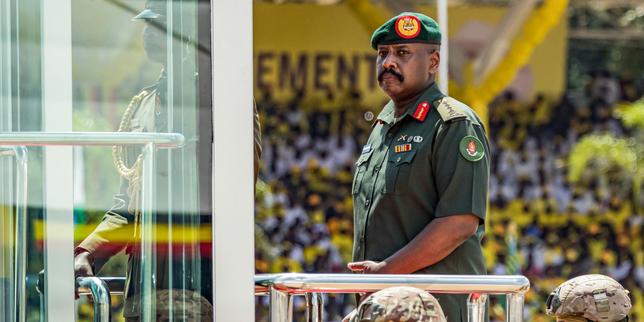
General Muhoozi Kainerugaba sits at the sharpest fault line of Ugandan power, blending military command, unpredictable social media outbursts, and a contested push to succeed his father, President Yoweri Museveni. For decades, Kampala’s political theater followed a familiar script in which Museveni kept rivals off balance while grooming no official heir. Kainerugaba has blown up that ambiguity in public view, pairing top posts inside the Uganda People’s Defence Forces (UPDF) with fiery online declarations aimed at a 2031 presidential run. Watching him up close means separating reckless bravado from hard institutional muscle.
The French headline that sparked this piece frames him as a brutal and whimsical heir who lops off any head that rises too high. That caricature captures a real edge of his reputation. Yet treating Kainerugaba purely as an erratic prince misses the deeper mechanics holding Uganda’s state together—and straining it from within.
How Military Command Became a Political Launchpad
Power in post-1986 Uganda has always run through the barracks. Museveni came to office through the bush war of the National Resistance Army, and every major political bargain since has rested on loyalty within the security apparatus. By moving Kainerugaba through the Special Forces Command, land forces, and into the role of Chief of Defence Forces in March 2024, the presidency concentrated real coercive weight in his hands.
Commanding troops is not the same as commanding a party coalition. Inside the ruling National Resistance Movement, long-serving politicians and veteran officers have watched the rise of the Patriotic League of Uganda—rebranded from the earlier MK movement—with a mix of calculation and unease. Some see a generational bridge. Others see a shortcut that bypasses hard-won seniority and institutional rules.
Even Kainerugaba’s own public signals have swung sharply. In early November 2026, he posted on X that his time as Chief of Defence Forces was nearing an end and spoke of dedicating himself to Christ after handing over the office, only to follow up with remarks suggesting he would stay around longer and vow days later that nobody would stop his bid for the presidency after his father in 2031.
A general who announces his exit, hints at spiritual retreat, and pledges a future presidential campaign within days keeps allies guessing and opponents off guard.
That whiplash is a feature of his political style, not an accident. Ambiguity forces rivals to react to rumors rather than organize around a single target. Still, volatility carries a cost when you lead a national army whose doctrine depends on chain-of-command discipline.
Social Media Firestorms and Diplomatic Blowback
Few senior officers anywhere in the world conduct statecraft and personal grievances quite like Kainerugaba on X. Over the years, his posts have veered from geopolitical musings and neighborly provocations to sharp attacks on domestic figures, including Vice President Jessica Alupo over alleged plot links involving former deputy Lt Gen Peter Elwelu, followed by threats of ten-year prison terms for foreign media outlets deemed insulting to his family or uncle, Gen Salim Saleh.
Defenders and military spokespeople frequently brush off such posts as banter, jokes, or online remarks blown out of proportion by critics. That defense wears thin when the poster commands the armed forces. Words spoken by the head of the UPDF carry state weight whether a press officer calls them casual or not.
Consider a hypothetical example to see how quickly digital bluster collides with real-world diplomacy. Suppose a senior general posts an off-the-cuff threat against a neighboring capital or a foreign correspondent during a tense border dispute. Even if diplomats later walk the comment back, traders, intelligence services, and regional mediators still price the risk into their decisions. In East Africa, where cross-border trade routes, rebel movements, and security pacts are tightly woven, loose rhetoric travels faster than official communiques.
Over the years, figures like Gen Salim Saleh have often played the quieter, stabilizing card behind the scenes when tensions flared. That contrast highlights a central tension inside the first family: pragmatic containment versus confrontational display.
The Overlooked Fault Lines Inside Kampala
Most coverage of Uganda’s succession focuses on two questions: will Museveni step aside, and can Kainerugaba inherit the crown? Those questions matter, yet they overlook three quieter pressures that will shape whatever happens next.
- Institutional friction inside the state: A succession built around personal loyalty rather than durable laws strains civil service norms, judicial independence, and party discipline. When security organs become the primary arena for settling political disputes, civilian institutions lose breathing room.
- The weight of human rights allegations: Critics, opposition figures such as Bobi Wine, and rights monitors have raised grave allegations of abductions, unlawful detention, and abuse linked to security operations over the years, with Kainerugaba’s camp rejecting involvement. Unresolved grievances of that kind linger in public memory long after elections or reshuffles pass.
- Impersonation and information chaos: Even fake accounts and parody pages trading on family names or military imagery—such as bogus profiles using the name of Kainerugaba’s son, Second Lieutenant Ruhamya Kainerugaba, to target officials—muddy an already noisy information space. When official accounts are combative and unofficial ones are deceptive, ordinary citizens struggle to tell policy from noise.
There is also a genuine gray area in how outsiders read Kampala. Foreign commentators often assume Uganda is headed for an immediate, dramatic rupture. History suggests a slower grind is just as likely: incremental power shifts, backroom bargaining among veterans, selective concessions, and prolonged uncertainty rather than a sudden collapse.
What Observers Should Watch Between Now and 2031
Tracking Kainerugaba’s trajectory requires looking past viral screenshots to tangible power markers. Watch who actually holds key command posts inside the UPDF and intelligence services when leadership transitions occur. Watch how senior National Resistance Movement figures position themselves in regional and district politics.
Pay close attention to whether the Patriotic League of Uganda builds real grassroots organization or remains primarily a vehicle for personal mobilization. Most of all, watch how the state handles dissent, media scrutiny, and internal rivalries when pressure rises.
In Kampala, bluster wins headlines in a single afternoon. Control over guns, courts, budgets, and party networks decides who actually holds power when the curtain rises on the next chapter.