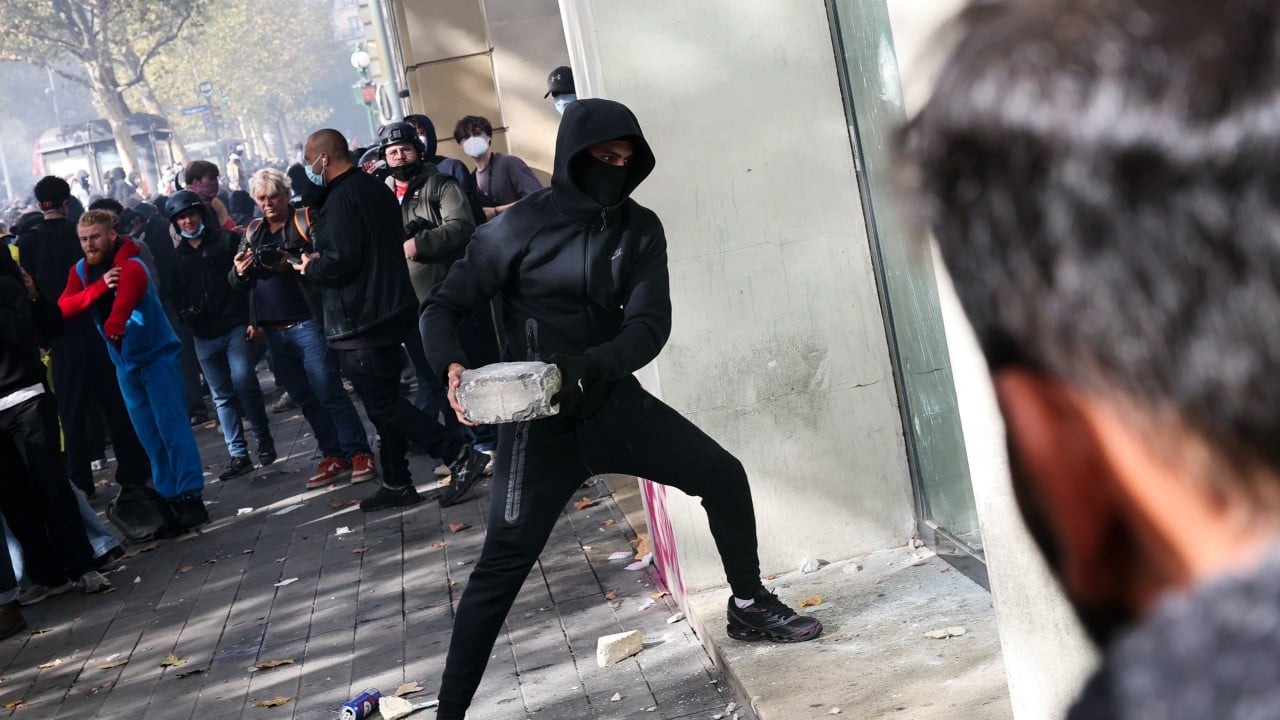
The iron shutters came down in a hurry. Along the Rue de Rivoli, the metallic screech of corrugated steel slamming against storefronts became the soundtrack of the afternoon, drowning out the usual chatter of café terraces. Shopkeepers didn't wait for orders. They watched the smoke rising two blocks away, felt the vibration of distant chants against the soles of their shoes, and grabbed whatever padlocks were closest.
Glass shatters differently when it happens to a livelihood. It is not the clean, cinematic pop of a bottle or a windshield. It is a dull, heavy crunch—thousands of tiny fragments giving way under heavy boots, followed immediately by the collective intake of breath from people who built their lives behind those panes.
Paris is a city built on the illusion of permanence. Its stone facades have stood through revolutions, world wars, and shifting empires. Tourists photograph the Haussmann balconies and romanticize the cobblestones, forgetting that beneath the postcard veneer lies a restless friction. When economic anxiety meets political fury, that friction ignites.
To understand what happened when the shops were smashed and the smoke filled the evening sky over France, you have to look past the cable news chyrons shouting about unacceptable violence. You have to look at the atmosphere that precedes the spark.
Consider a hypothetical shop owner named Marc. For twenty years, Marc has opened a small boutique selling leather goods near the Place de la République. He knows the weight of every hide, the name of every regular customer, and the exact toll of every tax hike. Marc is not a politician. He is not a billionaire whose holdings are spread across offshore accounts. He is a man with a ring of heavy brass keys and a ledger that keeps him awake at two in the morning.
When protests swell into riots, Marc becomes collateral damage in a war he never voted for. The slogans shouted outside his door are about pension reforms, purchasing power, and a fractured social contract. But the concrete blocks thrown through his display window do not discriminate between political philosophy and retail inventory.
Violence in urban spaces rarely arrives without a pedigree. It is cultivated by a slow, grinding erosion of hope. When inflation outpaces wages for consecutive years, when public services fray at the edges, and when citizens feel entirely detached from the levers of power, the street becomes the only amplifier left. The anger is real. The frustration is historic.
Yet, something breaks in the collective psyche when legitimate social grievances mutate into pure destruction. The line between protest and pillage is thin, guarded only by a shared social contract that assumes everyone agrees on the rules of engagement. Once a few storefront windows are breached with impunity, that contract evaporates. Opportunism floods in behind ideology.
The police response was swift, heavy, and inevitable. Batons raised, tear gas stinging the eyes of both rioters and innocent bystanders, sirens wailing in a chaotic chorus that echoed off the limestone walls. But tear gas does not settle economic inequality. It only clears the air temporarily, leaving behind a bitter residue and boarded-up windows.
By morning, the boulevard looked like a stage after the actors had gone home and the set had been struck. Sweepers pushed piles of shattered glass into gutters. Plywood replaced display windows. Tourists walked past with hesitant steps, smartphone cameras out, recording the scars of the previous night as if they were historic monuments.
The true cost of these clashes is rarely captured in the immediate casualty reports or the estimated property damage figures released by insurance associations. The cost is measured in the quiet retreat of trust. It is measured in the hesitation of a small business owner who wonders if renewing a lease is worth the risk. It is measured in the hardening of attitudes on all sides, where nuance is traded for slogans and dialogue is replaced by barricades.
France has a proud, turbulent history of taking to the streets to demand a better world. From 1789 onward, the French republic has defined itself through the willingness of its people to challenge authority. But there is a profound difference between challenging a regime and destroying the fabric of everyday community life.
The glass will be replaced. The graffiti on the limestone walls will be pressure-washed away. The cafes will reopen, and espresso will be served on the sidewalk once more.
Step outside tonight and listen closely to the quiet hum of the city after the crowds disperse. The underlying tension remains, waiting for the next spark, a reminder that peace in a modern metropolis is never guaranteed—it is merely leased, day by fragile day.