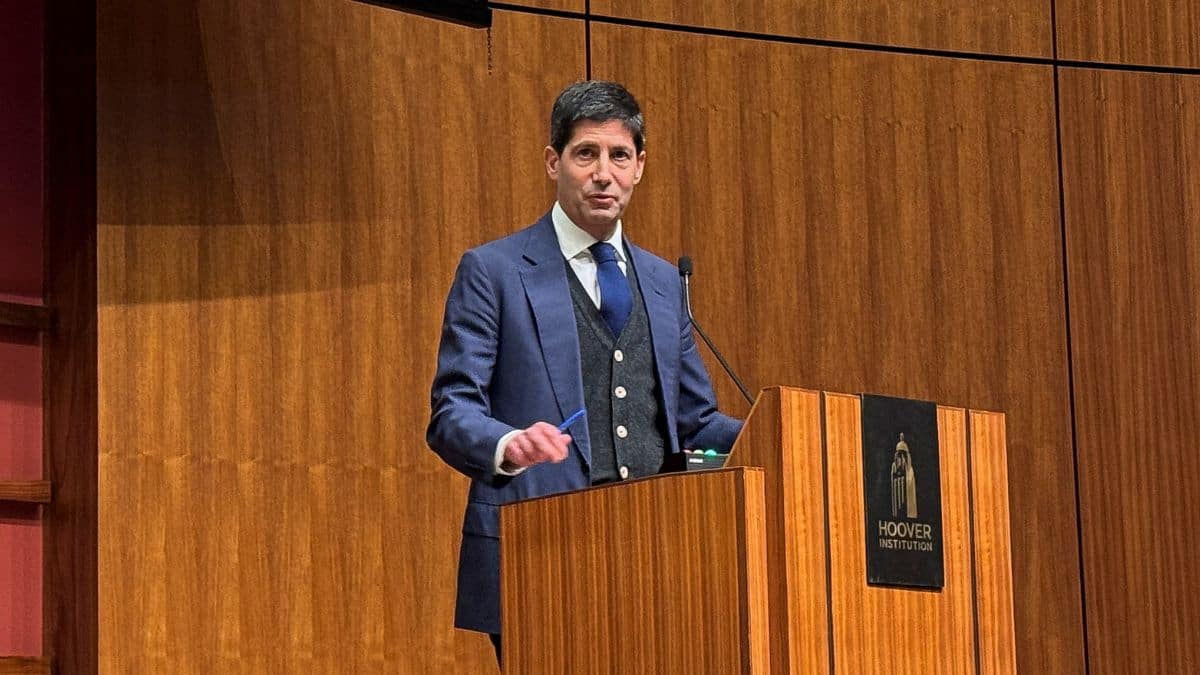
The formal nomination of Kevin Warsh to lead the Federal Reserve marks the end of an era and the beginning of a battlefield. On March 4, 2026, the White House officially sent Warsh’s name to the Senate, setting the clock ticking toward May 15, when Jerome Powell’s term expires. While the surface-level narrative focuses on a simple transition of power, the underlying reality is far more combustible. This is not just a change in personnel; it is a fundamental assault on the institutional independence that has defined American central banking for half a century.
Warsh, 55, arrives with the "central casting" seal of approval from a president who prioritizes aesthetic authority as much as policy alignment. Yet, the man entering the Eccles Building will find himself squeezed between a White House demanding aggressive rate cuts and a Senate Banking Committee that is currently a cage of political and legal maneuvering. The nomination is already hitting a wall in the form of Senator Thom Tillis, a North Carolina Republican who has vowed to block the process until a federal criminal investigation into Jerome Powell is settled.
The stakes go beyond the federal funds rate. At the heart of this transition is a plan to radically reshape how the Fed interacts with the U.S. economy, moving away from the "data-dependency" of the Powell years and toward a more aggressive, supply-side focused intervention.
The Warsh Doctrine
Kevin Warsh is often mislabeled. During his previous stint on the Fed board from 2006 to 2011, he was viewed as a hard-line inflation hawk. He famously resigned in protest over the second round of quantitative easing, fearing it would debase the currency and distort market signals. Today, however, Warsh has pivoted toward a "hawkish-dove" hybrid that serves the current administration's goals.
His primary thesis is that the U.S. is on the cusp of a productivity explosion driven by artificial intelligence. In his view, if the economy is becoming more efficient, the Fed can afford to lower interest rates without triggering a wage-price spiral. He argues that the central bank has been "looking at the wrong gauges," obsessing over labor market tightness while ignoring the deflationary power of technological shifts.
This intellectual shift provides a convenient bridge to the president’s demands. Trump has been vocal about wanting rates slashed by two to three full percentage points to "juice" growth. Warsh offers a sophisticated economic justification for doing exactly that.
The Balance Sheet Trade-Off
If Warsh is a dove on interest rates, he remains a predator regarding the Fed’s balance sheet. He has long criticized the "monetary dominance" of the central bank, arguing that its massive holdings of Treasuries and mortgage-backed securities have turned the Fed into a silent partner of fiscal expansion.
- The Strategy: Warsh intends to aggressively shrink the Fed's $7 trillion balance sheet.
- The Goal: By draining liquidity from the financial plumbing, he believes he can justify lower short-term borrowing costs for "Main Street" businesses and households.
- The Risk: This is a high-wire act. Rapidly offloading assets could spike long-term Treasury yields, effectively raising mortgage rates even as the Fed lowers the overnight rate.
The Shadow of the Treasury
The dynamic between Warsh and Treasury Secretary Scott Bessent is perhaps the most critical—and volatile—relationship in Washington. In early February, Bessent sat before a Senate committee and pointedly refused to rule out the possibility of the Justice Department investigating or suing a Fed Chair who failed to comply with presidential demands.
The threat was thinly veiled. While Trump later dismissed his comments about suing Warsh as a "roast" or a joke, the message to the nominee was clear: loyalty is the currency of the realm. Warsh is being positioned as a "bridge to Wall Street," but the bridge is being built under the constant threat of demolition by the executive branch.
Institutional Friction and the Tillis Blockade
The confirmation process is unlikely to be a coronation. Senator Tillis’s opposition stems from a $2.5 billion subpoena involving the Fed’s building renovations—a scandal that has become a convenient tool for those looking to delay or influence the leadership change. If Tillis holds his ground and attracts even a few more skeptily-minded Republicans or a unified Democratic front, the nomination could stall indefinitely.
This creates a vacuum. If a successor isn't confirmed by May, the Fed enters a period of unprecedented uncertainty. Under the law, the Vice Chair would step in, but the administration is already looking at ways to install a "shadow chair" or use temporary appointments to bypass a recalcitrant Senate.
Market Reality vs. Political Fantasy
The market reaction to the "Warsh Shock" has been telling. When the nomination was first signaled in late January, gold and silver prices plummeted, losing 9% and 26% respectively in a spectacular unwind of the "inflation hedge" trade. This suggests that despite his recent dovish rhetoric, the "smart money" still views Warsh as a man who will eventually tighten the screws on the money supply to protect the dollar's value.
Bitcoin, too, saw a massive drawdown, falling nearly 40% from its October 2025 highs. Investors are realizing that a Warsh-led Fed might be good for the "real" economy of factories and construction, but it could be lethal for the liquidity-driven bubbles of the digital and precious metal markets.
The End of Data Dependency
For the last decade, the Fed has operated on a philosophy of "wait and see." Jerome Powell made no move without a mountain of labor and CPI data to back him up. Warsh has openly mocked this approach, calling it "monetary junk food."
He favors a more intuitive, forward-looking policy that anticipates shifts in the global economy rather than reacting to the "weather" of monthly reports. This sounds bold, but it removes the objective guardrails that prevent the Fed from becoming a political tool. If the data no longer dictates policy, then the only thing left to dictate it is the person in the chair—and the person who put him there.
The transition from Powell to Warsh is not a simple passing of the baton. It is a fundamental rewriting of the contract between the central bank and the government. As the Senate hearings approach, the question is not whether Kevin Warsh is qualified—his pedigree is undisputed—but whether he can maintain the integrity of the institution while under a siege he was hired to lead.
Would you like me to analyze the specific impact of the Warsh nomination on long-term Treasury yields and the "term premium" for investors?