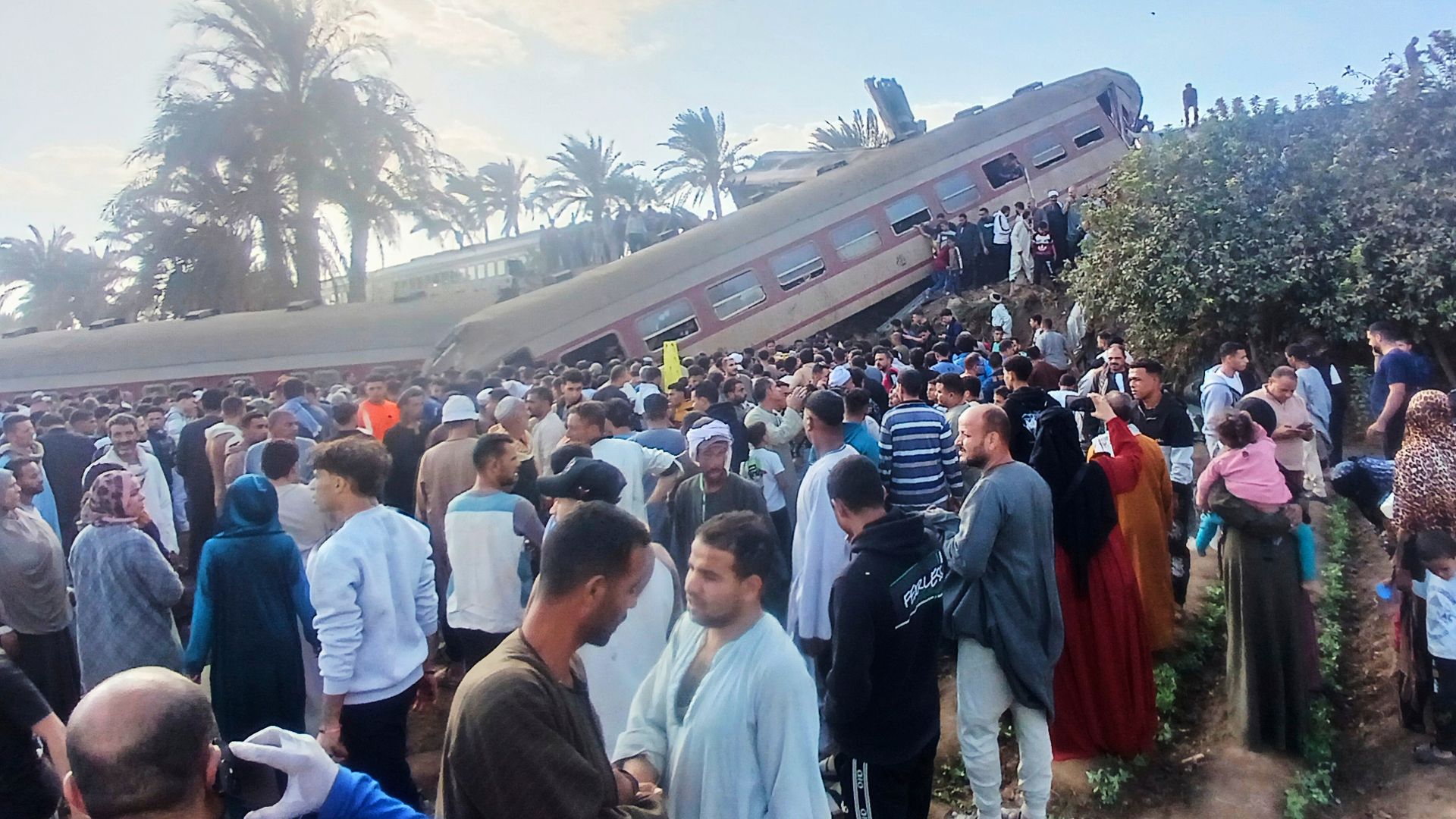
Seven people died and 114 suffered injuries when a passenger train collided with another train near Cairo, turning an ordinary morning commute on the Nile Delta corridor into another grim statistic for the Egyptian National Railways. The crash occurred along one of the most heavily trafficked rail arteries in the Middle East, where aging signaling hardware, human error, and chronic infrastructure bottlenecks routinely collide. While initial reports focus on the immediate wreckage and emergency response, the real story lies beneath the twisted steel—a decades-long structural failure to modernize a network that carries more than a million passengers every single day.
To understand how a modern rail network still suffers high-casualty collisions just miles from a major capital, you have to look past the press releases issued in the wake of every disaster. Officials routinely point to driver error or signal-box negligence. Those explanations are convenient. They isolate blame to a handful of low-level operators rather than confronting an institutional architecture designed around deferred maintenance, manual overrides, and extreme passenger density. If you found value in this article, you should read: this related article.
The Anatomy of a Corridor Under Extreme Stress
The rail lines radiating north and south from Cairo's Ramses Station are the circulatory system of Egypt. Unlike freight-heavy North American rail networks, the Egyptian National Railways (ENR) operates primarily as a mass-transit lifeline for working-class commuters, students, and agricultural traders. Tickets are heavily subsidized by the state, keeping fares artificially low to preserve social stability.
That subsidy model creates a fatal financial trap. When ticket revenues cannot cover basic operating expenses, let alone capital expenditure, maintenance gets pushed to the next fiscal year. Over thirty or forty years, "next year" becomes a permanent state of decay. For another look on this story, refer to the latest update from Associated Press.
Consider what happens on a track segment operating above design capacity. Steel rails experience constant metal fatigue from axle loads that exceed original engineering tolerances. Ballast—the crushed stone bed that holds wooden or concrete sleepers in place—degrades into dust if it is not periodically cleaned and tamped. When the track geometry shifts by even a few centimeters under the weight of a passing locomotive, the risk of a derailment or a delayed braking response spikes dramatically.
On the corridors leading out of Cairo, trains frequently share tracks across varying speed profiles. Express services, local commuter trains that stop every few kilometers, and slow-moving cargo consist all navigate the same narrow right-of-way. Keeping them apart requires split-second coordination. For decades, that coordination relied on mechanical semaphore signals and manual telegraph or telephone block systems operated by human signalmen stationed in brick towers along the tracks.
Why Modern Signaling Remains Half-Finished
In the aftermath of the crash near Cairo, investigators immediately zeroed in on how two trains ended up occupying the same block of track. In railway engineering, a block system divides a rail line into distinct sections, enforcing a strict rule that only one train may occupy a block at any given time.
Modern railways enforce this rule electronically through Automatic Train Protection (ATP) and centralized traffic control. Sensors embedded in the track detect the presence of a train's wheels, automatically flipping signals behind it to red and triggering emergency brakes in a following locomotive if the driver fails to slow down.
Egypt has spent billions of dollars over the past decade attempting to retrofit these exact electronic signaling systems onto its main trunk lines, working with major international engineering contractors and development banks. Yet the transition has created a dangerous hybrid environment.
The Danger of Partial Automation
When you upgrade a 5,000-kilometer rail network in pieces, you end up with seams—points where computerized electronic interlocking meets fifty-year-old mechanical levers. Worse, even on stretches where new electronic signals have been installed, full Automatic Train Control (ATC)—the onboard cab equipment that physically overrides a human driver—is often disabled, uncalibrated, or missing from older locomotives.
Drivers operating under pressure to maintain schedules frequently encounter false red signals caused by faulty track circuits or vandalized copper wiring. When a signal shows red because a sensor is broken rather than because a train is ahead, stationmasters issue written or verbal permissions to pass the signal at restricted speed.
Once bypassing red signals becomes a routine workaround to keep traffic moving, the psychological barrier against ignoring warnings collapses. A safety system that cries wolf ten times a day stops functioning as a safety system at all.
A Pattern Written in Twisted Steel
Anyone who has covered transport infrastructure in North Africa knows that the crash near Cairo is not an anomaly. It is part of a documented, recurring cycle that stretches back more than twenty years.
| Year | Location | Primary Cause Reported | Casualties |
|---|---|---|---|
| 2002 | Al Ayyat (South of Cairo) | Fire in overcrowded passenger carriages | Over 370 dead |
| 2012 | Manfalut (Asyut Governorate) | Crossing guard fell asleep; train hit school bus | 51 dead |
| 2017 | Alexandria | Rear-end collision due to signaling failure | 41 dead, over 170 injured |
| 2019 | Ramses Station, Cairo | Unmanned locomotive crashed into buffer stop | 25 dead, over 40 injured |
| 2021 | Tahta (Sohag Governorate) | Emergency brakes pulled; second train collided | 20 dead, nearly 200 injured |
| 2021 | Toukh (Qalyubia, North of Cairo) | Track maintenance and speed derailment | 23 dead, nearly 140 injured |
Look closely at the 2021 Sohag collision and the Toukh derailment just north of Cairo. Both happened after the government launched a massive multi-billion-dollar overhaul of the rail sector. In Sohag, passengers inside the lead train pulled the emergency brake valve, bringing the train to a halt on the main line. Because the signaling and communication architecture failed to alert the approaching train in time, a rear-end collision ensued at high speed.
The recent crash near Cairo echoes those exact vulnerabilities. Seven fatalities and 114 injuries represent a lower death toll than the catastrophic fires of 2002, largely because newer rolling stock features better crashworthiness and non-flammable interiors. The coaches buckled rather than disintegrating. Still, the underlying operational failure—two trains converging without an automated intervention—remains stubbornly unresolved.
The Human Factor Nobody Wants to Audit
Prosecutors in Egypt move swiftly after a rail crash. Within hours, train drivers, assistant drivers, and signalmen are typically arrested, detained, and subjected to drug screenings and criminal negligence charges. Accountability, in the official narrative, is swift and personal.
That approach misses the systemic reality of working inside the railway bureaucracy.
Consider the daily working conditions of a locomotive engineer or a signal-box operator on the Cairo commuter lines. Shifts routinely stretch past twelve hours due to chronic shortages of certified technical staff. Cabins in older diesel-electric locomotives are noisy, poorly ventilated, and vibrate violently, inducing severe sensory fatigue long before a shift ends.
Training protocols present another blind spot. Introducing digital signaling consoles and computerized diagnostic screens to a workforce trained on mechanical relays requires deep, continuous simulation training. Instead, operators are often given brief classroom orientations before being sent back onto live tracks carrying thousands of passengers.
When an exhausted driver makes a split-second misjudgment—or when a stationmaster authorizes a manual bypass to clear a backlog of delayed commuter trains—arresting the individual satisfies public anger. It does nothing to fix the organizational culture that forced the shortcut in the first place.
The Megaproject Paradox
To understand why basic commuter lines near Cairo remain vulnerable despite massive state spending on transportation, you have to examine where the capital is actually going.
Over the past decade, Egypt has poured tens of billions of dollars into showcase transit megaprojects. These include a brand-new high-speed electric rail network designed to connect the Red Sea to the Mediterranean, elevated monorail lines linking Cairo to the New Administrative Capital, and expansions to the Cairo Metro.
On paper, these projects look visionary. They attract international financing, utilize pristine European rolling stock, and operate on dedicated, grade-separated tracks free from pedestrian crossings and decades-old baggage.
Yet building a shiny new high-speed line in the desert does not fix the legacy tracks running through the densely populated Nile Delta. In fact, it often starves the legacy system of its best engineers, senior managers, and administrative focus.
Legacy Tracks vs. Greenfield Projects
Building a greenfield rail project—laying tracks across empty land where no railway previously existed—is an engineering challenge, not an operational nightmare. Contractors work uninterrupted. Nothing is running while they build.
Upgrading a brownfield network like the Cairo commuter lines is infinitely harder. You are trying to replace the signaling cables, rebuild the track bed, and renovate the stations while hundreds of trains roll through the work zone every twenty-four hours. If you shut down a line for six months to do the work properly, millions of low-income workers lose their only affordable way to reach their jobs in Cairo.
Because the state cannot afford the political fallout of shutting down commuter lines, contractors are forced to work in brief, fragmented overnight windows. Progress crawls. Temporary signaling workarounds stay in place for years instead of weeks. The very period meant to make the railway safer becomes its most hazardous phase.
The Unseen Hazards Along the Right-of-Way
Even if every signal box near Cairo were upgraded tomorrow and every driver rested for ten hours before a shift, the physical environment surrounding Egyptian tracks would still generate constant emergencies.
Unlike modern European or Japanese rail corridors that are sealed behind concrete walls and acoustic fencing, large stretches of the rail network around Cairo run directly through dense urban neighborhoods and agricultural villages.
- Informal Crossings: Residents routinely knock holes in perimeter walls to create shortcuts across the tracks for pedestrians, motorcycles, and donkey carts.
- Unprotected Level Crossings: Hundreds of official road crossings lack automated boom barriers, relying instead on manual chains operated by guards who have no direct radio link to approaching locomotives.
- Debris and Encroachment: Markets, trash dumps, and construction sites spill right up to the edge of the ballast, obstructing sightlines around curves.
Every time a driver spots a vehicle stalled on an informal crossing, they must slam the train into emergency braking. Emergency braking from 100 kilometers per hour puts immense thermal and mechanical stress on brake shoes, wheels, and couplers. It also creates sudden, unscheduled stops on the main line—the exact scenario that leaves a stationary train exposed to a rear-end collision if the signaling system behind it has a blind spot.
What Real Railway Reform Actually Requires
Buying new locomotives and painting station platforms creates the visual impression of modernization. True rail safety is invisible to the passenger. It lives in maintenance logs, redundant sensor loops, and a safety culture that rewards reporting flaws rather than hiding them.
If the Egyptian National Railways wants to break the cycle of crashes near Cairo, three structural shifts are non-negotiable.
First, full end-to-end activation of Automatic Train Control must take precedence over timetable adherence. A modern signaling system cannot be treated as advisory. If a track circuit fails or an onboard cab computer malfunctions, the train must be held until the fault is cleared—even if it delays ten thousand commuters. Accepting delays is the price of eliminating collisions.
Second, independent accident investigation must be separated from criminal prosecution. In global aviation and top-tier rail networks, safety investigators operate under strict non-punitive mandates. Operators are granted immunity from criminal charges in exchange for total honesty about why a procedure was bypassed or why a signal was misread. As long as Egyptian railway workers know that admitting a systemic flaw leads straight to a prison cell, they will hide broken equipment and falsify logbooks until the next crash forces the truth into the open.
Third, capital allocation must tilt back toward core maintenance. Replacing worn switches, re-ballasting unstable track beds, and sealing the urban right-of-way near Cairo lack the ribbon-cutting glamour of a new monorail. They are expensive, disruptive, and politically unsexy.
Until the unglamorous work of basic track maintenance and non-punitive safety auditing takes priority over ribbon-cutting ceremonies, the rails leading into Cairo will remain a gamble for everyone who steps aboard.