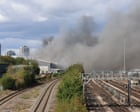
High-capacity urban transit systems operate on narrow margins of redundancy, where a single localized hazard can trigger systemic network degradation. The recent large fire near Wembley Stadium demonstrates how physical infrastructure proximity to critical transit corridors creates catastrophic single points of failure. When a major industrial or commercial fire erupts adjacent to national rail lines and underground transit arteries, the immediate tactical response requires an absolute cessation of movement to prevent structural, thermal, and electrical hazards from compromising passenger safety.
Urban transit resilience depends on spatial separation and asset hardening. When an external combustion event breaches the protective buffer zones of a major transport hub like Wembley, network operators face an immediate forced choice between throughput maintenance and life safety protocols. This analysis deconstructs the operational mechanics, economic shockwaves, and systemic risk factors exposed by infrastructure-adjacent fires in metropolitan transport corridors.
The Three Vectors of Transit Disruption
Network paralysis during a major fire event does not happen through a single mechanism. It is the simultaneous compounding of three distinct operational vectors: thermal safety thresholds, electrical isolation protocols, and regulatory emergency mandates.
- Thermal and Structural Integrity Risk: Railway infrastructure relies on precise tolerances for steel tracks and overhead electrification gantries. Intense convective and radiant heat from nearby structures alters the metallurgical properties of rails, risking warping and catastrophic derailment. Engineering standards dictate that track exposure to sustained high heat requires direct physical inspection before load-bearing operations resume.
- Grid Isolation and Traction Power Termination: Firefighting operations involving high-pressure water streams and conductive foam require absolute de-energization of the surrounding area. Third-rail power systems and overhead catenary lines carrying thousands of volts must be grounded to protect emergency response personnel. This strips the network of its primary operational energy source across multiple block sections.
- Visibility and Atmospheric Contradictions: Dense smoke plumes reduce locomotive engineer visibility below operational safety thresholds. Furthermore, particulate accumulation within subterranean tunnel ventilation intakes forces the automated reversal or shutdown of ventilation fans, inadvertently pulling smoke into passenger concourses and subterranean platforms.
These three vectors interact non-linearly. A localized thermal event does not merely pause traffic within the affected square kilometer; it breaks the signaling block chain, desynchronizes rolling stock allocation rosters across the national network, and strands thousands of commuters at terminal nodes miles away from the incident site.
Network Topology and Bottleneck Amplification
Wembley functions as a critical multi-modal transit nexus, integrating heavy rail national lines with high-frequency underground metropolitan services. The architectural layout of such hubs creates inherent vulnerability to localized disruptions.
Heavy rail corridors entering major urban centers typically feature high track utilization rates. During peak operational windows, headway between trains drops to minimal timeframes. When an incident forces an emergency blockade, the upstream accumulation of trains creates a kinetic traffic jam. Dispatchers must hold incoming services at distant junctions, exhausting platform capacity across the entire regional grid.
The underground segments face a complementary set of constraints. Evacuation modeling assumes that station egress routes operate independently of external hazards. When an external fire occurs near primary surface-level ventilation shafts or station entrances, crowd control protocols force the inversion of normal pedestrian flows. Commuters are held within concourse levels or diverted outward into congested street grids that are simultaneously experiencing emergency vehicle influx.
[External Fire Event]
       │
       ├──> [Thermal Radiation] ──> Track Warping Risk ──> Mandatory Speed Restrictions / Halt
       ├──> [Firefighting Ops]   ──> Traction Power Cut  ──> Complete Electrification Loss
       └──> [Smoke / Particulates] ──> Ventilation Shutdown ──> Station Egress & Access Blockade
The Economic Cost Function of Unscheduled System Halts
Quantifying the economic impact of a sudden transit stoppage requires examining both direct operational losses and indirect productivity destruction. Network operators incur immediate costs through passenger refund liabilities, emergency bus bridging deployment, and asset remediation delays. However, these direct outlays represent a minor fraction of the total economic penalty.
The primary financial loss stems from the friction imposed on the regional labor market. Modern urban productivity relies on precise temporal synchronization. When an essential commuter artery is severed without advance notice, individual travel time variability spikes.
- Valuation of Delayed Time: Economic loss models calculate passenger delay costs by multiplying lost hours by the average regional hourly wage rate, adjusted for the proportion of knowledge-worker versus manual labor segments affected.
- Schedule Recovery Expenditure: Restoring timetable equilibrium requires deadheading empty rolling stock, paying overtime wages to displaced crew members, and managing rolling stock maintenance schedules that have been thrown out of sequence.
- Modal Shift Friction: Displaced commuters forced onto alternative bus networks or ridesharing platforms create secondary road congestion externalities, slowing down freight movement and emergency services across adjacent municipal zones.
Systemic Risk Management and Mitigation Limits
Mitigating the threat of external fires adjacent to critical transport links presents a persistent engineering challenge. Urban densification frequently places industrial, commercial, and residential structures within close proximity to legacy rail corridors.
Regulatory bodies mandate safety clear zones, but enforcement across aging metropolitan landscapes is uneven. Land use planning policies often fail to account for the compounding risk of high-density real estate development directly bordering critical national infrastructure. While operators maintain rigorous vegetation clearing protocols along tracks to prevent trackside brush fires, they possess zero jurisdictional control over the structural fire safety standards of third-party commercial buildings situated outside the railway boundary fence.
Physical barriers, such as fire-rated retention walls and automated deluge systems at high-risk interfaces, offer localized protection. Yet, deploying these countermeasures across hundreds of miles of urban rail network remains economically prohibitive. Consequently, network vulnerability to perimeter hazards remains an accepted structural residual risk of modern mass transit design.
Operational Redundancy Protocols
To neutralize the cascading effects of localized transport outages, regional operators rely on pre-engineered diversion algorithms and multi-modal routing agreements. When primary corridors fail, automated traffic management systems attempt to shunt regional express services onto secondary freight bypass lines.
However, these bypass routes frequently lack the electrification standards, signaling compatibility, or platform clearance required for high-frequency passenger rolling stock. The transition from a primary high-capacity artery to an auxiliary route inevitably results in a severe capacity reduction, often capping passenger throughput at a fraction of baseline operations.
Municipal authorities must therefore treat infrastructure-adjacent fire events not merely as local municipal emergencies, but as systemic shocks to regional economic output.
Strategic Infrastructure Hardening and Autonomous Routing
Modernize structural zoning laws within a one-kilometer radius of critical transport hubs to mandate advanced fire suppression systems in commercial and industrial facilities. Transition network management software toward decentralized, predictive rerouting architectures that isolate power grid dependencies during localized emergency interventions.