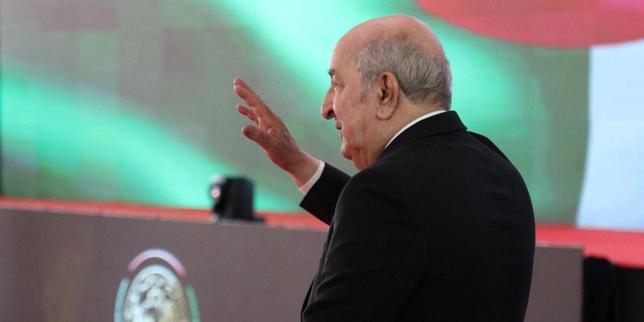
Abdelmadjid Tebboune has spent his first term and the opening of his second crafting a "New Algeria" that looks remarkably like the old one, only with a more concentrated center of gravity. While the 2019 Hirak protests demanded a total dismantling of the military-backed "system," the current administration has instead used the vacuum to pull every lever of state authority into the presidential office. This is not a mere continuation of the Bouteflika era; it is a more disciplined, technically efficient consolidation that has effectively sidelined the parliament, the judiciary, and the street.
The project is sold under the guise of stability and institutional reform. However, the reality on the ground in early 2026 suggests a regime that has traded the messy clan-based competition of the past for a vertical hierarchy where the presidency is the only relevant actor. By rewriting the constitution and adjusting electoral laws, Tebboune has ensured that while the military remains the ultimate guarantor of the state, the civilian facade is no longer a shared space. It belongs to one man.
The Constitutional Architecture of Control
The 2020 constitutional referendum was the first major brick in this new wall. On paper, it was presented as a response to the Hirak, promising a balance of powers and term limits. In practice, it hollowed out the legislature. The president now possesses the authority to appoint a prime minister from the parliamentary majority, but if no such majority exists, he simply appoints a "head of government" of his choosing. This clever semantic distinction ensures that the executive branch never loses its grip on the legislative agenda.
The parliament has devolved into a decorative body. While it retains the right to debate, its ability to initiate meaningful legislation or provide oversight of the executive is virtually non-existent. Most critical decisions are made via presidential decree or through "technical amendments" that bypass the broader democratic process. The recent 2026 push for further constitutional revisions, framed as "purely administrative," serves to tighten the mechanics of the Council of the Nation, ensuring that even the upper house remains a predictable echo chamber.
The Judiciary as an Administrative Tool
The transition from a Constitutional Council to a Constitutional Court was marketed as a leap toward the rule of law. Yet, the appointment process remains heavily weighted toward the presidency. When the executive branch selects the people who determine the constitutionality of its own actions, the concept of "checks and balances" becomes a theoretical exercise rather than a functional reality.
Independent journalists and human rights activists have felt the sharp edge of this "strengthened" legal framework. Since 2019, the use of Article 87-bis of the Penal Code—which defines terrorism in broad, often vague terms—has become the primary tool for silencing dissent. By labeling political activism as a threat to national security, the regime has moved beyond the "soft" censorship of the Bouteflika years into a more systematic, legally-sanctioned repression.
The Economic Rent and the Silence of the Masses
Tebboune’s survival and his "landslide" 84% re-election in late 2024 were not fueled by democratic fervor. They were bought with energy receipts. The surge in global oil and gas prices following the invasion of Ukraine provided the Algerian state with a massive windfall. This allowed the government to fund social peace: housing projects were completed, unemployment benefits for youth were introduced, and civil service salaries were hiked.
It is a classic rentier state maneuver. The government provides for the material needs of the population in exchange for their political apathy. The 2024 election turnout figures, which were initially reported at impossible levels before being revised downward under pressure from even the candidates themselves, told the real story. Over half the population simply did not show up. They are not convinced by the "New Algeria," but they are also not currently willing to risk the stability of the status quo for an uncertain revolution.
The Military Partnership
The most critical factor in this presidentialization is the evolving relationship between the Mouradia Palace and the Tagarins (the Ministry of Defense). Historically, Algeria was ruled by a "collegiate" system of generals who used the president as a civilian spokesman. Tebboune has managed to navigate this by positioning himself as the most reliable protector of the military's interests.
- Budgetary Expansion: The military budget has seen record increases, reaching nearly $22 billion in 2025.
- Institutional Integration: The presidency has integrated military figures into civilian administration more overtly than in previous decades.
- Shared External Enemies: Both the presidency and the High Command have leaned heavily into nationalist rhetoric regarding Morocco and the Western Sahara, using regional tensions to justify the centralization of power.
This is not a civilian takeover of the military; it is a partnership where the presidency has been granted more operational autonomy in exchange for safeguarding the military’s core privileges and the state’s security apparatus.
The Risk of the Empty Center
The danger of this hyper-presidentialization is that it leaves no room for error. When all power is concentrated in the presidency, every failure of the state—from a bread shortage to a water crisis—is laid directly at the feet of the head of state. By dismantling the "intermediary bodies" like labor unions, independent political parties, and a free press, Tebboune has removed the shock absorbers that usually protect a regime from popular anger.
The opposition is currently a ghost of its former self. Traditional parties like the FLN and RND have been "domesticated," serving as little more than cheering sections for the president. The Islamist opposition, led by the MSP, has been integrated into the system's periphery, given enough concessions to stay quiet but not enough power to lead.
This creates a brittle political environment. Without a functional parliament or a vibrant civil society, the only way for the people to communicate with their government is through the street. The Hirak was a warning that the "system" had become too rigid to listen. Tebboune’s response has been to build a more efficient, more centralized version of that same rigidity.
The "New Algeria" is currently a high-stakes gamble on the longevity of high energy prices and the continued loyalty of the security services. As the administration moves further into its second term with 2026 technical amendments, the facade of pluralism is fading. What remains is a system where the president is not just the head of the state, but its only functioning part. When the next economic downturn or social spark arrives, there will be no one else to blame, and no institutions left to mediate the fallout.
Would you like me to analyze the specific impact of the 2025 military budget on Algeria’s regional diplomatic standing?