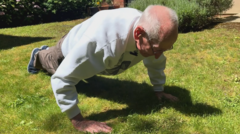
The human fixation on centenarians who perform daily physical feats relies on a comforting lie. When a 98-year-old claims that doing 40 push-ups every morning is the secret to their near-century of life, the public eagerly swallows the narrative because it implies control. It suggests that a simple, disciplined routine can bypass the brutal, systemic decay of aging. The reality is far less egalitarian. The elderly individual doing push-ups at 98 is not doing them to achieve longevity; they can do them because they were already genetically predisposed to survive that long in the first place.
We are looking at the ultimate example of survivorship bias. By focusing exclusively on the outlier who survived a lifetime of oxidative stress, cellular senescence, and telomere shortening, we ignore the graveyard of equally disciplined individuals who did their chores, ate their vegetables, and still died of heart disease at 65. To understand how some people maintain functional strength at an age when most are bedridden, we have to look past the surface-level morning routine. We must examine the biological lottery of exceptional aging.
The Genetic Fortress Below the Surface
Aging is fundamentally a breakdown of cellular maintenance. Every time a cell divides, the protective caps at the ends of our chromosomes, known as telomeres, lose a piece of their length. Eventually, these caps wear down completely, forcing the cell into a state called senescence. Senescent cells stop dividing, refuse to die, and begin pumping out inflammatory molecules that degrade surrounding tissue. This is the baseline reality for the vast majority of human beings.
Super-centenarians and those approaching the century mark possess a distinct biological advantage. Their bodies manage cellular waste differently. Researchers tracking long-lived cohorts have consistently identified specific genetic variants that alter metabolic pathways.
Consider the FOXO3 gene, often referred to as a longevity gene. Certain variations of this gene are heavily enriched in people who live past 95. This gene acts like a master switch for cellular defense, triggering the repair of damaged DNA, boosting antioxidant production, and accelerating autophagy, which is the body's method of clearing out damaged cellular components.
For a hypothetical example of how this plays out in real life, imagine two individuals. Both perform 40 push-ups every morning for forty years. Individual A possesses the standard suite of mammalian genes. By age 75, the accumulated micro-tears in their muscle tissue trigger chronic, low-grade inflammation that permanently degrades their joint cartilage and muscle mass. Individual B carries the favorable FOXO3 variant. Their cells clean up the metabolic debris from exercise overnight, allowing them to rebuild muscle fiber efficiently well into their nineties. Individual B did not earn their longevity through the push-ups; their longevity allowed the push-ups to continue.
Why Standard Exercise Metrics Break Down After Eighty
The physiological response to exercise changes drastically as the body crosses into advanced old age. In youth and middle age, progressive overload builds muscle. You stress the muscle, cause micro-trauma, and the body overcompensates by building thicker fibers.
In advanced age, a condition called sarcopenia takes hold. This is the progressive loss of skeletal muscle mass and strength, driven by a drop in anabolic hormones, a reduction in nerve signals traveling to muscles, and poor protein synthesis. After age 80, the body becomes resistant to the signals that normally trigger muscle growth.
[Standard Lifespan Aging Pathway]
Telomere Shortening -> Cellular Senescence -> Chronic Inflammation -> Sarcopenia -> Frailty

[Exceptional Longevity Pathway (FOXO3/APOE Variations)]
Enhanced Autophagy -> Maintained Telomeres -> Low Base Inflammation -> Preserved Neuromuscular Function -> Sustained Mobility
For the average 90-year-old, attempting a high-intensity upper-body routine like 40 consecutive push-ups is often a recipe for injury rather than a path to vitality. The rotator cuff muscles thin out, the bone density in the wrists decreases, and the skin loses its underlying collagen, making blood vessels prone to tearing under pressure.
When an exceptional outlier performs these exercises smoothly, it indicates an unusually well-preserved neuromuscular junction. The nerves feeding their muscles are still firing with high fidelity, preventing the muscle wasting that leaves others frail. This preservation is largely governed by the presence of specific neuroprotective proteins and low systemic inflammation, not the exercise itself.
The Invisible Interventions of Wealth and Environment
The narrative of the rugged, self-made centenarian ignores the heavy impact of socioeconomic scaffolding. It is easy to romanticize the image of an elderly person exercising in a modest home, but long-term survival requires a highly specific environment.
- Continuous Medical Surveillance: Minor infections or slight cardiovascular shifts that would kill an isolated elder are caught and treated immediately in a well-supported environment.
- Environmental Stability: Clean air, zero exposure to industrial toxins over a lifetime, and homes free of fall hazards significantly reduce accidental mortality.
- Nutritional Consistency: Access to high-quality, easily digestible proteins and micronutrients prevents the rapid nutritional deficiencies that common illnesses cause in older adults.
The ability to exercise consistently at age 98 requires decades of freedom from debilitating chronic illness, physical trauma, and heavy manual labor that destroys joints early in life. The daily push-up routine is a luxury allowed by a lifetime of systemic stability, not a magical shield that created that stability.
Changing the Focus from Longevity to Functional HealthSpan
The obsession with reaching 100 years of age distorts the true goal of preventive medicine, which should be the extension of healthspan—the period of life spent free from chronic disease and disability. Attempting to mimic the extreme routines of genetic outliers is a flawed approach to health.
Instead, modifying the rate of aging requires targeting the specific mechanisms of decline that affect the average population. This means managing metabolic health to prevent insulin resistance, protecting bone density through progressive resistance training suited to one's specific skeletal age, and maintaining cardiovascular elasticity.
Focusing on a arbitrary number of repetitions of a single exercise misses the bigger picture of systemic balance. For the average individual, a varied routine emphasizing balance, core stability, and lower-body strength yields much better protection against the primary driver of elderly decline: accidental falls. A broken hip at age 85 carries a one-year mortality rate approaching thirty percent due to the complications of prolonged immobility. The ability to stand up effortlessly from a chair is far more critical to survival than the ability to push one's weight off the floor.
The Limits of Self-Determination in Aging
We must abandon the comforting idea that we can completely control our expiration date through sheer willpower. The human body is a complex system subject to thermodynamics and biological limits. While poor lifestyle choices can certainly accelerate decay, making perfect choices does not guarantee an exceptional lifespan.
Accepting this reality changes how we approach daily health choices. We should stop viewing exercise as a transaction where we trade current effort for guaranteed future decades. Exercise matters because it preserves immediate function, reduces current systemic inflammation, and improves the immediate quality of life. The 98-year-old doing push-ups should be viewed as a biological marvel to observe, not a blueprint to copy. Your aging process will be uniquely your own, dictated by your DNA, shaped by your environment, and only partially influenced by your habits.