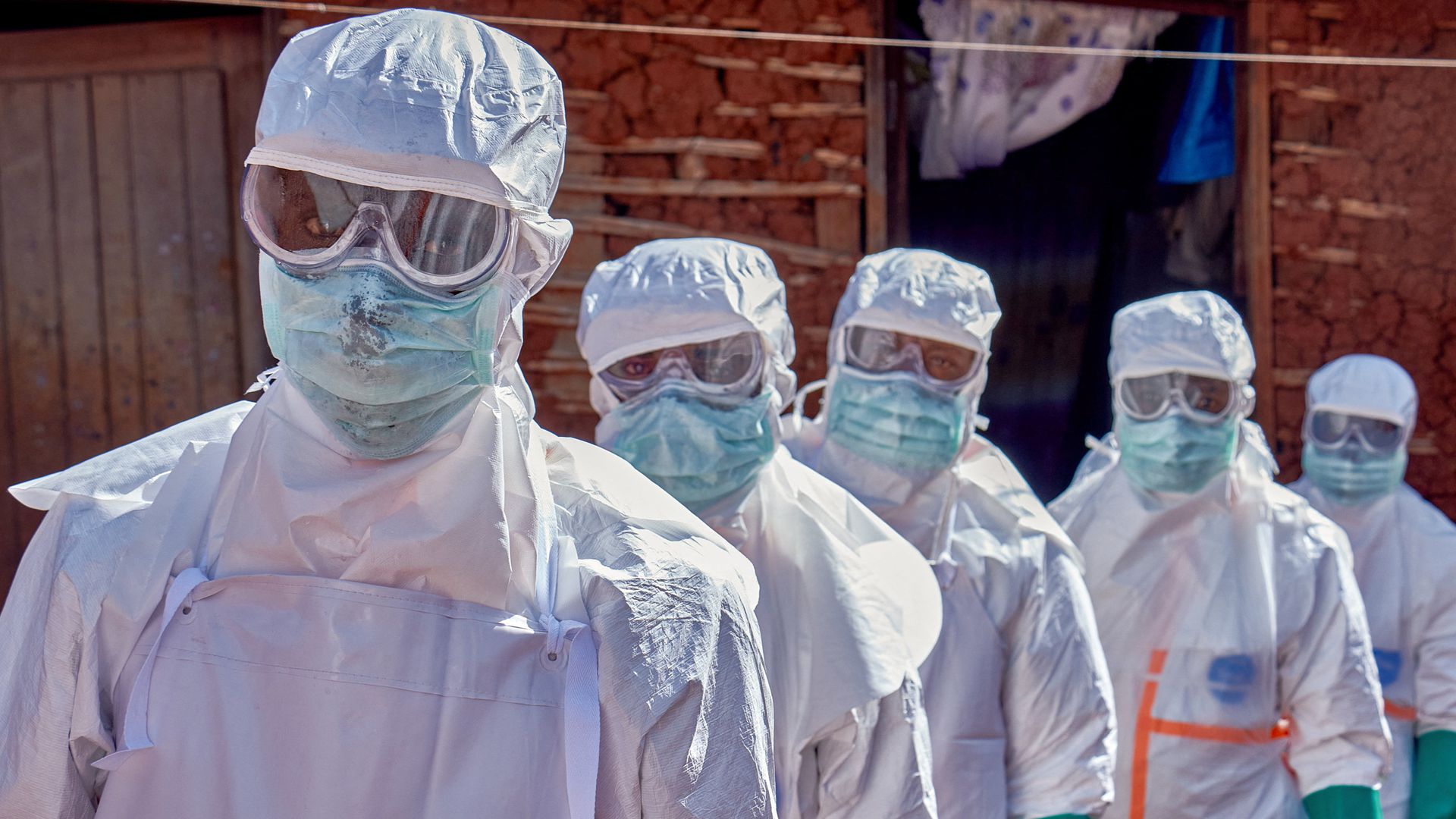
The dirt road leading to the Mpondwe border crossing does not understand international diplomacy. It understands dust. It understands the heavy, wet heat of the East African afternoon. And, most of all, it understands the sudden, terrifying silence that follows a gunshot.
For months, this red-dirt artery between the Democratic Republic of Congo and Uganda was a lifeline. Traders pushed wooden bikes piled high with green bananas. Women with vibrant kitenge cloth wrapped around their waists carried baskets of cassava. But today, the wooden barricades are down. The border is closed.
To the bureaucrats sitting in Geneva or Kampala, this closure is a line item in a security briefing. They call it a strategic containment measure.
They are wrong. It is a collision.
When a highly lethal pathogen meets an active war zone, the traditional playbook of medicine does not just fail. It combusts. We are witnessing the birth of a new kind of crisis, one where the microscope and the machete operate in terrifying tandem.
The Anatomy of an Invisible Border
To understand why a closed border is both a desperate shield and a psychological prison, you have to look at how Ebola moves.
Ebola is not a cloud of vapor. It does not drift on the wind. It travels at human speed, inside human veins. It requires intimacy. A handshake at a funeral, a mother wiping the brow of a feverish child, a traditional healer washing a body before burial. It thrives on love and grief.
Now, layer that intimate biology over a map scarred by decades of militia warfare.
In the eastern DRC, decades of conflict have left communities deeply, understandably suspicious of outsiders. When men in white, ghostly hazmat suits arrive in SUVs, shouting instructions through megaphones, the local population does not see salvation. They see an invasion.
Hypothetically, consider a young father we will call Alí. He lives three miles from the Ugandan border. His daughter wakes up with a burning forehead. She is vomiting. In a normal world, Alí would put her on the back of a motorbike taxi and head to the clinic across the border, where medicine is stocked and the staff speak his dialect.
But the border is shut.
Alí now faces a choice that no parent should ever have to make. Does he keep his daughter at home, hoping it is just malaria, risking the infection of his entire household? Or does he attempt to smuggle her through the dense, bushland paths controlled by the Allied Democratic Forces—a rebel group known for hacking civilians to death?
This is the human calculus of a geopolitical shutdown. The virus closes in from one side; the militia closes in from the other. The space to survive shrinks to nothing.
The Mirage of Isolation
There is a comforting fiction that wealthy nations tell themselves whenever an outbreak flares up in a distant corner of the world. The fiction is that borders work. We believe that if we draw a line in the dirt, post soldiers with rifles, and cancel flights, the danger will stay on its side of the fence.
It never does.
Borders in this part of Africa are lines drawn by nineteenth-century Europeans with rulers and no knowledge of the terrain. They cut directly through families, tribes, and marketplaces. A man might sleep in the Congo and farm his fields in Uganda. A woman might give birth in a Ugandan hospital because her mother lives down the street from it, despite holding a Congolese identity card.
When the World Health Organization head sounded the alarm over this "catastrophic collision," he was not just talking about the rising body count. He was talking about the collapse of trust.
When you close a formal border crossing, you do not stop people from crossing. You merely force them into the shadows. Instead of walking through a checkpoint where a health worker can use an infrared thermometer to scan their forehead for fever, people walk through the forest. They cross rivers at night. They bypass the thermal scanners entirely.
The data disappears. The virus becomes a ghost, moving undetected through the brush, waiting to reappear in a crowded market twenty miles inland.
The Weaponization of Rumor
In the vacuum left by closed borders and broken trust, rumors become currency.
During my time analyzing health emergencies in conflict zones, I learned that a bullet is loud, but a whisper is lethal. In the local taverns and makeshift markets along the frontier, the stories mutate faster than the virus itself.
The white doctors brought the disease to steal our organs.
The government invented the fever to cancel the upcoming election.
The vaccine is a poison designed to make our women barren.
To a Western observer, these claims sound like absurd conspiracies. But look at it through the lens of history. For generations, these populations have known the state only as an extractive force—an entity that sends soldiers to burn villages or officials to collect bribes. Why would they suddenly believe that the government’s sudden interest in their health is benevolent?
When health workers arrived in the town of Beni to set up an Ebola treatment unit, they were met not with gratitude, but with stones. Later, the stones turned to gunfire.
Imagine trying to insert an intravenous line into a dehydrating patient while listening for the mortar rounds of a rebel faction two miles away. Imagine wearing a heavy, yellow rubber suit that traps the heat until your boots fill with your own sweat, knowing that if you tear the glove on a piece of rusty corrugated iron, you have just signed your own death warrant.
This is not healthcare. It is combat medicine where the enemy is invisible, and the civilians do not know who to shoot.
The Cost of the Long Shadow
The true tragedy of this collision is that Ebola kills far more people than those who actually test positive for the virus.
When an health system goes into lockdown, everything else stops. The nurses who should be delivering babies are reassigned to contact tracing. The clinics that should be distributing antiretroviral drugs for HIV or nets for malaria are shuttered because the staff fled after the last rebel raid.
The numbers are staggering, yet they rarely make the headlines. For every individual who dies from the hemorrhaging caused by Ebola, three more die because the basic infrastructure of survival has been liquidated. A mother dies of a preventable postpartum hemorrhage because the clinic down the road was burned by militants. A child dies of measles because the refrigeration chain for vaccines broke down during a prolonged power outage caused by fighting.
We focus on the spectacular horror of the virus—the bleeding gums, the organ failure—while ignoring the quiet, systemic rot that allows it to flourish.
Beyond the Red Zone
The World Health Organization can issue warnings from Geneva. Presidents can deploy troops to guard the riverbanks. But the solution to a crisis born of conflict and disease cannot be found in a lab or a military headquarters.
It is found in the slow, agonizing work of building a relationship with the people who live in the red dirt.
It means training local grandmothers to recognize the signs of early fever, because a community trusts a grandmother far more than they trust an international expert. It means paying local motorbike drivers to act as couriers for blood samples, turning the very network that could spread the disease into the network that catches it.
The sun is beginning to dip below the Rwenzori Mountains, casting long, jagged shadows across the empty Mpondwe border post. A lone Ugandan soldier sits on a plastic chair, his rifle resting across his knees, staring across the barrier into the Congolese hills.
Somewhere out there, in the darkening forest, someone is beginning to sweat. Their throat is dry. Their muscles ache with a deep, unnatural fatigue. They look toward the closed border, then turn their back on the road, disappearing into the trees to find another way across.


