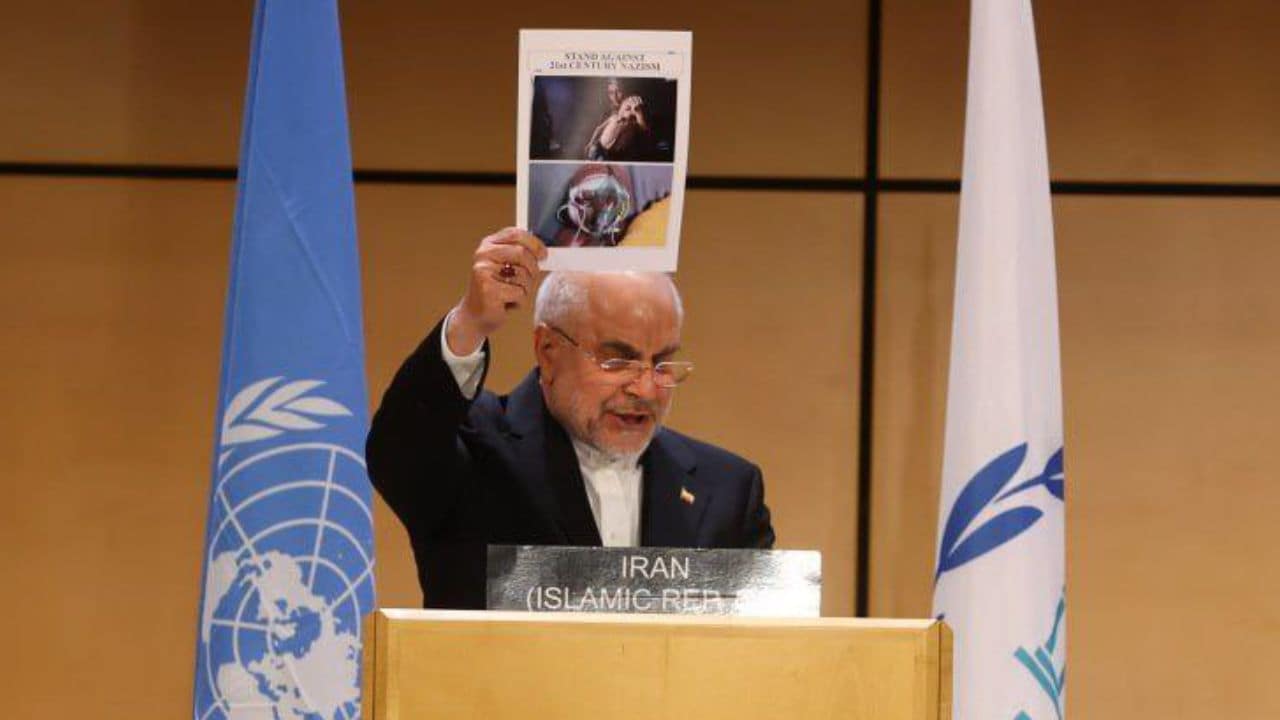
When Mohammad Baqer Qalibaf, the Speaker of Iran’s Parliament, stood before the Islamic Consultative Assembly to declare that "anyone clothed by the United States is actually naked," he wasn't just recycling revolutionary rhetoric. He was articulating a hard-nosed geopolitical calculation that has defined Tehran’s foreign policy for decades. The statement targets the growing military footprint of the West in the Persian Gulf, specifically the web of bilateral security agreements that allow the U.S. to maintain a massive logistical and strike capability across the region. For Iran, these bases are not stabilizers; they are provocative targets that offer the host nations a false sense of permanence.
The core of the Iranian argument rests on a simple, brutal premise. Security cannot be imported. Tehran views the presence of the U.S. Fifth Fleet in Bahrain, the sprawling Al Udeid Air Base in Qatar, and the various installations in the Emirates and Kuwait as an unnatural intrusion into a regional ecosystem. By relying on a distant superpower for survival, Gulf monarchies have essentially outsourced their sovereignty. This dependency creates a "nakedness"—a vulnerability where the moment the U.S. shifts its strategic focus toward the Indo-Pacific or suffers a domestic political seizure, the local regimes are left exposed without an indigenous defense architecture to catch them. For another perspective, read: this related article.
The Strategic Trap of Regional Outsourcing
The current security framework in the Gulf is a relic of the post-Cold War era, specifically the aftermath of the 1990 invasion of Kuwait. Since then, the region has become a dense thicket of American hardware and personnel. However, the ground is shifting. The "Carter Doctrine," which once asserted that the U.S. would use military force to defend its interests in the Gulf, is under immense strain.
Washington’s withdrawal from Afghanistan and its oscillating commitment to the Joint Comprehensive Plan of Action (JCPOA) have signaled to regional players that American protection is conditional. When Qalibaf speaks of "nakedness," he is poking at this specific anxiety. He is reminding Riyadh, Abu Dhabi, and Manama that the armor they wear is rented, and the landlord has started looking at properties in a different neighborhood. Related reporting on this matter has been provided by Al Jazeera.
The Mechanics of the Security Umbrella
To understand why this rhetoric carries weight, one must look at the physical reality of these bases. These are not just runways and barracks; they are integrated hubs for intelligence, surveillance, and reconnaissance (ISR).
- Al Udeid Air Base, Qatar: Serves as the forward headquarters for U.S. Central Command. It coordinates every air operation from the Levant to the Hindu Kush.
- Naval Support Activity Bahrain: The heartbeat of the Fifth Fleet, ensuring the flow of oil through the Strait of Hormuz.
- Ali Al Salem Air Base, Kuwait: A vital theater gateway for cargo and personnel moving into the heart of the Middle East.
From Iran’s perspective, these sites are "fixed targets" in any high-intensity conflict. They represent a paradox. While they are designed to deter Iranian aggression, their presence provides Iran with a ready-made list of high-value assets to hold hostage. In any scenario where the U.S. or Israel strikes Iranian nuclear facilities, these bases—and by extension, the nations hosting them—become the front line of the retaliation. The "clothing" provided by the U.S. essentially turns the wearer into a magnet for incoming fire.
Sovereignty as a Zero Sum Game
The Iranian leadership views regional security as a closed system. In their eyes, every American soldier in the Gulf is a subtraction from regional autonomy. This is why Tehran constantly pushes the narrative of a "Regional Security Dialogue" that excludes external powers. It is a clever, if self-serving, proposal. By removing the U.S. from the equation, Iran becomes the natural hegemon by virtue of geography, population, and military industrial capacity.
The "nakedness" Qalibaf describes is also a psychological critique. He is suggesting that the Gulf states have lost the will or the ability to defend themselves without a Western crutch. This critique resonates with a specific brand of Middle Eastern nationalism that views Western intervention as a continuation of colonial-era mandates. It ignores, of course, Iran’s own interventionist policies in Lebanon, Syria, Iraq, and Yemen, but the hypocrisy does not diminish the effectiveness of the message among those skeptical of American staying power.
The Cost of the Guarded Gate
Maintaining these bases is an expensive proposition for the host nations. While the U.S. pays for operations, the host countries often foot the bill for infrastructure and provide the land. There is a domestic political cost as well. A permanent foreign military presence can be a radicalizing force, providing fodder for extremist groups who claim the local government has "sold out" to the West.
Iran leverages this internal friction. Their propaganda often highlights the contrast between Iran’s self-reliance—borne of decades of sanctions—and the "bought" security of their neighbors. Iran builds its own drones, missiles, and fast-attack craft. The Gulf states buy F-35s and Patriot batteries. One side has the blueprints; the other side has the user manual and a very expensive service contract. If the service provider stops answering the phone, the hardware becomes a collection of very expensive paperweights.
Why Deterrence is Failing
The traditional model of deterrence is failing because the stakes have changed. In the 1980s, the U.S. presence was about keeping the oil flowing. Today, the U.S. is a net exporter of energy. The strategic necessity of the Gulf has been diluted by the shale revolution and the pivot to green energy.
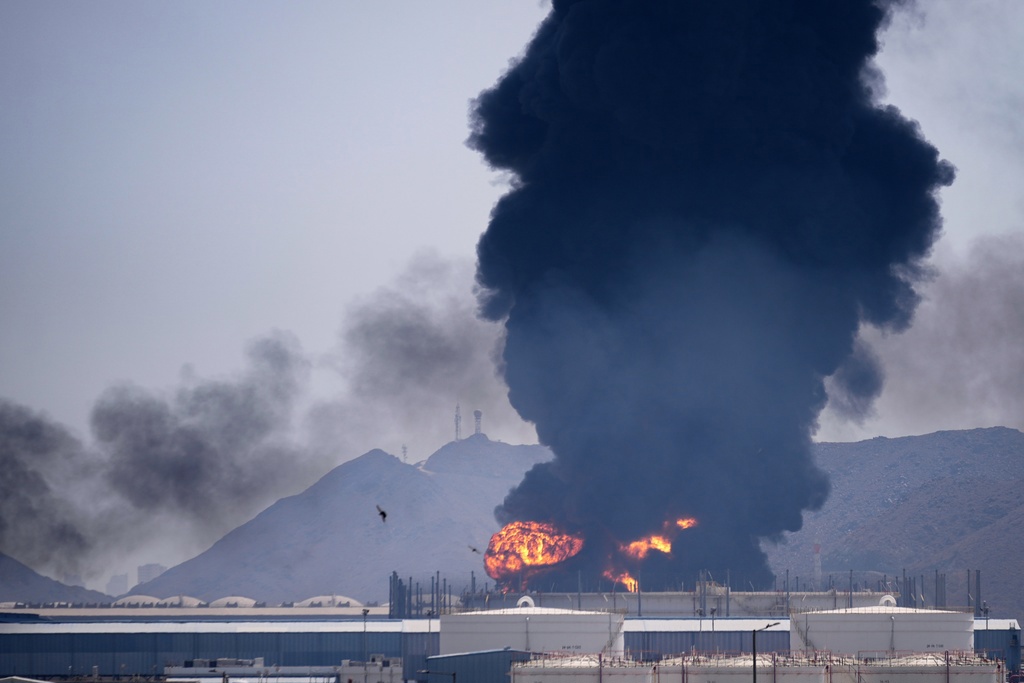
Tehran sees this clearly. They have watched as the U.S. failed to respond forcefully to the 2019 Abqaiq–Khurais attack on Saudi oil facilities. That moment was a turning point. It proved that even with the most sophisticated American "clothing" available, a sovereign nation could still be struck with impunity if the political will in Washington was absent. The "nakedness" was no longer a metaphor; it was a documented reality.
The Asymmetric Edge
Iran does not need to match the U.S. carrier strike groups in a ship-for-ship battle. They have invested in "anti-access/area denial" (A2/AD) capabilities. This includes:
- Swarm Tactics: Using hundreds of small, fast boats to overwhelm the sophisticated sensors of larger Western destroyers.
- Ballistic Missile Proliferation: Maintaining the largest arsenal in the region, capable of reaching any U.S. base in the Gulf within minutes.
- Proxy Networks: Cultivating "non-state actors" who can strike from directions the U.S. isn't looking, providing Tehran with plausible deniability.
This asymmetric approach is designed to make the U.S. presence too costly to maintain. If the "clothing" becomes a burden rather than a benefit, the wearer will eventually discard it. Qalibaf’s speech is an invitation for the Gulf states to discard it before it is taken from them.
The Pivot to the East
As the perceived reliability of the U.S. wanes, Gulf states are not simply standing around "naked." They are looking for new tailors. The recent China-brokered rapprochement between Iran and Saudi Arabia is a prime example of this shift. It was a clear signal to Washington that if it cannot provide a definitive security guarantee, the regional players will seek stability through diplomacy with their rivals.
China offers a different kind of "clothing." Unlike the U.S., Beijing does not demand human rights reforms or democratic transitions in exchange for cooperation. It wants energy and stability for its Belt and Road Initiative. However, China is not ready, nor willing, to replace the U.S. as a military guarantor. It prefers to play the role of the neutral merchant. This leaves the Gulf states in a dangerous middle ground: they are losing the protection of the old world order without having fully secured their place in the new one.
The Fallacy of the Ironclad Guarantee
There is no such thing as an ironclad guarantee in international relations. History is littered with abandoned allies. From the South Vietnamese in 1975 to the Kurds in northern Syria, the lesson is consistent: great powers follow their interests, not their friendships.
The Iranian leadership calculates that the U.S. interest in the Persian Gulf is hitting a point of diminishing returns. They are betting that the American public is tired of "forever wars" and that the American treasury is tired of subsidizing the defense of wealthy monarchies. When that fatigue reaches a breaking point, the withdrawal will be swift.
Redefining Regional Autonomy
If the Gulf states want to avoid the "nakedness" Qalibaf predicts, they must move toward a genuine indigenous collective security framework. This is easier said than done. Deep-seated mistrust, sectarian divides, and competing economic visions make a "Middle Eastern NATO" a distant dream.
Yet, the status quo is becoming untenable. The heavy reliance on U.S. bases has created a moral hazard where local states might take greater risks, assuming the Americans will bail them out. Conversely, it allows Iran to frame every regional dispute as a struggle against "Arrogant Powers" (the U.S.) rather than a legitimate disagreement between neighbors.
The Intelligence Gap
One of the most significant vulnerabilities of the current setup is the reliance on U.S. intelligence. Gulf nations have spent billions on hardware but often lack the deep-bench analytical capabilities to process the data those systems generate. They are dependent on the U.S. for the "picture" of the battlefield. This means they only see what Washington wants them to see. True sovereignty requires not just the sword, but the eyes to see where to strike.
Iran, conversely, has built an intelligence network rooted in the local fabric of the region. They don't need satellites to know what is happening in a Damascus suburb or a Baghdad marketplace; they have people on the ground. This "organic" intelligence is a form of clothing that cannot be stripped away by a change of administration in Washington.
The Strategic Choice Ahead
The rhetoric coming out of Tehran is a challenge to the very foundation of the modern Middle East. It forces a question that most regional leaders would prefer to avoid. Is the American presence a shield or a target?
If it is a shield, it is one that is visibly cracking. If it is a target, then the host nations are currently standing in the center of the bullseye. The "nakedness" Qalibaf speaks of is not just about a lack of weapons; it is about a lack of a viable Plan B. The U.S. bases in the Gulf are monuments to a strategic era that is rapidly concluding.
The transition to what comes next will be volatile. As the U.S. footprint shrinks—whether by design or by disaster—the nations of the Gulf will have to find a way to cover themselves. They can do this through a genuine, albeit difficult, accommodation with Iran, or they can continue to cling to a security umbrella that is being folded up.
The Iranian Speaker’s words were a warning, but they were also an observation of a trend that is already well underway. In the harsh light of a shifting global order, the old alliances are looking increasingly transparent. For the states of the Persian Gulf, the task now is to build a defense that doesn't rely on the whims of a superpower located seven thousand miles away.
Security that can be given can just as easily be taken away. True strength is never rented. It must be grown from the soil it intends to defend.