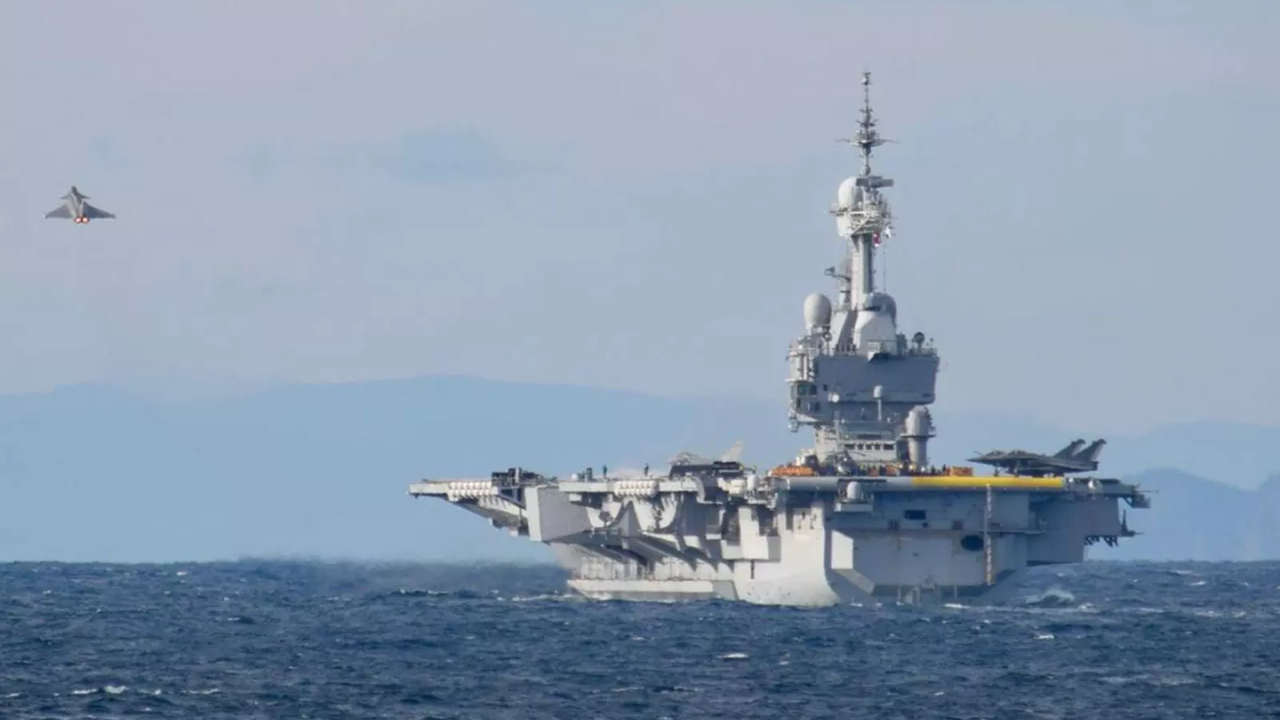
The pre-dawn air in the eastern Mediterranean carries a specific weight. It is salt-thick, humid, and carries the faint, metallic scent of jet fuel and hydraulic fluid. For an officer stationed aboard the Charles de Gaulle, the French Navy's flagship, this environment is both a workplace and a floating fortress. It is a four-acre slice of France, drifting through a region currently defined by hair-trigger tensions and shadows.
In the belly of the ship, the routine is rhythmic. You wake, you dress, and if you are disciplined, you maintain your fitness. High-performance military life demands it. So, you strap on your GPS watch, tighten your laces, and hit the treadmill or the designated jogging track on the deck. You press "Start." You run. You sweat. You beat your personal best for the 5K. Then, with a flick of a thumb, you sync your data to Strava.
In that one-second wireless handshake between a watch and a satellite, the invisible walls of the nuclear-powered aircraft carrier dissolved.
The Charles de Gaulle was supposed to be a ghost. In the strategic chess match currently playing out near the Levantine coast, the exact coordinates of a carrier strike group are the most valuable pieces of information on the board. These vessels do not just provide air power; they are symbols of national resolve and deterrents against regional escalation. To maintain that power, they rely on the vast, empty blue of the ocean to hide their tracks.
But privacy is a relic of the analog age.
The Digital Breadcrumbs of a Ghost Ship
Open-source intelligence (OSINT) analysts are the new cartographers of the modern world. They don't need spy planes or deep-cover assets when they have "Social Fitness." By monitoring public heatmaps and individual profiles on fitness tracking apps, these digital detectives began to notice a curious pattern. A specific user—an officer with a penchant for morning runs—had left a glowing neon trail across a blank patch of the Mediterranean Sea.
The data wasn't just a point on a map. It was a diary. The GPS pings revealed a tight, repetitive circuit. When you overlay that circuit onto the known dimensions of a carrier deck, the "ghost" takes a solid, metallic shape. The speed of the movement, tracked over several hours, matched the cruising velocity of a carrier group. Suddenly, the most sophisticated naval asset in the European arsenal was no longer a mystery. It was a pinpoint.
Consider the irony. We spend billions of Euros on electronic warfare suites, stealth coatings, and radar-jamming technology. We train sailors to maintain strict "EmCon" (Emission Control) protocols, turning off radios and silencing sensors to avoid detection by enemy ears. Yet, all of that institutional rigor is undone by a piece of consumer plastic wrapped around a wrist, designed to tell a middle-aged jogger how many calories they burned before breakfast.
The Psychology of the Sync
Why does this happen? It isn't a lack of intelligence. The officers aboard these ships are among the most highly trained individuals on the planet. The problem is the compartmentalization of our digital lives. We have been conditioned to view our "personal" devices as extensions of our bodies rather than as broadcasting stations.
To that officer, the watch was a coach. To a Russian or Iranian intelligence analyst, that watch was a beacon.
There is a deep-seated human desire to quantify our progress. We want to see the map of where we’ve been. We want the digital "kudos" from our friends back home in Toulon or Paris. It is a tether to normalcy in a high-stress, isolated environment. But in a theater of war, "normalcy" is a liability. This isn't the first time fitness data has betrayed the state. We saw it in 2018 when Strava’s global heatmap inadvertently revealed the outlines of secret U.S. bases in Afghanistan and Syria, tracing the patrol paths of soldiers as they walked the perimeter.
We keep making the same mistake because we fail to realize that in the twenty-first century, there is no such thing as an "offline" moment.
The Invisible Stakes of a Cold Mediterranean
When a carrier's location is leaked, the ripples extend far beyond a single ship. A carrier never travels alone. It is the center of a "Strike Group"—a protective ring of destroyers, frigates, and submarines. When you reveal the carrier, you reveal the entire formation.
If an adversary knows exactly where the Charles de Gaulle is located, they can coordinate surveillance flights, position their own "shadow" vessels, or—in a worst-case scenario—target the group with long-range anti-ship missiles. In the current geopolitical climate, where a single miscalculation in the eastern Mediterranean could spark a broader conflict involving Israel, Lebanon, and regional proxies, the "visibility" of a French nuclear carrier shifts the balance of power. It invites provocation. It emboldens those who wish to test the limits of NATO's presence.
The French Ministry of Armed Forces has long been aware of these risks, issuing strict guidelines on the use of connected devices. But guidelines are often ignored in the face of habit. The "bring your own device" (BYOD) culture has bled into the world of high-stakes espionage.
A Problem That Cannot Be Patched
You can patch a software vulnerability. You can't easily patch human nature.
The military can ban smartwatches, and in many high-security areas, they do. But as sensors become more integrated into our lives—embedded in our rings, our shoes, and eventually our clothing—the "attack surface" for a foreign intelligence agency becomes infinite. Every sailor is a potential leak. Every heartbeat recorded is a data point that can be sold, scraped, or analyzed.
This isn't just about a runner on a ship. It is about the fundamental erosion of operational security in an era where our gadgets are designed to be "always on" and "always sharing." We are living through a period where the individual’s right to data-driven self-improvement is in direct conflict with the collective need for national security.
The officer probably didn't think twice about that final sync. They were likely thinking about a shower, a cup of coffee, and the day's flight operations. They didn't see the invisible line of code stretching from their wrist, up to a satellite, and down onto the monitors of a basement office half a world away.
The Mediterranean remained blue and vast. The ship continued its steady churn through the waves. But the shroud was gone. In the digital age, a secret isn't something you keep; it's something you haven't uploaded yet.
Late that night, as the carrier turned into the wind to launch a Rafale fighter, the data remained on the server. A permanent record of a ghost that forgot to stay hidden. The ocean is no longer large enough to hide us from ourselves.
Would you like me to look into the specific security protocols the French Navy has implemented since this breach to see how they're handling the "smartwatch" problem?