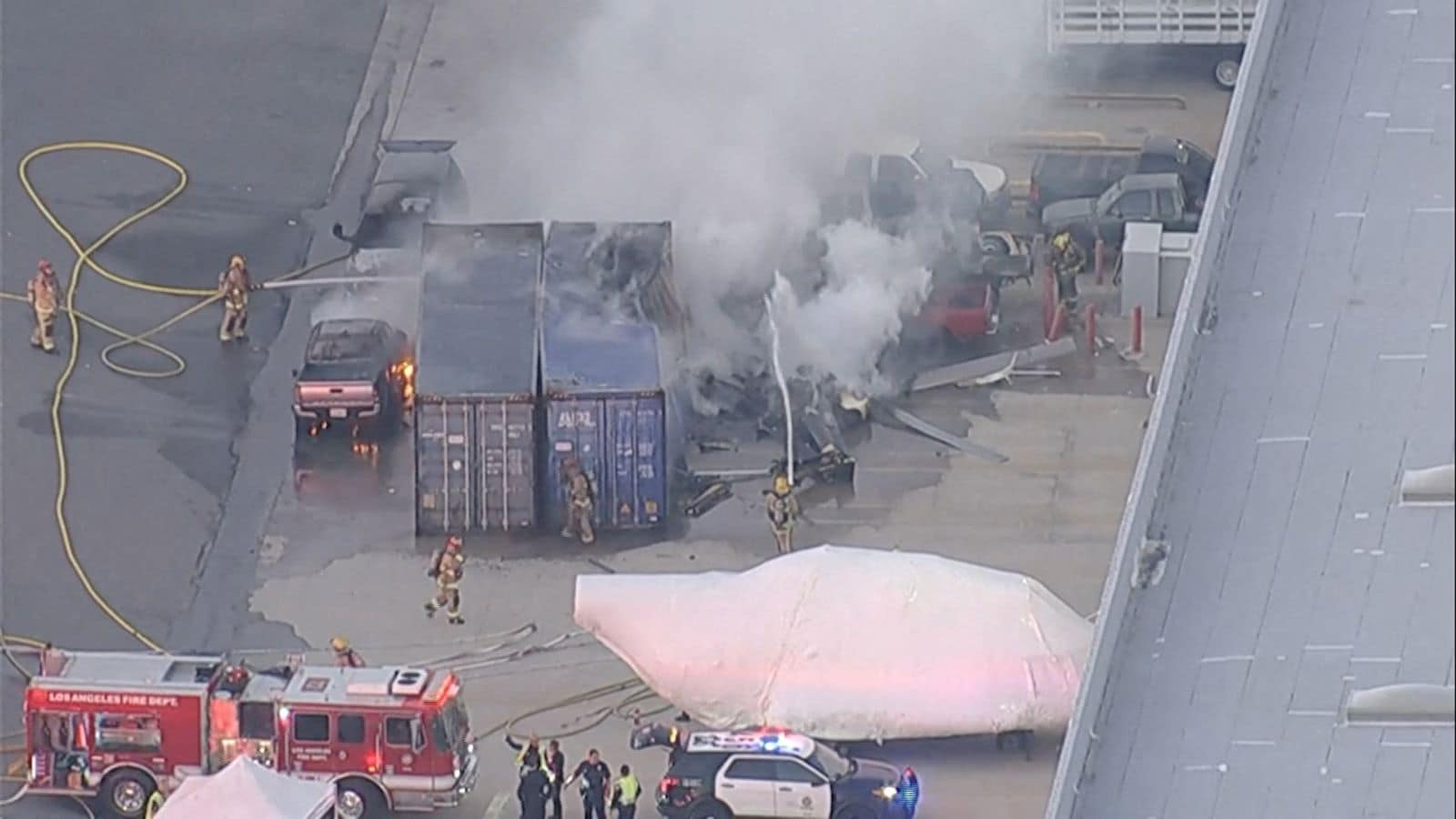
Three lives ended abruptly on a Tuesday evening in September 2026 over the sprawling grid of the San Fernando Valley. An NBC4 news helicopter, up in the air to broadcast the grim reality of a fatal bus collision in Chatsworth, spiraled down into a commercial area parking lot. Pilot George Marciniw, reporter Eliana Moreno, and a pedestrian on the ground named Edy Guitierrez Mejia perished in the flames.
This tragedy exposed an uncomfortable truth about modern media operations. Electronic news gathering fleets face immense pressure to feed an insatiable public appetite for real-time visual crisis coverage. The desire to capture every angle of urban tragedy pushes crews into hazardous low-altitude airspace.
The Mechanics of Aerial Journalism Risk
Operating a helicopter in an active news environment demands extraordinary concentration under chaotic conditions. Multiple aircraft often swarm a single point of interest, creating a high-density traffic hazard outside of controlled airport environments. Pilots must navigate complex wind patterns, thermal currents rising from burning wreckage, and unexpected obstacles like power lines and construction cranes.
The pressure to perform live compounds these operational hazards. Reporters and photographers communicate a narrative on the fly while monitoring police scanners, managing broadcast equipment, and directing the pilot's positioning. Attention becomes fragmented. When breaking news unfolds, safety protocols frequently take a back seat to the race for the live shot.
Southern California holds a unique place in the history of broadcast aviation. Local television stations pioneered the use of dedicated news helicopters to track high-speed pursuits, brush fires, and major accidents from miles away. Over decades, this created an expectation among viewers that every major incident demands immediate aerial perspective.
Yet, the operational cost of maintaining this hyper-vigilant eye over the basin remains extraordinarily high. Airspace congestion above Los Angeles is constant, involving commercial traffic, private aviation, law enforcement units, and media birds. The margin for error is razor-thin.
Safety Protocols Under Scrutiny
Federal regulators and independent aviation experts have long debated the necessity of continuous live aerial reporting given the availability of advanced drone technology and high-definition ground cameras. Drones offer alternative perspectives without placing human lives directly inside hazardous low-level flight corridors. However, traditional news helicopters retain an unmatched operational range, endurance, and payload capacity for live microwave transmission equipment.
The shift toward safer alternatives moves slowly within legacy broadcast organizations bound by tradition and competitive market pressures. When competing networks deploy aircraft to a breaking story, the remaining stations feel compelled to match the coverage. This competitive spiral creates an environment where grounding a fleet can feel like professional surrender, even when safety margins are compromised by fatigue, weather, or congested airspace.
Investigations led by the National Transportation Safety Board and the Federal Aviation Administration will eventually reconstruct the final moments of the flight. Mechanical failure, spatial disorientation, or environmental factors will be analyzed line by line. Yet the broader systemic question extends beyond the wreckage in Chatsworth.
Communities across the country consume the products of aerial journalism every day without contemplating the human toll behind the lens. The pursuit of immediacy commands a heavy price. Until the industry fundamentally reevaluates the risk-to-reward ratio of live helicopter broadcasting, the skies above our cities will remain a dangerous workplace for those assigned to watch over us.
Three dead after NBC4 helicopter crashes near site of deadly LA bus collision
This video provides local news coverage of the tragic accident in Chatsworth, detailing the emergency response and the impact on the local journalism community.