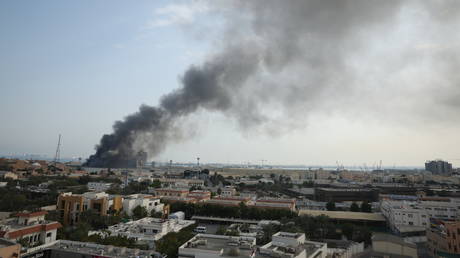
Every desk warrior in the defense commentary circuit is currently hyperventilating over a fresh batch of leaked imagery showing shattered hangars, scorched tarmac, and blown-out perimeter walls at regional installations following recent missile exchanges. The breathless consensus across the cable news loops and open-source intelligence subreddits follows a predictable script. We are told these photographs represent an unmitigated operational catastrophe, proof positive that modern ballistic technology has rendered fixed fortifications obsolete, and a humiliation for base commanders.
It is a lazy, superficial read of modern military engineering and strategic signaling.
I have spent the better part of two decades watching analysts panic over high-explosive impact craters while ignoring the actual architecture of power projection. When you stare at a smoking crater in a reinforced revetment, your civilian brain registers destruction. My operational brain registers a calculated absorption of kinetic energy designed to preserve the strategic core while letting the theater absorb the shock.
Let us strip away the sensationalism and look at what is actually happening when a barrage of precision munitions impacts a modern logistics hub.
The Absurdity of the Fortress Fallacy
The foundational error underpinning every panicked op-ed about these leaked images is the belief that a military base is supposed to be an indestructible medieval castle. That doctrine died out somewhere around the introduction of rifled artillery in the nineteenth century, yet civilian observers still clutch their pearls whenever a concrete slab cracks.
Modern installations are not designed to remain pristine under fire. They are designed for resiliency, redundancy, and rapid reconstitution.
When a state actor launches dozens of intermediate-range ballistic missiles at an airfield, they are burning through a finite, extraordinarily expensive stockpile of guidance systems and rocket motors. What do they hit? Empty maintenance bays, administrative offices built out of standard cinder blocks, and decoy revetments explicitly positioned to draw fire away from hardened command and control nodes.
If you look at the architecture of these targeted sites, the high-value assets—fuel storage bladders buried deep beneath reinforced earth, encrypted communications trunks routed through subterranean fiber-optic rings, and aircraft dispersed to austere highway strips hours before launch—are entirely absent from the damage reports.
The photos show what the strike package was allowed to hit.
The Economics of Kinetic Waste
Let us talk about the cold math that the commentariat conveniently ignores. A theater ballistic missile carrying a heavy high-explosive warhead costs millions of dollars per unit to manufacture, transport, and launch. When that missile obliterates a corrugated steel aircraft shelter that costs roughly as much to build as a suburban garage, who is actually winning the economic war of attrition?
I have sat in procurement briefings where bean counters wept over maintenance budgets, but in a shooting war, infrastructure is disposable ammunition. Concrete is cheap. Guidance chips are scarce.
By allowing imagery of cracked pavements and shattered glass to leak into the wild, defense planners achieve two distinct objectives without firing a single counter-battery shot:
- Information Dominance: They feed the adversary an inflated sense of tactical success, encouraging them to waste subsequent reload cycles on low-value targets that have already been written off the ledger.
- Budgetary Leverage: Nothing opens the treasury faster than photographic evidence of burned infrastructure. Every leaked photo of a scorched hangar is worth an extra ten billion dollars in supplemental defense appropriations during the next fiscal cycle.
To call this a disaster is to fundamentally misunderstand how modern great powers manage theater logistics.
What the Leak Industrial Complex Gets Wrong
Open-source intelligence has democratized military analysis, and almost none of it is a good thing for public clarity. Every amateur with a satellite subscription and a Twitter account fancies themselves an armchair Clausewitz because they can identify a scorch mark on a taxiway.
They focus entirely on tactical damage assessment while ignoring strategic posture.
Imagine a scenario where a high-end logistics hub takes twenty direct hits from advanced delivery systems. To the untrained eye scrolling through compressed smartphone captures, it looks like Stalingrad in 1942. But if the runway is operational within four hours because rapid-setting polymer concrete crews patched the craters before the smoke cleared, the strike was a tactical failure disguised as a photo-op victory.
We are measuring success by how many windows were broken rather than how fast sortie generation resumed. That metric is useless. It tells you nothing about combat power. It tells you everything about performative outrage.
The Uncomfortable Downside of Structural Resilience
Let me be entirely transparent about the flaws in this doctrine, because contrarianism without caveats is just marketing.
The downside of treating physical infrastructure as disposable is the psychological toll it takes on the personnel stationed inside the perimeter. When you are sleeping in a corrugated container twenty yards away from a revetment that just took a five-hundred-pound high-explosive warhead, architectural resilience does very little to calm your nervous system.
Morale does not run on concrete cure rates. It runs on the feeling of invulnerability, and leaked photos of destruction pierce that illusion instantly. Troops want to see impenetrable defenses, not calculated trade-offs between asset hardening and fiscal efficiency. When those images circulate in the mess hall, they breed a quiet cynicism about the competence of rear-echelon leadership.
Furthermore, relying on rapid reconstitution assumes a permissive or semi-permissive environment where your supply chains for heavy repair equipment remain intact. If those supply lines face sustained interdiction, your disposable hangars stop being clever decoys and start becoming permanent industrial graveyards.
Stop Asking About the Craters
People ask how these bases can possibly remain viable after taking such heavy visual trauma. The question itself is contaminated by a false premise.
You are looking at the skin of the beast and confusing it with the skeleton.
The real capability of a modern projection force does not live in the hangars you can photograph from a commercial satellite or leak through a disgruntled supply sergeant's messaging app. It lives in the distributed logistics network, the pre-positioned stocks scattered across three different time zones, and the ability to reconstitute command functions before the dust from the initial impact has even settled on the runway.
The next time you see a viral thread breaking down the latest damage assessment imagery from a contested zone, remember what you are actually looking at: a staged autopsy of things that were designed to be broken in the first place.
Stop mourning the concrete. Start paying attention to what survived in the dark.