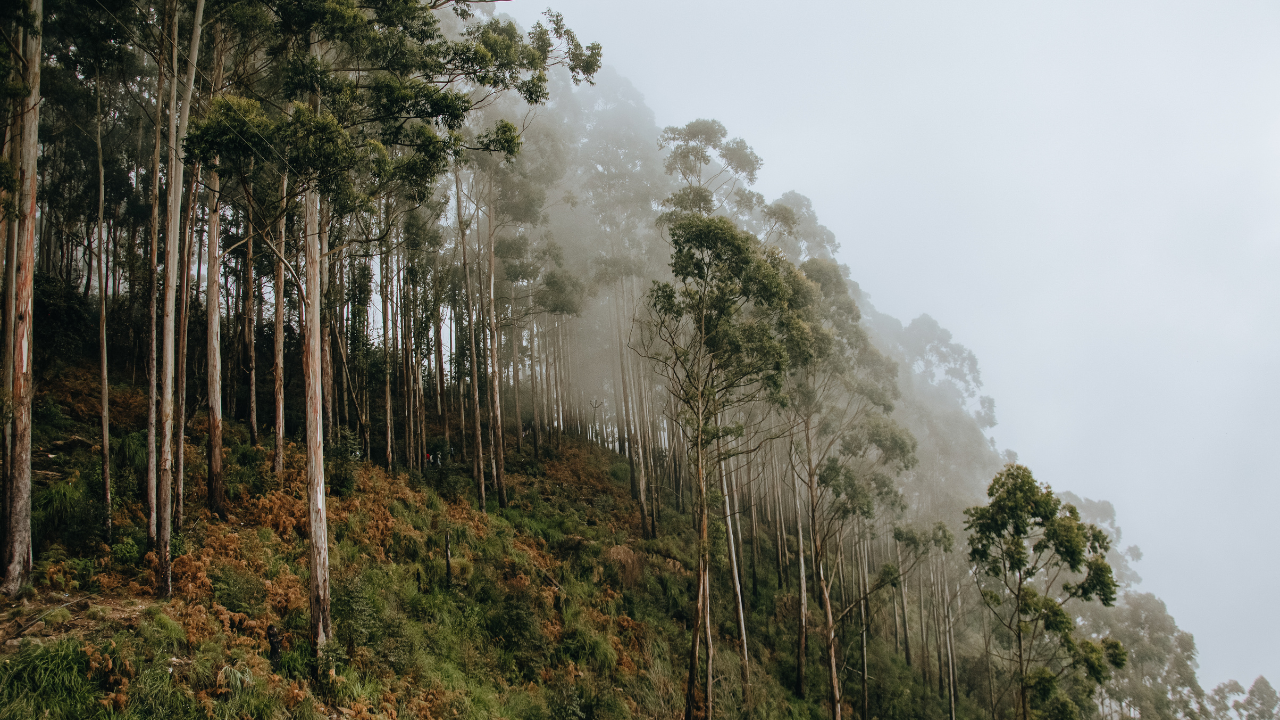
Standard botany articles love a good survival story. They paint the natural world as a harmonious community where every adaptation is a peaceful defensive shield. Read any basic explainer on the eucalyptus tree, and you will find the same lazy consensus: the tree sheds its bark to rid itself of parasites, photosynthesize through its trunk, and protect itself from the harsh Australian elements.
It sounds beautiful. It is also a fundamental misunderstanding of the tree’s actual evolutionary strategy.
The eucalyptus does not shed its bark to survive the environment. It sheds its bark to weaponize the environment. The ribbons of dry, hanging bark trailing from a blue gum or stringybark are not discarded trash; they are kindling. The eucalyptus is a biological arsonist, and its peeling bark is a deliberate mechanism designed to incinerate its neighbors.
The Flawed Parasite Myth
The standard narrative claims that peeling bark is a hygiene tactic. The logic goes that by dropping its outer layers, the tree sheds boring insects, mosses, lichens, and fungal spores.
If this were the primary driver of the adaptation, we would see similar, regular mass-shedding behaviors across thousands of other tree species in high-parasite environments, such as tropical rainforests. Instead, rainforest trees utilize chemical defenses or slick, waxy barks that prevent epiphytes from attaching in the first place. Dropping structural material annually is an incredibly expensive metabolic process. To suggest a tree undergoes this massive energy expenditure just to clear off a few bugs is a failure of evolutionary math.
Furthermore, look at the physical reality of a shedding eucalyptus. The bark does not just fall straight to the dirt and rot. It peels away in long, fibrous ribbons that remain draped over the branches for months, creating a massive, tangled web of dead biomass hanging mid-air. If the goal were pure hygiene, leaving the infested material dangling in the canopy would be counterproductive. The parasites would simply crawl back across the bridge.
The hanging bark serves a far more sinister purpose.
Pyrophilic Warfare: How the Shed Facilitates Murder
To understand the eucalyptus, you must understand pyrophytism. These trees do not fear fire; they invite it. They require it.
The eucalyptus canopy is loaded with volatile terpenoid oils. These oils make the leaves highly flammable, exploding into flame at relatively low temperatures. But a fire burning quickly through the canopy might leave the surrounding understory intact. It might not kill off the competing vegetation permanently.
This is where the shed bark comes in.
As the bark peels, it dries into highly combustible tinder. Because it hangs down from the upper branches to the ground, it creates a perfect physical "fuel ladder." When a ground fire starts, these ribbons of bark catch the flames and carry them directly into the canopy, transforming a minor bushfire into a devastating crown fire.
More importantly, these long strips of burning bark detach during a fire. The thermal updrafts lift the lightweight, flaming ribbons high into the air, carrying them kilometers ahead of the main fire front. This phenomenon, known as spotting, ignites new fires behind enemy lines, breaching firebreaks and ensuring the total destruction of the local landscape.
Imagine a scenario where an organism intentionally manufactures and distributes matches throughout its home just to ensure the entire neighborhood burns down. That is the eucalyptus.
When the fire roars through, the eucalyptus survives thanks to epicormic buds protected deep beneath its thick, insulated inner bark and lignotubers buried underground. The competing species—the wattles, the banksias, the rainforest saplings trying to encroach on the territory—are obliterated. The eucalyptus clears the field, monopolizes the sudden flush of nutrients in the ash bed, and enjoys unrestricted access to sunlight. The bark shed is an offensive weapon used to execute a scorched-earth policy.
The Photosynthesis Misdirection
Another common argument found in mainstream nature writing is that smooth-barked eucalyptus species shed their outer layers to reveal a green, chlorophyll-rich inner bark capable of photosynthesis. Writers claim this gives the tree a massive energy boost, especially during times of stress when it may have lost its leaves.
This is a classic case of confusing a byproduct with a primary function.
While cortical photosynthesis does occur in young twigs and the trunks of certain smooth-barked trees, its contribution to the overall energy budget of a mature eucalyptus is minimal. The surface area of the trunk and main branches is a fraction of the surface area provided by the massive canopy.
Investing energy into shedding a thick layer of protective bark just to expose a tiny fraction of photosynthetic tissue on a trunk is bad bioenergetics. The tree does not shed to photosynthesize; it photosynthesizes because it has shed. The presence of chlorophyll in the stem is an opportunistic fallback mechanism, a way to salvage some energy after the deliberate shedding of its skin has served its primary, fire-spreading purpose.
The Cost of the Strategy
No strategy is perfect. If you adopt a contrarian evolutionary path like the eucalyptus, you accept massive downsides.
The strategy relies entirely on fire returning at specific intervals. If a fire occurs too frequently, young eucalyptus saplings are killed before they can develop fire-resistant bark or lignotubers. If fire is suppressed for too long, the accumulated bark and fuel load can create a fire so intensely hot that it destroys even the adult trees' protective layers, cooking the epicormic buds beneath.
In managed forestry situations outside of Australia, such as the massive plantations in California, Portugal, and South America, this adaptation becomes a liability. In these regions, the eucalyptus behaves exactly as its DNA dictates: it accumulates fuel, sheds its bark, and waits for the spark.
When the spark arrives, the resulting fires are catastrophic because local management practices often try to treat the eucalyptus like a normal, docile tree. They ignore the fact that the tree is actively trying to burn the forest down.
Dismantling the PAA Consensus
If you look at public queries regarding this tree, the questions are fundamentally broken because they stem from a flawed premise.
- "Why do eucalyptus trees shed bark?" The standard answer is protection. The real answer is fuel accumulation.
- "Is peeling bark a sign of a dying eucalyptus?" No. It is a sign of a tree preparing to kill everything around it.
- "How do you stop a eucalyptus from shedding?" You don't. You cannot prune or fertilize away millions of years of pyrophilic evolution.
Stop viewing the shedding bark of the eucalyptus as a passive, defensive reaction to environmental stressors. Nature is not a peaceful commune where trees simply shed their old clothes to stay clean. The eucalyptus is a dominant, aggressive competitor that uses its own dead tissue to engineer high-intensity fire storms, wiping out the competition to secure its own survival. It doesn't shed to adapt; it sheds to conquer.