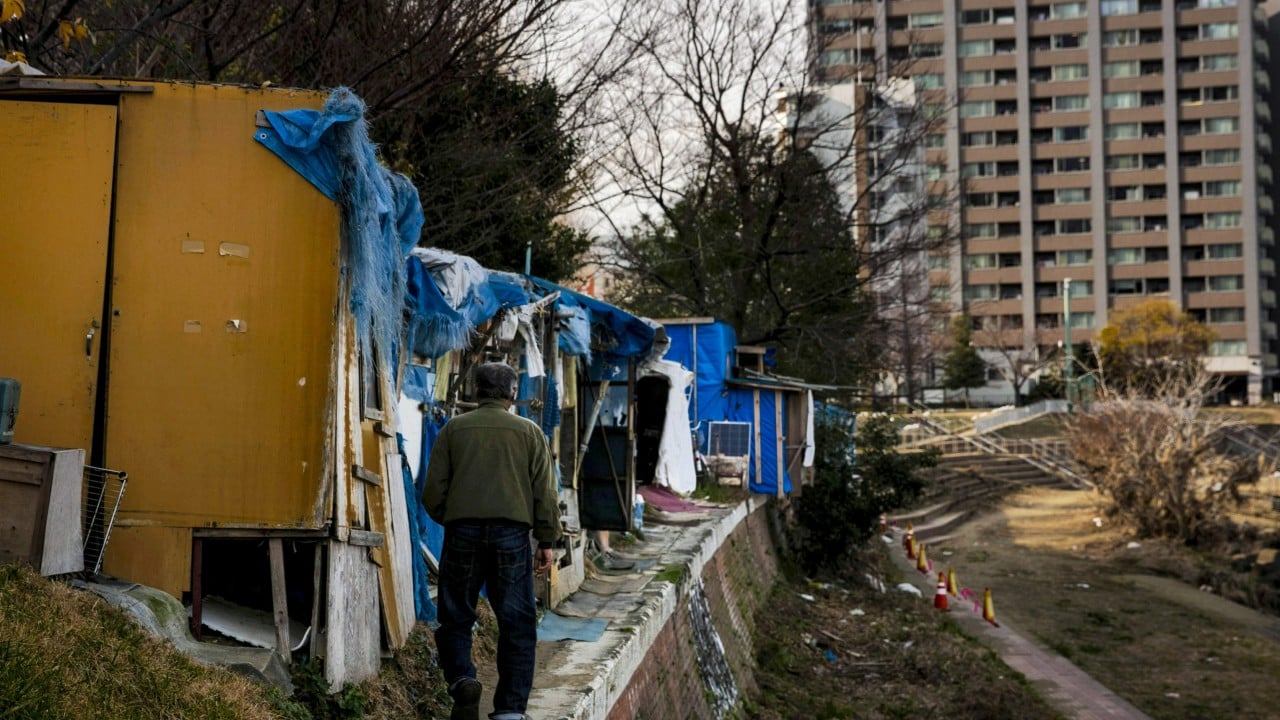
Hollywood loves a ghost story. Western journalism loves an exotic one. Put them together, and you get the standard-issue feature piece about how Japan’s roughly 660 designated "most wanted" fugitives vanish into thin air—sleeping in Osaka’s Kamagasaki slums, hauling concrete as off-the-books day laborers, and flashing forged IDs like characters in a noir thriller.
It makes for great copy. It is also largely nonsense.
That narrative relies on a lazy consensus that treats 2026 Japan like a 1990s yakuza movie. Reporters love the visual of the doya-gai—the skid rows of Airin-chiku in Osaka or San’ya in Tokyo—because it gives them a gritty backdrop to explain away a statistical anomaly. They look at a hyper-monitored, low-crime society with an astonishingly high conviction rate and ask: How does anyone slip through the cracks? Then they reach for the easiest tropes on the shelf: fake passports, cash-in-hand construction gigs, and shadowy flophouses.
They are asking the wrong question entirely. Fugitives in Japan do not survive because they are masterminds of the criminal underworld. They survive because Japan’s legal architecture, privacy laws, and bureaucratic friction actively manufacture blind spots. You do not need a forged My Number card to disappear in Tokyo. You just need to understand how terrified Japanese institutions are of overstepping their legal mandate.
The Myth of the Master Forger
Let’s dismantle the forged ID trope first. Anyone who has actually worked in Japanese compliance, corporate security, or criminal defense knows that high-grade document forgery in Japan is practically dead.
Between the biometric chips in Japanese passports, the cryptographic verification embedded in modern driver’s licenses, and the tightening rollout of the My Number system, faking a government ID that survives a basic terminal scan requires state-level resources. Street-level criminals and desperate suspects do not have state-level resources. Even the yakuza—historically the logistical backbone for fake documents—have been decimated by the Organized Crime Exclusion Ordinances passed across all 47 prefectures by 2011. Today, a syndicate member cannot even open a bank account or rent an apartment without triggering an immediate police database hit.
If the organized underworld cannot procure clean paper for its own captains, a lone fugitive on the National Police Agency’s (NPA) wanted poster is not walking into a ward office with a convincing fake ID.
So how do they get by without legitimate paperwork? They stop participating in systems that ask for it.
The competitor’s narrative assumes fugitives are actively fooling gatekeepers. In reality, they simply route around the gates. When Satoshi Kirishima—one of Japan’s most notorious domestic terror fugitives, wanted for the 1974 Mitsubishi Heavy Industries bombing—finally surfaced in a Kanagawa hospital in January 2024 just days before dying of terminal cancer, investigators did not uncover a sprawling network of master forgers or safe houses. He had lived for decades under a simple alias, working a quiet, cash-paid job at a small construction firm in Fujisawa. No fake microchip IDs. No cinematic disguises. Just forty-nine years of never applying for a credit card, never visiting a doctor until he was dying, and never giving a beat cop a reason to ask for his zairyu or driver’s license.
Slums Are Surveillance Traps, Not Sanctuaries
The second pillar of the standard media narrative is the "slum sanctuary." Writers point to day-laborer districts like Kamagasaki as black holes where the state cannot see.
Ask anyone who has spent time walking those blocks or studying urban policing in Osaka, and they will tell you the exact opposite is true. Airin-chiku is one of the most heavily surveilled square kilometers in the country. Following decades of labor riots and organized crime turf wars, the Osaka Prefectural Police blanket the area with CCTV cameras and plainclothes patrols. Welfare caseworkers, NPO outreach teams, and municipal auditors comb through the doya flophouses constantly because the local government subsidizes much of the housing for elderly, indigent men.
A healthy, nervous thirty-something fugitive showing up in Kamagasaki looking for cash work sticks out like a flare in a dark room. The average age in those districts is well over sixty. The day-labor market itself has contracted dramatically over the past twenty years, replaced by temp agencies that demand bank accounts and tax withholding forms.
Hiding in a slum is an amateur mistake. If you want to vanish in Japan, you do not go to the margins of society. You go straight into the middle of its most boring, understaffed, high-turnover industries.
Think about the logistics of modern Japan’s labor shortage. In 2026, the country faces a demographic crunch so severe that small businesses in logistics, agriculture, waste management, and regional construction are perpetually desperate for warm bodies. A tiny family-owned demolition subcontractor in rural Ibaraki or a late-night dishwashing operation in a mid-sized provincial city does not run background checks. Often, the owner is sixty-eight years old, hates paperwork, and pays in cash envelopes on Fridays because accounting software costs money and compliance is a headache.
Fugitives do not hide in the shadows of the underworld. They hide in the administrative laziness of small-business Japan.
The Real Shield Is Japan’s Obsession With Privacy and Jurisdiction
To understand why 660 high-priority fugitives remain at large in a nation famous for neighborhood koban police boxes, you have to stop looking at the criminals and start looking at the rules binding the police.
Western readers often assume Japan is a frictionless surveillance state where the police can tap any phone, pull any tax record, and track every train swipe at the push of a button. That is a fundamental misunderstanding of post-war Japanese law. Because of the trauma of the pre-1945 Kempeitai military police, Japan’s modern legal framework places rigid, almost paralyzing walls between government agencies.
Consider the Act on the Protection of Personal Information (APPI) and the strict statutory firewalls surrounding the National Tax Agency, the Ministry of Health, Labour and Welfare, and the National Police Agency.
- Prefectural Silos: Japan does not have an FBI with seamless nationwide operational command over local street cops. Policing is divided among 47 prefectural forces. While the NPA coordinates national wanted lists and shares fingerprint and DNA databases, street-level intelligence sharing between, say, the Tokyo Metropolitan Police Department and the Fukuoka Prefectural Police is notoriously bureaucratic. Turf wars over who gets credit for an arrest frequently slow down cross-prefectural tracking.
- The Warrant Threshold: Japanese judges routinely rubber-stamp arrest warrants once a prosecutor builds a file, which contributes to the famous 99% conviction rate. However, investigative warrants for proactive digital surveillance—like real-time GPS tracking or sweeping cellular tower dumps—face strict legal hurdles under the Code of Criminal Procedure. The Supreme Court of Japan ruled in 2017 that attaching a GPS tracker to a suspect’s vehicle without a specific warrant is illegal, forcing police to rely heavily on old-fashioned physical tailing and fixed CCTV footage.
- Cash Is Still King: Despite government pushes toward cashless payments, roughly 60% of point-of-sale transactions in Japan still involve physical yen. A person carrying a thick envelope of 10,000-yen notes can rent a weekly mansion (manshon) through a third-party proxy, buy a used kei car in a private sale, eat at convenience stores, and travel across the country on highway buses without ever generating a digital breadcrumb.
Imagine a scenario where a suspect wanted for a high-profile fraud in Nagoya simply walks out of the city, buys a second-hand bicycle, and takes a local bus to a coastal town in Mie Prefecture. He rents a room above a closed shop from an elderly landlord who hasn't reported rental income to the tax office since the Heisei era. He works nights sorting scrap metal for cash. He never gets into a bar fight. He never jaywalks in front of a koban. He never visits a clinic.
Unless a neighbor happens to recognize his face from a faded poster taped to a post office wall—a poster whose photo was taken twelve years ago when he was twenty kilograms heavier and had a full head of hair—no algorithm in Japan is going to flag him. The state does not have a unified dashboard blinking red when a citizen drops off the grid. In Japan, dropping off the grid is functionally indistinguishable from simply being an isolated, eccentric loner—a demographic that numbers in the millions.
Answering the Questions Reporters Get Backward
When readers search for how fugitives evade capture in Japan, they usually type variations of the same flawed assumptions into search bars. Let’s strip the romance out of the answers.
How do fugitives get medical care in Japan without an insurance card?
They don’t. That is the brutal reality most articles gloss over. Japan’s National Health Insurance (Kokumin Kenko Hoken) is tied directly to municipal resident registration (juminhyo). If you register at a city hall to get an insurance card, the municipal database cross-references your identity, and you are in handcuffs within forty-eight hours.
Walking into a clinic without an insurance card means paying 100% of medical costs out of pocket—which is still surprisingly affordable in Japan compared to the United States, often under 10,000 yen for a basic consultation—but it triggers immediate scrutiny from hospital administrators who must log uninsured cash patients. Consequently, long-term fugitives simply endure untreated illnesses until their bodies collapse. They pull their own teeth, treat infections with over-the-counter drugs from corner pharmacies, and show up at emergency rooms only when they are days from death, just as Satoshi Kirishima did in 2024 and Tatsuya Ichihashi did after nearly three years on the run for the 2007 murder of Lindsay Hawker.
Why doesn't Japan’s facial recognition network catch them?
Because Japan does not have a unified, real-time public facial recognition network scanning the streets. Private rail operators like JR East and Tokyo Metro have tested and deployed limited camera analytics strictly for detecting suspicious unattended packages or tracking registered criminal offenders inside specific transit hubs after major incidents, and Narita and Haneda airports use facial gates for immigration.
However, public backlash over privacy violations—most notably the fierce legal and public pushback in 2021 when JR East quietly tested scanning released convicts in train stations—forced transit authorities to pull back. The CCTV cameras hanging over Japanese shopping streets (shotengai) are mostly dumb recording devices owned by local merchant associations. Police only pull that footage after a crime is reported in that specific neighborhood. Nobody is sitting in a bunker in Kasumigaseki running live biometric sweeps on commuters in Shibuya.
Do the yakuza still hide fugitives?
Almost never, unless the fugitive is a high-ranking syndicate member whose silence protects a boss from a life sentence. Under the revised Anti-Boryokudan Laws, harboring a wanted fugitive exposes a syndicate’s leadership to civil liability and police raids that can shut down their remaining legitimate front companies overnight. To modern yakuza groups, a fugitive on the NPA’s top-wanted list is radioactive waste. If a low-level associate goes on the run, the syndicate is far more likely to cut him loose—or quietly tip off the police to earn goodwill with local detectives—than waste money hiding him.
The Uncomfortable Truth About the "660"
There is one more piece of context the standard feature story leaves out: the number 660 itself is a bureaucratic illusion.
When the National Police Agency publishes its annual tally of designated "most wanted" suspects (juyo shimei tehai), it lumps together brutal murderers from the 1970s, cold-case robbers from the 1990s, and mid-level fraudsters from last Tuesday. A significant percentage of the longest-running names on that list are almost certainly dead.
Japan’s geography is 73% forested mountains. Every year, hikers and forestry workers stumble across unidentified remains in the deep woods of Aokigahara, the Japan Alps, or the rural coastlines of the Sea of Japan. When a fugitive runs out of cash, develops an untreated infection, or realizes the walls are closing in, walking into the mountains with no ID is a grimly common exit strategy. Because DNA matching against cold-case files requires manual prioritization by understaffed prefectural crime labs, a fugitive who died alone in a gully in Nagano twenty years ago can remain an active, terrifying statistic on a Tokyo police poster for decades.
The Cost of Friction
Admitting that Japan’s system has blind spots does not mean the country is soft on crime. Quite the opposite. Once a suspect is physically in custody, Japan’s criminal justice apparatus—with its 23-day pre-indictment detention period (daiyo kangoku) and relentless interrogation culture—is one of the most unforgiving machines in the democratic world. That is precisely why fugitives run so hard and stay hidden for so long: they know that the moment a beat cop checks their bicycle registration and finds a match, their life is effectively over.
Yet the reason they manage to stay out of that machine is not because they are brilliant escape artists thriving in a romanticized underworld of fake IDs and gritty slums. It is because a free society built on cash, strict data silos, and administrative privacy inherently leaves space for a human being to disappear—provided they are willing to live like a ghost, surrender their health, and never ask the state for anything at all.
Stop looking for criminal masterminds in the alleys of Osaka. Look at the quiet guy washing dishes in the back of a ramen shop in a town you’ve never heard of, paying rent in cash, and praying he never gets a toothache.


