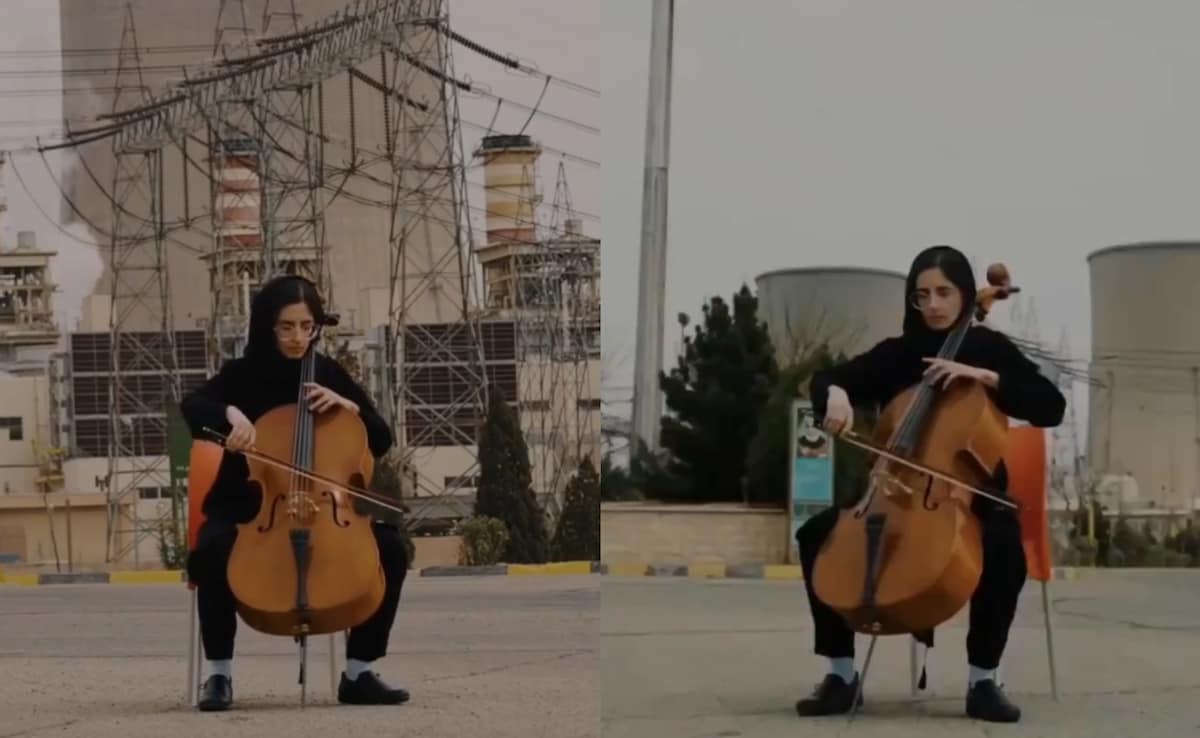
The performance of a cellist within the confines of a power plant during a period of heightened kinetic threat is not an act of mere artistic expression; it is a calculated deployment of Strategic Cultural Signaling (SCS). When Iran responds to external strike threats—specifically those targeting critical infrastructure—by producing high-fidelity media of classical performances at these sites, it is executing a multi-vector psychological operation designed to manipulate the risk-assessment models of its adversaries. This maneuver leverages the "soft power" of high culture to create a moral and political friction point, complicating the targeting logic used by Western military and political planners.
The Architecture of Symbolic Deterrence
Modern warfare is governed by the principles of Proportionality and Distinction under International Humanitarian Law (IHL). By situating a solo musician at the heart of a "dual-use" facility (infrastructure that serves both civilian and military purposes), the state alters the optical and legal cost-benefit analysis of a potential strike.
The strategic logic functions through three specific mechanisms:
- The Humanization of Critical Nodes: Infrastructure is typically viewed through the lens of thermal signatures, megawatt output, and logistical value. Introducing a human element—specifically an artist performing a Western-derived classical instrument—recontextualizes the target from a "grid component" to a "cultural site."
- Cognitive Dissonance in Adversary Populations: The choice of the cello, an instrument deeply rooted in European classical tradition, creates a bridge of shared values. This aesthetic alignment is intended to trigger a hesitation in the public and political spheres of the threatening power, as it contrasts the "barbaric" label often applied to the adversary with the "civilized" reality of the performance.
- Signal of Resilience and Operational Stability: Performing in a high-security industrial zone suggests that the state maintains total control over its internal security environment despite external pressure. It signals that the workforce is unbowed and that the facility is functioning at a capacity that allows for non-essential, symbolic activity.
Quantifying the Infrastructure Target
To understand why a power plant serves as the stage for this performance, one must analyze the Criticality Index of the Iranian energy grid. In a state under heavy economic sanctions, the energy sector is the primary backbone of domestic stability.
The vulnerability of these sites is defined by the following variables:
- Generation Capacity (GW): The total electrical output the facility provides to the national grid.
- Replacement Lead Time: The duration required to procure and install specialized components, such as high-voltage transformers or turbines, which are subject to export controls.
- Societal Interdependence: The degree to which civilian life (hospitals, water treatment, residential heating) depends on that specific node.
By performing at a "Biggest Power Plant," the artist is standing at the nexus of these vulnerabilities. The act of playing music amidst the hum of turbines is a demonstration of Asymmetric Resilience. It posits that even if the physical hardware is destroyed, the national identity remains intact. However, the data-driven reality is that the destruction of such a facility would result in a multi-year recovery period, regardless of the cultural defiance displayed.
The Cello as a Vector of Information Warfare
The selection of the cello over traditional Iranian instruments like the setar or kamancheh is a deliberate choice for an international audience. The cello’s frequency range and its history of being used in "protest" contexts (e.g., Vedran Smailović during the Siege of Sarajevo) imbue the footage with a pre-existing narrative of "civilization under fire."
Tactical Media Dissemination
The production quality of such videos suggests state-level coordination rather than an organic, grassroots event. We can categorize the dissemination strategy into three phases:
- Phase I: The Viral Seed: Distribution via social media accounts with high engagement among the Iranian diaspora and international journalists.
- Phase II: The Emotional Hook: Focusing on the contrast between the delicate physical form of the musician and the brutalist, industrial scale of the power plant.
- Phase III: The Political Leverage: Using the resulting media coverage to frame any subsequent military action as an attack on "culture" and "humanity" rather than a strategic strike on energy logistics.
This creates what is known as a Moral Hazard for Targeteers. If a strike occurs, the imagery of the performance becomes the visual shorthand for the conflict’s cost, shifting the narrative from a "clean" surgical strike to a "tragedy" of civilian collateral damage.
The Conflict Between Kinetic Reality and Symbolic Defense
While symbolic defense is effective in the domain of international public opinion, it does not alter the physical survivability of the asset. A kinetic strike—utilizing GPS-guided munitions or cyber-physical attacks—is indifferent to the presence of art.
The gap between the symbolic and the physical creates a Strategic Paradox:
- The Symbolic Gain: Increased internal morale and international sympathy.
- The Physical Risk: If the bluff is called, the state loses the asset and the "human shield" of the narrative is proven ineffective, potentially leading to a collapse in the very morale the performance sought to bolster.
Deterministic Modeling of Infrastructure Strikes
When an adversary evaluates a target like a power plant, they utilize a Target Value Analysis (TVA). This model calculates the impact of the node's removal on the enemy's Ability to Sustain (ATS).
The performance of the musician attempts to insert a new variable into the TVA equation: Political Fallout (Pf).
$$Total Target Value = (Operational Impact \times Replacement Cost) + Political Fallout$$
In this equation, if $Pf$ is sufficiently high, the $Total Target Value$ may be deemed too "expensive" for the attacking force to pursue, despite high operational impact. The Iranian strategy is to maximize $Pf$ to the point where it exceeds the tactical benefits of the strike.
The Limitations of Aesthetic Defiance
The effectiveness of this strategy has a definitive half-life. Information fatigue and the repetition of similar imagery reduce the emotional impact over time. Furthermore, this approach assumes a rational adversary that is sensitive to international opinion. In a scenario of "Total War" or "Existential Conflict," the $Pf$ variable is often discarded in favor of raw kinetic necessity.
The second limitation is Authenticity Erosion. As the global audience becomes more aware of the state's hand in producing these "spontaneous" moments of art, the content is reclassified from "human expression" to "propaganda." This shift nullifies the bridge of shared values, as the audience begins to view the artist as a tool of the regime rather than a representative of the people.
Strategic Recommendation for Infrastructure Defense Analysis
The use of cultural signaling confirms that the target in question is perceived by the state as both highly valuable and highly vulnerable. Analysts should not view the performance as a sign of strength, but as a Confirmation of Criticality.
The correct analytical response is to:
- Isolate the Signal: Strip away the aesthetic elements to identify the exact facility and its role in the national power grid.
- Assess the Hardening: Determine if the cultural performance is being used to mask physical hardening efforts or the deployment of point-defense systems (e.g., surface-to-air missiles) in the immediate vicinity.
- Monitor the Frequency: An uptick in "cultural" content centered around specific infrastructure nodes often precedes or follows a specific threat cycle, serving as a leading indicator of state anxiety.
The strategic play is to decouple the "cultural" narrative from the "functional" target. This involves preemptive communication that distinguishes between the civilian populace and the state's strategic assets, thereby neutralizing the cognitive dissonance the SCS seeks to create. The performance at the power plant is a signal that the theater of war has shifted from the physical to the psychological; the defense of the asset must now occur in both.