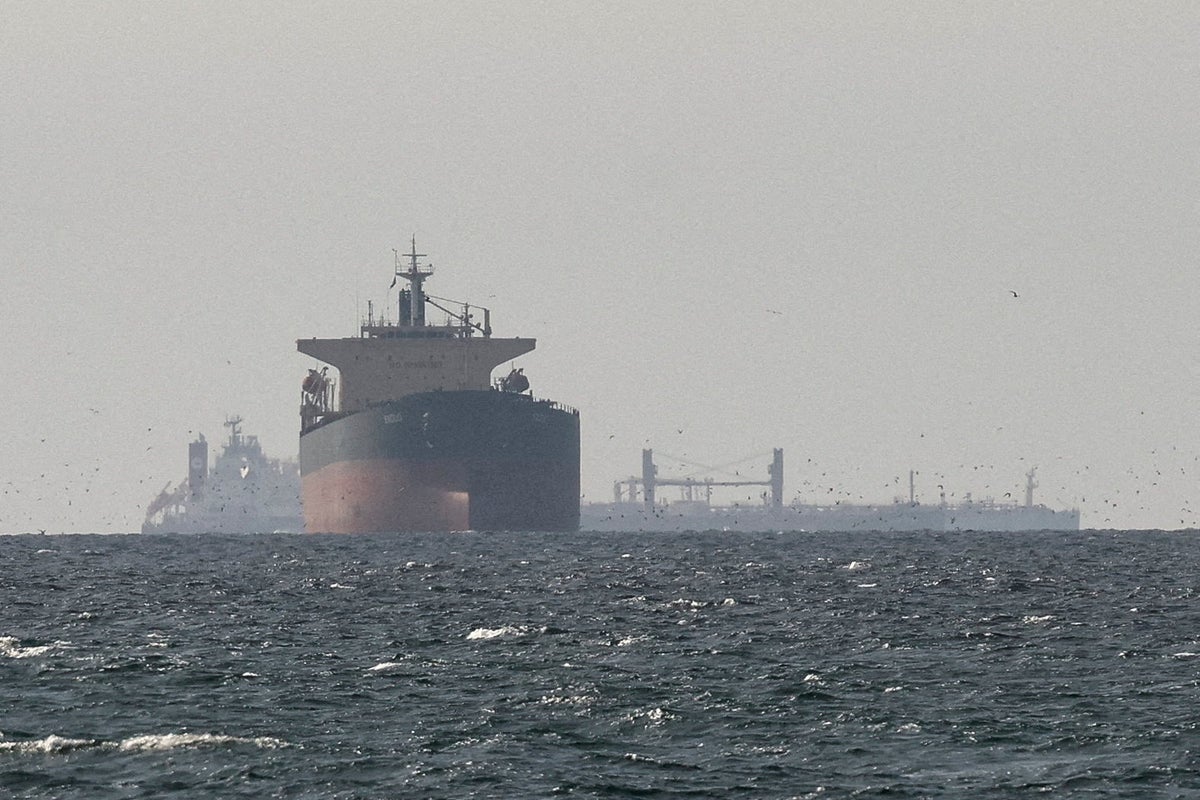
The English Channel is one of the most crowded stretches of water on the planet. On a clear day, you can stand on the white cliffs and see the steel skeletons of industry hauling the world’s cargo from one horizon to the other. It is a predictable, regulated ballet. But lately, there are shadows in the dance.
They are called the shadow fleet. To the accountants in London or the strategists in Moscow, they are "vessels of convenience" or "dark tankers." But to a coastguard watchman staring at a radar screen, they are something far more visceral. They are ghosts. These ships are often decades old, rusting hulks that should have been turned into razor blades years ago. Instead, they carry millions of barrels of crude oil through some of the most sensitive ecosystems and busiest shipping lanes in the world.
And they are doing it with their eyes shut.
The Invisible Armada
Imagine a captain standing on the bridge of a 250,000-ton tanker. Let’s call him Mikhail. He isn't a villain in a thriller; he’s a man with a mortgage and a thinning coat, working for a shell company registered in a jurisdiction that doesn’t exist on most maps. His ship is the Vela, or the Andromeda, or whatever name was slapped onto the hull in a harbor three weeks ago.
Under international law, Mikhail’s ship must broadcast its position via an Automatic Identification System (AIS). It’s the maritime equivalent of driving with your headlights on. But as he nears the waters controlled by the United Kingdom, Mikhail reaches for a switch. The signal vanishes. On the screens of the Maritime and Coastguard Agency, a massive vessel simply ceases to exist.
This isn't just a game of hide-and-seek. It’s a calculated middle finger to the global financial system. Following the invasion of Ukraine, Western powers slapped a price cap on Russian oil, designed to starve the war machine while keeping the lights on in Europe. The shadow fleet is the workaround. By using aging ships, obscure insurance, and "dark" sailing, Russia continues to move its primary export, bypassing the sanctions that were supposed to bring its economy to a standstill.
A Threat Beyond the Ledger
The UK government recently signaled a shift in tone. Prime Minister Keir Starmer suggested a more aggressive posture—boarding ships, inspecting papers, and making it clear that British waters are not a free pass for sanction-busting. But the ships keep coming. Recently, a cluster of these tankers drifted through the Channel, ignoring the threats and sticking to the deep-water paths.
The tension isn't just political. It’s environmental.
Consider the math of a disaster. A modern, Tier-1 tanker is insured by the International Group of P&I Clubs. If it hits a reef or another vessel, there is a multi-billion-dollar safety net to pay for the cleanup, the dead birds, and the ruined livelihoods of fishermen. The shadow fleet operates outside this net. They carry "ghost insurance" from entities that likely don't have the liquidity to cover a cracked hull, let alone an ecological catastrophe.
If one of these rust-buckets loses power in a gale off the Cornish coast, the British taxpayer is the one holding the bucket. We are effectively subsidizing the risk of Russia’s oil trade. Every time a shadow tanker passes the Isle of Wight, it is a ticking time bomb with a faulty fuse.
The Shell Game at Sea
How does a ship become a ghost? It starts with a change of flag. Suddenly, a ship that flew the flag of a reputable maritime nation is registered in Gabon, or the Cook Islands, or Eswatini—a landlocked country in Africa. These "flags of convenience" provide a veneer of legitimacy while offering zero oversight.
Then comes the ownership. Trace the paper trail of a shadow tanker and you will find yourself in a labyrinth of Russian-linked shell companies. One company owns the engine, another owns the hull, and a third, based in a Dubai skyscraper, manages the crew. This fragmentation is intentional. It makes legal recourse nearly impossible. If the ship leaks, who do you sue? A PO Box in the Seychelles?
The UK’s threat to board these ships is a high-stakes gamble. Boarding a sovereign-flagged vessel in international waters—even if that flag is a transparent front—is a legal minefield. It risks escalation. Yet, doing nothing is an admission that the rule of law stops at the shoreline.
The Human Cost of the Dark Trade
We often talk about these ships as if they are autonomous drones. They aren't. They are manned by sailors who are often as much victims as they are accomplices.
These crews frequently work for substandard wages on ships with neglected maintenance. They know the lifeboats might not work. They know the engine room is a patchwork of recycled parts. They sail with the knowledge that if they are detained, their "owners" might simply vanish, leaving them stranded in a foreign port without pay or a way home.
The shadow fleet is a symptom of a fractured world. It is what happens when global trade meets a geopolitical brick wall. We want to stop the flow of money to a conflict, but the world’s thirst for energy creates a vacuum that even the tightest sanctions can’t fully seal. The result is a parallel economy—a dark mirror of the legitimate shipping world.
The Edge of the Horizon
Standing on the shore, you can’t tell the difference between a legitimate tanker and a shadow one. They both look like low-slung islands of steel against the grey Atlantic. But the difference is there, hidden in the lack of a radio signal and the absence of a verifiable insurance policy.
The British government’s "boarding threat" was a shot across the bow. It was an attempt to reassert control over a maritime territory that feels increasingly lawless. But as the shadow fleet continues to pass through, eyes shut and hulls heavy with sanctioned crude, it becomes clear that words are not enough to stop a ghost.
The sea doesn’t care about price caps. It doesn't care about the G7 or the Kremlin. It only cares about the integrity of the steel and the skill of the hands on the wheel. Every day that these aging, uninsured, and unmonitored vessels traverse the narrow lanes of the English Channel, we are betting the health of the ocean against the desperation of a cornered superpower.
The ships move on. The signals stay dark. Somewhere in the North Sea, another captain reaches for a switch, and another piece of the world’s order fades from the radar.