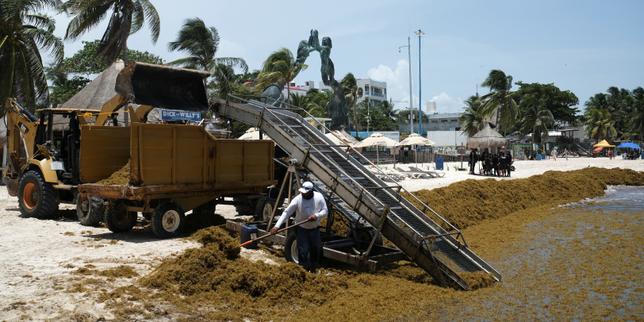
The Caribbean dream is currently suffocating under a thick, brown, foul-smelling blanket of sargassum. For travelers arriving in places like Tulum or Playa del Carmen this August, the promise of turquoise waters and pristine white sand has been replaced by the pungent odor of rotting eggs—a byproduct of hydrogen sulfide released as these massive mats of algae decompose on the shore. While government officials and tourism boards attempt to maintain a veneer of normalcy, the reality on the ground is a stark, economic contraction that threatens the very foundation of the region’s hospitality sector.
This is not a temporary anomaly or a seasonal hiccup that will resolve with the next tide. It is a fundamental shift in the marine ecosystem of the Atlantic, a runaway environmental phenomenon that has morphed into a permanent fixture of coastal life. Since 2011, the scale of these arrivals has expanded from a manageable nuisance into a multi-million-ton problem that defies conventional cleaning methods. If you liked this post, you might want to check out: this related article.
The scientific consensus points to a complex convergence of human impact and changing planetary conditions. Large-scale nutrient runoff—nitrogen and phosphorus carried into the ocean by the Amazon, Orinoco, and Congo rivers—serves as fuel for these floating mats. When coupled with rising ocean temperatures and altered current patterns, the Atlantic has effectively become a nursery for sargassum, churning out record-breaking biomass that spans the basin from West Africa to the Gulf of Mexico.
Attempts to manage this influx have largely been reactive. The Mexican Navy, for instance, has deployed specialized collection vessels and containment barriers designed to intercept the algae before it reaches the surf. While these efforts capture thousands of tons of material, they are essentially trying to bail out a sinking ship with a thimble. By the time the seaweed reaches the shoreline, the mechanical removal processes often cause further damage, eroding beach stability and disrupting the very habitats that hotels work so hard to market. For another look on this event, refer to the recent update from Travel + Leisure.
There is an uncomfortable truth that many stakeholders are hesitant to voice: the current model of "clearing the beach" is unsustainable. Heavy machinery, noisy equipment, and the massive scale of daily labor required to keep a resort front looking pristine are not just costly—they are ecologically invasive. Furthermore, when that seaweed is removed and dumped inland, the problem is not solved; it is merely relocated, often creating new environmental hazards as it leaches chemicals into the groundwater or emits methane during decomposition.
The economic consequences are equally brutal. Small businesses, restaurants, and independent service workers operate on razor-thin margins. A single bad month, characterized by a persistent stench and deserted beaches, can wipe out the annual earnings of a family-run enterprise. While luxury resorts might have the capital to invest in proprietary barriers or private cleaning crews, the secondary ecosystem of tourism—the tour operators, local cafes, and artisans—is being pushed to the brink.
Some innovators are attempting to pivot toward a circular economy by treating the sargassum as a resource rather than trash. There are active experiments involving the transformation of the algae into bio-fertilizers, construction blocks, and even materials for footwear. These are honorable efforts, but they remain niche. They lack the logistical scale to handle the sheer volume of 40 million tons of biomass recorded in recent cycles. To believe that we can monetize our way out of this crisis is to fundamentally misunderstand the scale of the intrusion.
Travelers looking to escape are increasingly turning to data to navigate the crisis, relying on real-time tracking maps and choosing destinations that are naturally shielded by geography, such as the northern coast of Cozumel or specific islands like Isla Mujeres. This behavior creates a fractured tourism market where only those with the time and resources to hunt for "clean" zones can enjoy the region as it once was. It turns a holiday into a logistical operation, stripping away the spontaneity that makes travel meaningful.
Looking ahead, we must accept that the "pristine beach" aesthetic is increasingly a curated performance rather than a natural state. The sea has changed. The environmental drivers—the fertilizer runoff, the warming currents, the atmospheric changes—are not being addressed with the urgency required to curb the phenomenon at its source. Until the international community treats the nutrient loading of the Atlantic as a global ecological emergency rather than a localized tourism annoyance, the brown tide will continue to define the future of the Caribbean coast.
We are left with a sobering reality. The industry is currently locked in a war of attrition against an adversary that grows exponentially more potent with every passing season. Whether through the development of better interceptor technology or a massive transition in how we approach coastal management, the era of passive, effortless beach tourism in Mexico is ending. We have entered a period where the survival of the sector depends on the willingness to fundamentally rethink our relationship with the coastline, acknowledging that nature no longer bends to the demands of the luxury travel industry.
The reality of the Mexican sargassum crisis
This video provides a direct look at the scale of the sargassum invasion and the ongoing efforts by the Mexican Navy to contain the seaweed, illustrating the logistical difficulty of the situation.
http://googleusercontent.com/youtube_content/1