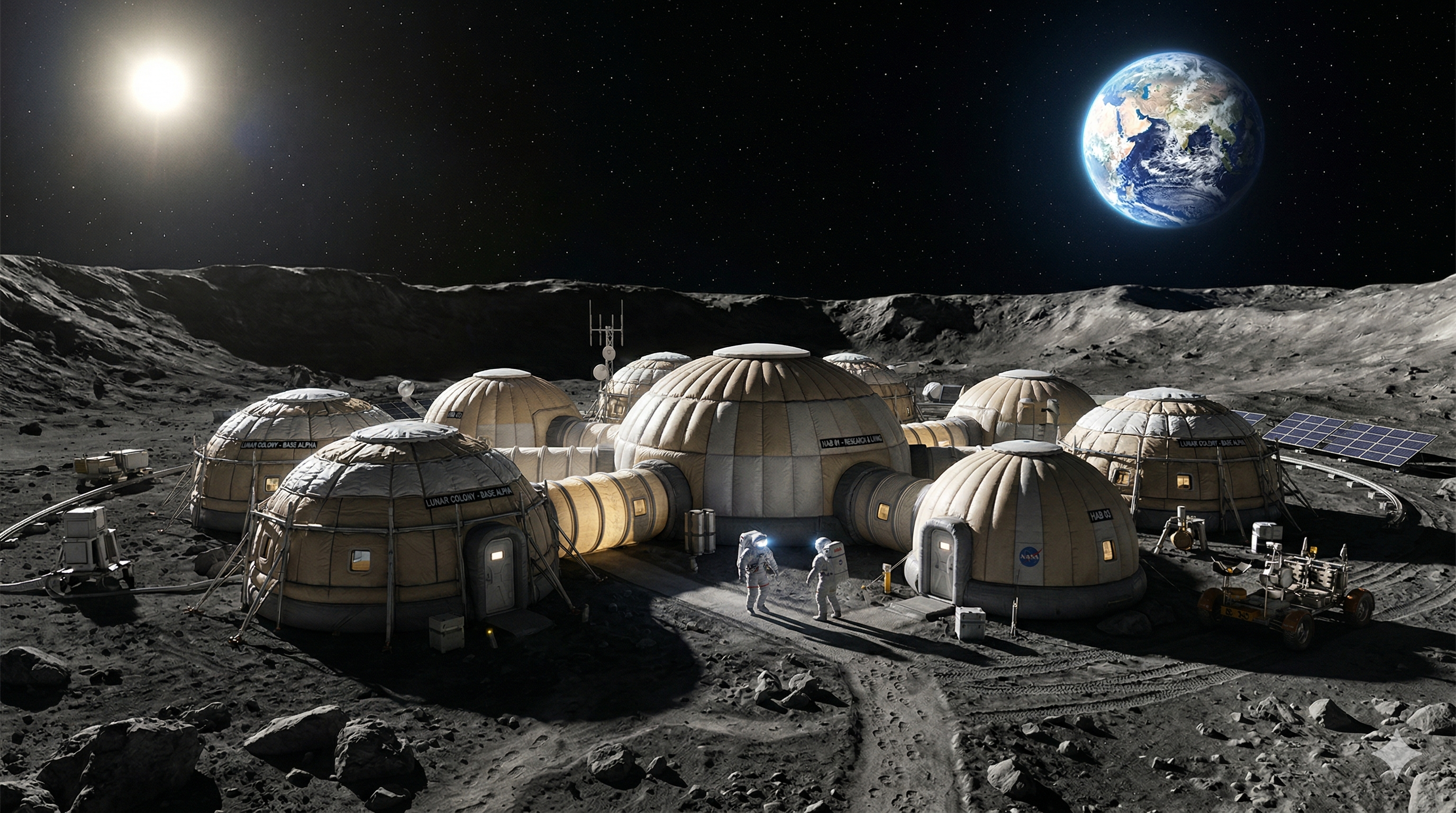
The dream of lunar colonization is currently tethered to a high-tech balloon. Recent breakthroughs in soft-goods engineering have pushed inflatable habitats from science fiction into the primary procurement pipelines of major space agencies. These structures, often made of layered Vectran or Kevlar-like fabrics, offer a massive volume-to-weight advantage over traditional metallic modules. By launching a compressed "pod" that expands once it reaches the lunar surface, engineers can bypass the physical constraints of rocket fairings. However, the transition from orbital success to lunar survival is fraught with geological and thermal hurdles that remain largely unsolved.
Living on the Moon is not a matter of simply keeping the air in. It is a desperate, constant battle against a vacuum that wants to tear a structure apart, radiation that degrades synthetic fibers, and a layer of abrasive dust that behaves like microscopic shards of glass. While the industry is buzzing about the "sooner than expected" timeline for these habitats, the technical debt required to make them truly permanent is staggering.
The Engineering Logic of the Expandable Shell
Standard space station modules are rigid aluminum cans. They are heavy, expensive to launch, and limited by the diameter of the rocket carrying them. If you want a bigger room, you need a bigger rocket. That math doesn't work for a sustainable lunar base.
Inflatable technology flips the script. By using flexible, high-strength fabrics, a module can be packed into a small footprint and then inflated to five or ten times its launch volume. This isn't your backyard bouncy castle. These shells are composed of dozens of layers, each serving a specific purpose.
The primary bladder holds the atmosphere. Outside that, structural "restraint" layers—often woven from liquid crystal polymers—take the massive tension of the internal pressure. Farther out, shielding layers protect against micrometeoroid impacts. In low Earth orbit, this technology has already been proven. The Bigelow Expandable Activity Module (BEAM) has been attached to the International Space Station for years, performing better than many of its rigid counterparts in terms of temperature regulation and radiation shielding.
The Lunar Dust Problem
The Moon is a different beast entirely. Unlike the vacuum of space, the lunar surface is covered in regolith. This isn't soft sand. Because there is no wind or water to erode the edges of rock particles, lunar dust is incredibly sharp and electrically charged.
When an inflatable habitat sits on the lunar surface, every vibration—from an astronaut’s footsteps to the cycling of life support pumps—creates friction between the fabric floor and the ground. Over months, that friction can act like sandpaper on the structural bladder. If the outer skin is compromised, the internal pressure will eventually find a way out.
Journalistic scrutiny of current lunar plans reveals a glaring lack of long-term wear data. Most tests involve short-duration exposure or simulations in clean rooms. We have yet to see how these advanced polymers hold up after 500 days of being pelted by secondary ejecta from nearby landings or the constant "breathing" of the structure as it expands and contracts during the lunar day-night cycle.
Radiation and the 300 Degree Swing
The temperature on the Moon is a nightmare for synthetic materials. In direct sunlight, the surface hits 127°C. When the sun goes down, it plunges to -173°C. These cycles last for two weeks at a time.
Most high-strength fibers have a specific "glass transition temperature" where they become brittle. If an inflatable habitat isn't perfectly insulated, the structural integrity of the folds and seams could fail during the lunar night. Engineers are currently proposing a "regolith shield"—using autonomous robots to pile lunar soil over the inflated modules.
This creates a paradox. The primary selling point of an inflatable is its lightweight, easy-set-up nature. But to make it safe for humans, you immediately need to bring heavy earth-moving equipment to bury it under three to five meters of dirt. Suddenly, the "sooner than expected" timeline looks a lot more like a decades-long infrastructure project involving heavy machinery that doesn't yet exist in a space-rated capacity.
The Business of the Lunar Gold Rush
Follow the money and you find a mix of visionary startups and legacy defense contractors. Companies like Sierra Space and Maxar are betting heavily on these soft-goods architectures. The motivation isn't just scientific curiosity; it is about establishing "squatter's rights" on the lunar south pole, where water ice is thought to exist in shadowed craters.
The Cost of Survival
| Feature | Rigid Metallic Module | Inflatable Fabric Module |
|---|---|---|
| Launch Mass | Extremely High | Low to Medium |
| Living Volume | Fixed and Narrow | Large and Adaptable |
| Shielding | Built-in (Aluminum) | Requires External Regolith |
| Failure Mode | Stress Cracks | Puncture/Delamination |
| Complexity | Low (Proven) | High (Deployment Risk) |
The internal economics of these missions are brutal. Launching a single kilogram to the Moon costs upwards of $1,000,000 depending on the vehicle and the landing hardware. If an inflatable module provides $200,000,000 worth of volume for the price of a $50,000,000 launch, the business case is clear. But that math only works if the habitat lasts. If a module fails after two years due to UV degradation or seal failure, the return on investment vanishes, and the mission becomes a high-profile tomb.
Psychologically Sustainable Architecture
We often overlook the human element in the rush to solve the physics. Traditional space modules are cramped, noisy, and clinical. Living in a "tin can" for months at a time leads to significant cognitive decline and interpersonal friction among crews.
Inflatables offer something metallic tubes cannot: verticality and light. Some designs feature multi-story interiors with open floor plans. This isn't a luxury; it is a psychological necessity. Being able to move through a space that doesn't feel like a submarine cabin allows for better mental health outcomes during long-duration stays.
However, the "open" nature of these habitats makes fire suppression and air circulation much harder. In a small tube, you can easily control airflow. In a massive, multi-story inflatable dome, carbon dioxide pockets can form in "dead zones," potentially suffocating an astronaut in their sleep. The life support systems for these structures must be significantly more sophisticated than anything we have used on the ISS.
The Hidden Risk of Deployment
The most dangerous moment for any inflatable habitat is the "unfolding." This is a complex mechanical sequence where high-pressure tanks fill the structure while internal sensors monitor for uneven expansion. If a fold gets snagged or a tether snaps, the entire module can "hernia," creating a weak point that will eventually burst under full pressure.
NASA’s recent testing of the LIFE (Large Integrated Flexible Environment) habitat involved "burst to destruction" tests on Earth. These tests are impressive, showing the units can withstand several times their operating pressure. But a pressurized room in a test bay at Marshall Space Flight Center is a far cry from a module that has been vibrating in a rocket for eight minutes, sitting in a vacuum for three days, and then expanding in 1/6th gravity.
Beyond the Hype
The narrative of "easy" lunar living is a dangerous oversimplification. We are currently in a transition period where the hardware is outpacing the operational reality. We can build a fabric room that holds air, but we haven't yet mastered the art of protecting that room from a celestial environment that is actively trying to destroy it.
The real test will not be the first inflation, but the five-year mark. We need to see how the bonded adhesives in the seams handle the vacuum-induced outgassing. We need to see if the thermal blankets can survive the relentless bombardment of solar protons without becoming brittle and flaking away.
The first inhabitants of these lunar balloons will be pioneers in the truest, most dangerous sense of the word. They will be living inside a pressurized bubble, protected from a lethal environment by little more than a few centimeters of specialized plastic and the hope that the math behind the seams holds true.
Contact a local aerospace procurement office to see the sheer volume of "Requests for Information" regarding regolith-stabilization techniques. That is where the real war for the Moon is being fought—not in the fabrics, but in the dirt.