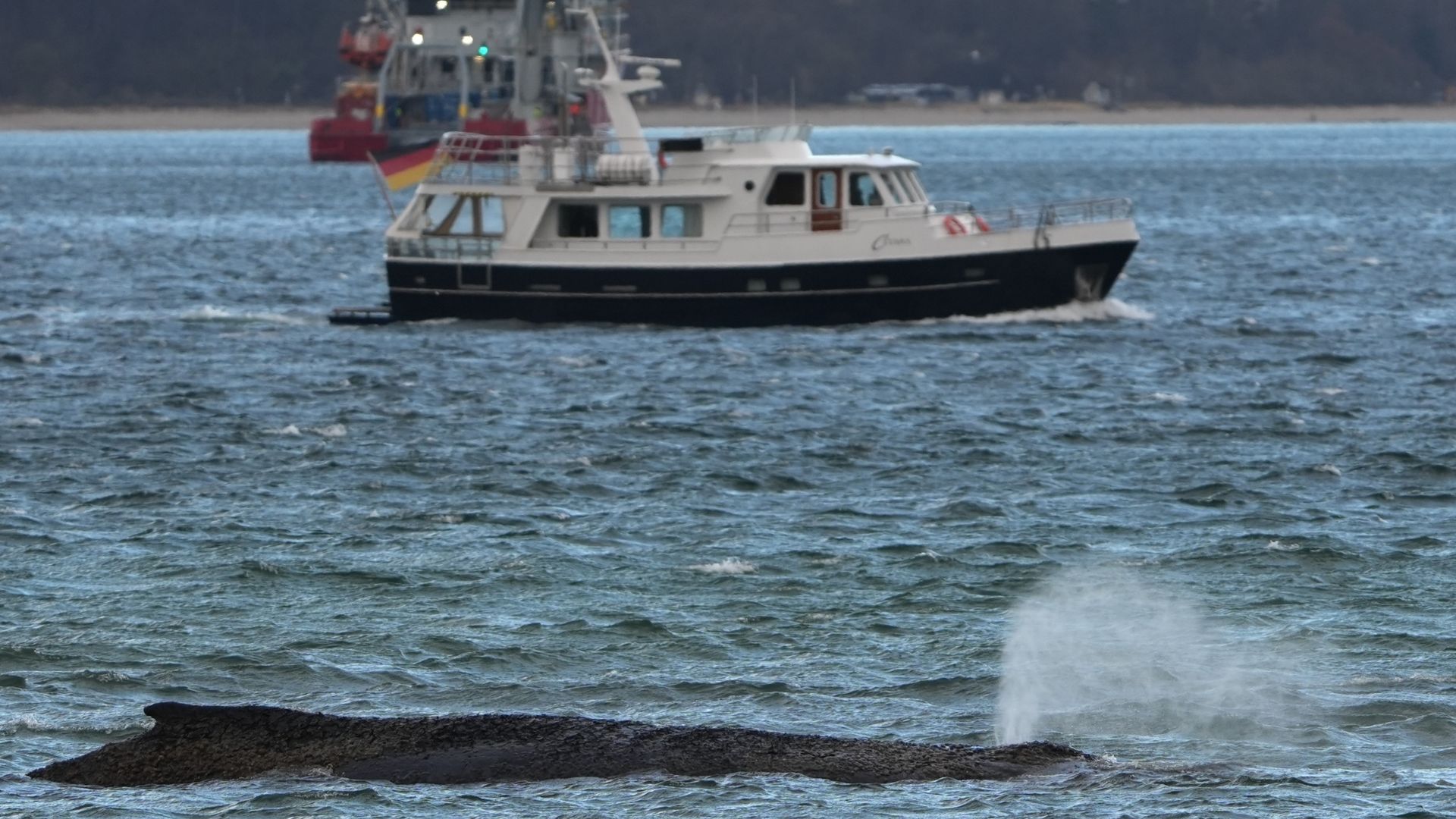
The North Sea is a place of gray iron and relentless movement, but the Baltic is different. It is shallower, more claustrophobic, a brackish cul-de-sac that was never meant to hold a nomad of the deep. When a humpback whale enters these waters, it isn't a majestic sighting. It is a navigational error that carries the weight of forty tons.
On a Tuesday that felt like any other damp morning on the German coast, the reports started trickling in near the island of Rügen. A dark shape. A plume of mist hitting the cold air. A fluke breaking the surface in a way that looked tired rather than playful. By the time the rescue teams arrived, the reality had settled into the sand. A young humpback was grounded.
Imagine the physics of a catastrophe.
In the open ocean, the water is a cradle. It supports every inch of that massive frame, neutralizing gravity so the whale can drift through the abyss with the grace of a bird. But the moment the tide retreats and the belly touches the seabed, the cradle becomes a rack. The whale’s own weight begins to crush its internal organs. The muscles, deprived of the buoyancy they evolved for, start to break down, releasing toxins into the bloodstream.
It is a race against biology.
The Human Chain Against the Tide
Standing on the shoreline, you don't see a "specimen." You see a mountain that breathes.
The rescuers—biologists from the German Oceanographic Museum, local firefighters, and volunteers in thick neoprene—operate in a state of controlled desperation. The air smells of salt, wet sand, and the distinct, metallic scent of a stressed animal. They are tiny moving dots against the vast, dark flank of the whale. They carry buckets. They carry soaked blankets. They carry the impossible hope that the next surge of the tide will be enough.
There is a specific sound a stranded whale makes. It is a low, vibrational huff, a forced exhale that you feel in your chest before you hear it in your ears. It is the sound of an engine struggling to turn over in the sub-zero dark.
Every person on that beach is thinking the same thing, even if they don't say it: why is it here?
Humpbacks are supposed to be following the invisible highways of the Atlantic, moving between breeding grounds in the tropics and feeding grounds in the Arctic. To end up in the Baltic Sea, a whale must pass through the narrow Skagerrak and Kattegat straits. It is a labyrinth of shipping lanes, underwater noise, and shifting currents. Sometimes, a young whale simply takes a wrong turn. It follows a school of herring or gets disoriented by the acoustic clutter of a modern, industrialized ocean.
One mistake. One detour. Suddenly, the horizon disappears, and the floor rises to meet you.
The Invisible Stakes of the Rescue
We often talk about wildlife rescue as a purely altruistic act, but there is something deeper happening on that German mudflat. When we see a creature that represents the primordial scale of the earth struggling in our backyard, it mirrors our own fragility.
The rescuers aren't just fighting to save one life. They are trying to bridge a gap we created. Our oceans are louder than they have ever been. Sonar, shipping turbines, and offshore construction create a "fog" of sound that can shatter the acoustic maps these giants use to find their way.
The humpback’s struggle is a physical manifestation of a planet out of sync.
Hours pass. The tide is a slow, teasing savior. It creeps up the whale’s sides, an inch every twenty minutes. The rescuers work to keep the skin moist, avoiding the blowhole—the single passage of life that must remain clear. If water enters the blowhole, the whale drowns in the very element meant to save it.
Consider the irony of that. A creature of the sea, dying because it is too deep in the water, or not deep enough.
The Strategy of the Shallows
Saving a whale isn't as simple as towing it out to sea. You cannot simply tie a rope to a tail and pull with a tugboat. The force required to move forty tons of flesh against suctioning sand would snap the animal’s spine or tear its flukes.
Instead, it is a game of patience and gentle persuasion.
The teams wait for the "high" high tide. They use inflatable pontoons, sliding them under the pectoral fins like soft yellow pillows. They wait for the water to provide just enough lift so that the whale can regain its sense of equilibrium.
The human element here is one of profound silence. On the shore, the crowds gather. They watch through binoculars. They whisper. There is no cheering. There is only a heavy, collective breath held in the lungs of hundreds of people, waiting for a signal from the water.
Logically, the odds are terrible. Stranded whales, even when successfully refloated, often turn back toward the shore. Their internal compass is broken. Their bodies are exhausted. But humans are not logical creatures when a giant is dying in front of them. We are a species defined by the refusal to accept the inevitable.
The Moment of Release
As the sun began to dip, casting long, orange shadows over the Baltic, the water finally reached the whale’s midsection. A shiver went through the animal. It wasn't a struggle; it was an awakening.
The rescuers backed away. This is the most dangerous part. A panicked flick of a tail can crush a boat or a ribcage. They watched from a distance as the humpback began to test the depth.
It moved.
Slowly at first, a heavy, dragging motion that sent plumes of silt into the air. Then, a rhythmic pulse. The fluke found purchase in the water column. The blowhole cleared the surface, and a massive, triumphant spray of mist erupted, catching the last of the light like a handful of diamonds thrown into the wind.
The whale was off the sand. It was no longer a mountain; it was a ghost again.
But the relief is tempered by a cold truth. The Baltic is still a trap. Even free of the sand, the whale is hundreds of miles from the open ocean. It must find its way back through the same labyrinth that caught it in the first place. The rescuers can provide the spark, but the whale must provide the fire.
We watch these events through screens or from the safety of the dunes because we need to know that the world is still capable of being mended. In an era of melting ice and rising temperatures, the sight of a single humpback slipping back into the dark blue is a small, necessary miracle. It is a reminder that while we have the power to disrupt the ancient paths, we also have the capacity to stand in the cold mud and wait for the tide to turn.
The whale disappeared into the dusk, leaving nothing behind but a flattened patch of sand and a shoreline of people who suddenly felt very small.
The water settled. The gray iron of the Baltic closed over the spot where the giant had been. It was as if nothing had happened, except for the salt on the skin of the rescuers and the memory of a heartbeat that shook the ground.