The announcement by US Central Command (CENTCOM) regarding the neutralization of 9,000 Iranian-linked targets represents more than a milestone in munitions expenditure; it serves as a data point for a shift in modern attritional warfare. When military command structures quantify success through high-volume kinetic engagement, they are measuring the degradation of an adversary’s physical infrastructure against the replenishment rate of an asymmetrical network. To evaluate the efficacy of these 9,000 strikes, one must move beyond the raw tally and analyze the operational logic governing target selection, the economic disparity of the exchange, and the structural resilience of the Iranian proxy architecture.
The Architecture of Proportional Attrition
The 9,000 strikes are not a singular campaign but the sum of a fragmented, multi-theater engagement strategy designed to enforce "deterrence through cost-imposition." This strategy relies on three distinct functional pillars that categorize every hit within the CENTCOM data set.
- Fixed Asset Eradication: This involves the destruction of hardened infrastructure, such as command-and-control (C2) nodes, subterranean storage facilities, and intelligence-gathering outposts. These targets are high-value but low-frequency.
- Mobile Vector Interdiction: A significant portion of the 9,000 hits targets the "logistics in motion"—truck convoys, maritime smuggling vessels, and mobile Transporter Erector Launchers (TELs).
- Active Threat Neutralization: This is the most reactive category, involving the interception of One-Way Attack (OWA) drones and anti-ship cruise missiles (ASCMs) in mid-flight.
The sheer volume of these engagements suggests a high-tempo "sensor-to-shooter" loop where satellite reconnaissance and signals intelligence (SIGINT) are integrated with precision-guided munitions (PGM) in real-time. However, the metric of 9,000 hits fails to account for the Resilience Coefficient—the speed at which an irregular force can replace a $20,000$ drone compared to the time it takes for a state actor to replenish a $2 million$ interceptor.
The Economic Asymmetry of Kinetic Defense
In traditional state-on-state conflict, the destruction of 9,000 targets would likely signal the collapse of a conventional military’s operational capacity. In the context of the Iranian threat network, the math changes. We must examine the Cost-Exchange Ratio (CER).
The Iranian strategy utilizes "Low-Cost, High-Volume" (LCHV) assets. A standard Shahed-series drone or a converted civilian ballistic missile costs a fraction of the sophisticated air defense systems used to neutralize them, such as the RIM-161 Standard Missile 3 or the Patriot PAC-3.
- Interceptor Scarcity: The industrial base for high-end interceptors is characterized by long lead times and limited monthly production yields.
- Target Saturation: By forcing the US and its allies to engage 9,000 times, the adversary is effectively "probing for exhaustion" in the ammunition supply chain.
- Infrastructure Adaptability: Iranian-linked groups often utilize dual-use civilian infrastructure, meaning the "target" is frequently a temporary site that can be reconstituted in a different basement or tunnel within 48 hours.
The 9,000 hits demonstrate a high level of tactical proficiency, yet they also reveal a strategic bottleneck. If the rate of target generation by the adversary exceeds the rate of precision strike capability, the kinetic campaign becomes a treadmill rather than a path to a definitive end-state.
Intelligence Integration and Target Identification
How does a command structure reach a figure of 9,000? This requires a sophisticated Target Development Nominalization process. This process moves through four stages:
Stage 1: Detection and Pattern Recognition
Advanced algorithmic analysis of ISR (Intelligence, Surveillance, and Reconnaissance) data identifies deviations in movement patterns within known smuggling corridors. This transforms raw footage into a "candidate target."
Stage 2: Validation and Legal Clearance
Each of the 9,000 strikes undergoes a vetting process to ensure compliance with the Laws of Armed Conflict (LOAC). This involves assessing the proximity to non-combatants and the military necessity of the strike. The high number suggests an increasingly automated or streamlined legal review process for "active threat" scenarios.
Stage 3: Kinetic Execution
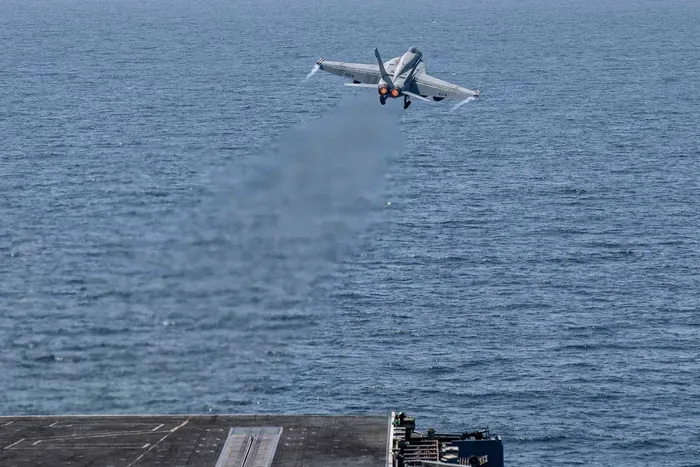
The choice of platform—be it a carrier-based F/A-18, an MQ-9 Reaper, or a surface-launched cruise missile—is determined by the target’s mobility and hardening.
Stage 4: Battle Damage Assessment (BDA)
A strike is only counted in the 9,000 if BDA confirms "functional defeat" or "total destruction." This is often verified through overhead imagery or intercepted communications (COMINT) confirming the loss.
The Displacement Effect in Proxy Warfare
A critical failure in analyzing raw strike data is the ignorence of the Displacement Effect. When a kinetic strike removes a node in a decentralized network, the network does not break; it reroutes.
The Iranian model uses "modular proxy units." Unlike a traditional army with a rigid hierarchy, these groups operate with significant local autonomy. When US forces hit a storage depot in eastern Syria, the logistics chain shifts to a different route through the Al-Anbar province. The 9,000 hits, therefore, represent a constant pruning of a rapidly growing hedge.
The effectiveness of these strikes is inversely proportional to the Regeneration Rate of the proxy. If the US destroys a rocket launcher (Cost: $50,000$) but the Iranian Quds Force can provide two replacements within a week, the 9,000 strikes function as a high-cost containment strategy rather than a degradative one.
Technical Vulnerabilities of the Iranian Kinetic Chain
Despite the resilience of the network, the 9,000 strikes highlight specific vulnerabilities in the Iranian military-industrial complex that CENTCOM is actively exploiting.
- Supply Chain Choke Points: While drones are cheap, the specialized components—servomotors, GPS modules, and high-energy fuels—often rely on illicit global procurement networks. Kinetic strikes on "consolidation points" where these parts are assembled cause disproportionate delays.
- Command Fatigue: The persistent threat of precision strikes forces high-ranking operatives to remain in hiding, degrading their ability to coordinate complex, multi-axis attacks.
- Technological Parity Gaps: The Iranian network relies heavily on electronic spoofing and jamming. The fact that 9,000 targets were successfully neutralized suggests that US Electronic Counter-Countermeasures (ECCM) are currently outperforming Iranian jamming capabilities.
The Limits of the "Cumulative Impact" Hypothesis
Military analysts often cite the "Cumulative Impact" theory—the idea that even if individual strikes are not decisive, the aggregate weight of 9,000 losses will eventually force a strategic retreat. This hypothesis assumes the adversary has a finite "breaking point."
However, in ideological and asymmetrical warfare, the breaking point is not defined by material loss but by political will. The Iranian "Forward Defense" doctrine views these 9,000 losses as acceptable overhead for keeping the conflict away from Iranian soil. As long as the cost of the strikes is borne by the US taxpayer and the physical casualties are largely restricted to non-Iranian proxy fighters, the incentive for Tehran to de-escalate remains low.
The Shift Toward Autonomous Interdiction
To maintain the pace of 9,000 strikes without depleting high-end PGM stockpiles, the US military is pivoting toward Autonomous and Semi-Autonomous Interdiction.
This involves the deployment of lower-cost loitering munitions and "Coyote" style interceptors specifically designed to counter drones. By lowering the cost-per-kill, CENTCOM aims to flip the economic script. Future reports will likely see the 9,000 figure grow exponentially as AI-driven systems take over the identification and engagement of low-tier threats, allowing human operators to focus on high-value strategic targets.
The metric of 9,000 hits is a testament to the proficiency of the US kinetic machine, but it also serves as a warning of the "forever-engagement" loop. The strategy is moving away from the "Decisive Battle" model of the 20th century toward a "Continuous Sanitization" model where the objective is not to win, but to manage the threat level through constant, high-volume attrition.
The logical conclusion for US strategy is the transition from reactive strikes to proactive Network Decapitation. This requires moving beyond hitting the 9,001st drone or 9,002nd truck and instead focusing on the "Digital and Financial Sinew" that binds the proxy network. If the kinetic campaign does not integrate with a more aggressive disruption of the financial flows and technical procurement hubs located outside the immediate theater of operations, the 9,000 strikes will remain a tactical triumph within a strategic stalemate.
The immediate operational priority must be the deployment of directed-energy weapons (lasers) to the theater. Replacing a $2 million interceptor with a "cost-per-shot" measured in cents is the only way to make the 9,000-strike pace sustainable in a prolonged conflict.
Would you like me to analyze the specific supply chain bottlenecks for the Shahed-136 drone components to identify more efficient non-kinetic intervention points?