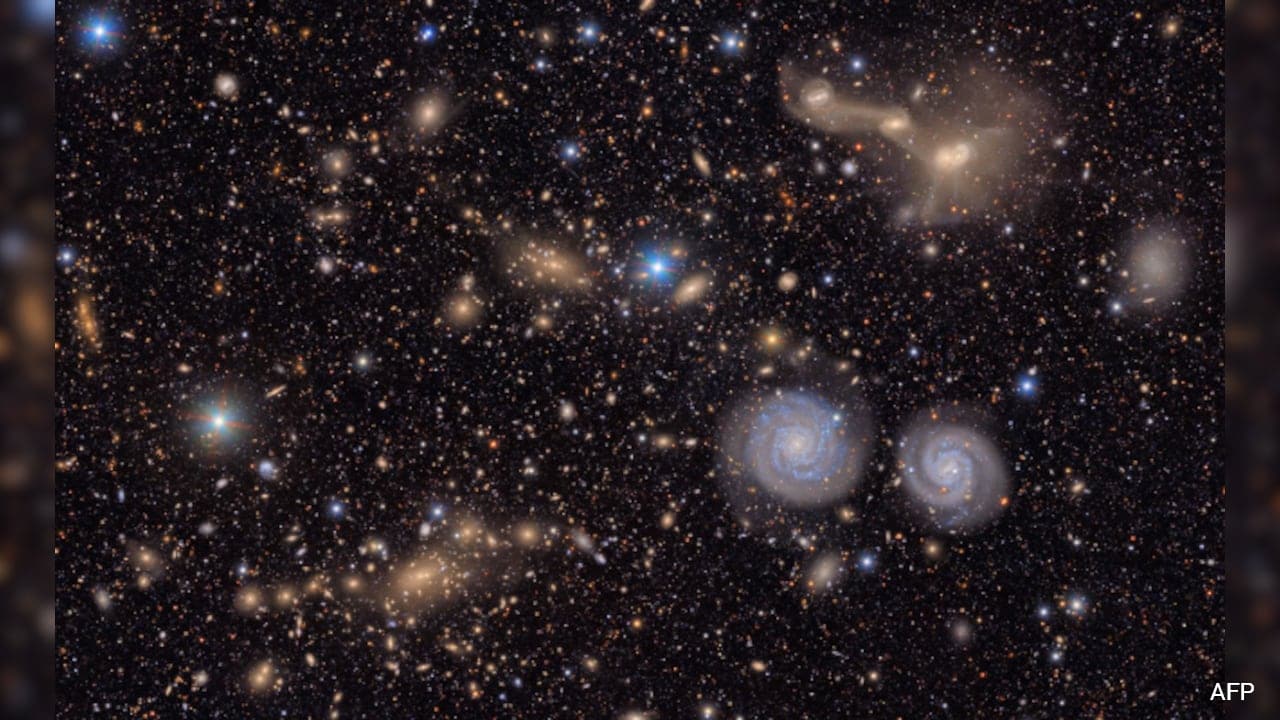
The tech press is currently losing its collective mind over a giant piece of glass and silicon sitting on a mountaintop in Chile.
They are calling the Legacy Survey of Space and Time camera at the Vera C. Rubin Observatory a triumph of human engineering. They gush over its 3.2-gigapixel sensor. They marvel at its ability to capture a golf ball from 15 miles away. They echo the public relations departments claim that this machine will instantly illuminate the darkest secrets of dark matter and dark energy.
It is a beautiful narrative. It is also entirely wrong.
The obsession with building increasingly massive astronomical cameras exposes a fundamental misunderstanding of modern science. We do not have a data collection problem in astronomy. We have an analysis crisis. By building a machine that captures 20 terabytes of raw data every single night, we haven't solved a mystery. We have just built the worlds most expensive digital landfill.
The Vanity Metric of Gross Pixels
For decades, consumer camera companies tricked buyers into believing that more megapixels equaled better photos. Astronomy has fallen into the exact same trap, just on a multi-million-dollar scale.
The Rubin Observatory camera is roughly the size of a small car and weighs three metric tons. Its focal plane utilizes 189 individual charge-coupled device sensors cooled to nearly minus 100 degrees Celsius to minimize thermal noise. The engineering is undeniably impressive. But the underlying assumption—that throwing more pixels at the sky inherently yields breakthrough discoveries—is flawed.
Consider how observational astronomy actually functions. A telescope collects photons; the camera records them. But a camera is only as good as the atmosphere it looks through and the software that parses its output. When you increase resolution to this extreme degree without an equivalent leap in data processing infrastructure, you create severe operational friction.
I have spent years watching research institutions misallocate capital into hardware vanity projects while their software departments run on shoestring budgets and legacy code written in Fortran by professors who retired in the nineties. We are funding the eyes while starving the brain.
The Terabyte Tsunami and the Algorithm Deficit
Let us look at the brutal arithmetic of the Rubin Observatory. Every night, the camera will generate about 20 terabytes of data. Over its planned ten-year run, it will assemble a 60-petabyte catalog of the night sky.
On paper, this sounds magnificent. In practice, it is a logistical catastrophe.
To handle this volume, the observatory relies on automated pipelines to flag transient events—things that move, flicker, or change brightness. The system is designed to generate up to 10 million alerts per night.
Think about that number. Ten million alerts every 24 hours.
Who filters them? Algorithms. And who writes those algorithms? Underpaid postdocs working with massive data sets they cannot possibly validate manually.
Raw Data (20 TB/Night) ──> Automated Filter Pipeline ──> 10 Million Alerts ──> The Bottleneck (Human Analysis)
When you flood an ecosystem with millions of alerts, you do not increase discoveries; you increase false positives and statistical noise. The signal-to-noise ratio of actual scientific breakthroughs plummets. Important astronomical anomalies will not be found by eagle-eyed scientists; they will be buried on page 4,000 of an unread automated spreadsheet stored on a server in Illinois.
Imagine a scenario where an automated pipeline flags an anomalous light curve that could indicate a novel type of supernova. Because the system is spitting out thousands of similar alerts due to atmospheric artifacts or sensor glitches, that specific alert is queued behind an ocean of digital garbage. By the time a human researcher reviews the data three months later, the event is over, the star has faded, and the opportunity for follow-up observation is gone forever.
This is not a hypothetical risk. It is the current state of high-cadence astronomy. We are drowning in data while starving for wisdom.
The Low-Earth Orbit Sabotage
Even if our algorithms were flawless, the hardware purists are ignoring a massive, shiny obstruction in the room: low-Earth orbit satellite constellations.
When the Rubin Observatory camera was conceived over two decades ago, the night sky was relatively empty. Today, companies like SpaceX, OneWeb, and Amazon are launching tens of thousands of communication satellites into orbit. These satellites are highly reflective. They do not just show up as faint dots; to a highly sensitive 3.2-gigapixel sensor, they look like searchlights blinding film.
A single satellite streak can ruin an entire exposure, saturating pixels and creating electronic ghosting across neighboring sensors. The Rubin camera has a massive field of view—roughly 9.6 square degrees, or 40 times the area of the full moon. Because it sees so much of the sky at once, it is uniquely vulnerable to satellite interference.
Estimates suggest that up to 30% of the cameras twilight exposures will contain at least one satellite streak. The solution proposed by the optimists? "We will just fix it in post-processing with software."
This is sheer delusion. You cannot simply algorithmically erase a streak without destroying the underlying data. If a satellite passes in front of a faint, distant galaxy you are trying to measure for weak gravitational lensing, that data is corrupted. Period. We are spending hundreds of millions of dollars to build a ultra-high-definition window to the universe, right as corporate enterprise is painting the glass black.
The False Promise of Democratized Science
Proponents love to argue that the open-access nature of the Rubin data will democratize astronomy. They claim that anyone with an internet connection will be able to search the archive and make discoveries.
This is a patronizing fantasy.
Downloading a multi-gigabyte astronomical image requires significant bandwidth. Querying a petabyte-scale database requires advanced knowledge of SQL, Python, and distributed computing architectures like Apache Spark. The average high school student or amateur astronomer cannot host a 60-petabyte dataset on their laptop.
The data will inevitably be monopolized by a handful of elite institutions that possess the high-performance computing clusters necessary to run deep learning models on the catalog. Instead of democratizing science, these mega-telescopes centralize power. They consolidate funding into a few massive, institutional collaborations, stifling the independent, high-risk research projects that historically drive major scientific pivots.
Shift Capital from Silicon to Software
If we want to actually understand dark energy and the structure of the cosmos, we need to stop building bigger cameras. We need to start building smarter systems.
- Fund the Data Architects: Redirect capital from physical optics into developing advanced machine learning models capable of real-time semantic segmentation of astronomical data.
- Invest in Targeted Follow-Up: A wide-field camera is useless without a fleet of smaller, agile telescopes ready to immediately pivot and confirm alerts. We need an automated, global network of reactive hardware, not just one giant eye.
- Acknowledge the Limits of Scale: Accept that a 3.2-gigapixel camera produces diminishing returns when atmospheric distortion and orbital debris set a hard ceiling on data quality.
Stop celebrating the sheer size of the machine. A bigger bucket does not matter if you are trying to catch water in a torrential downpour with a hole in the bottom. Turn off the hardware hype machine, open the code repositories, and start writing the software that can actually read the universe we are so desperately trying to photograph.