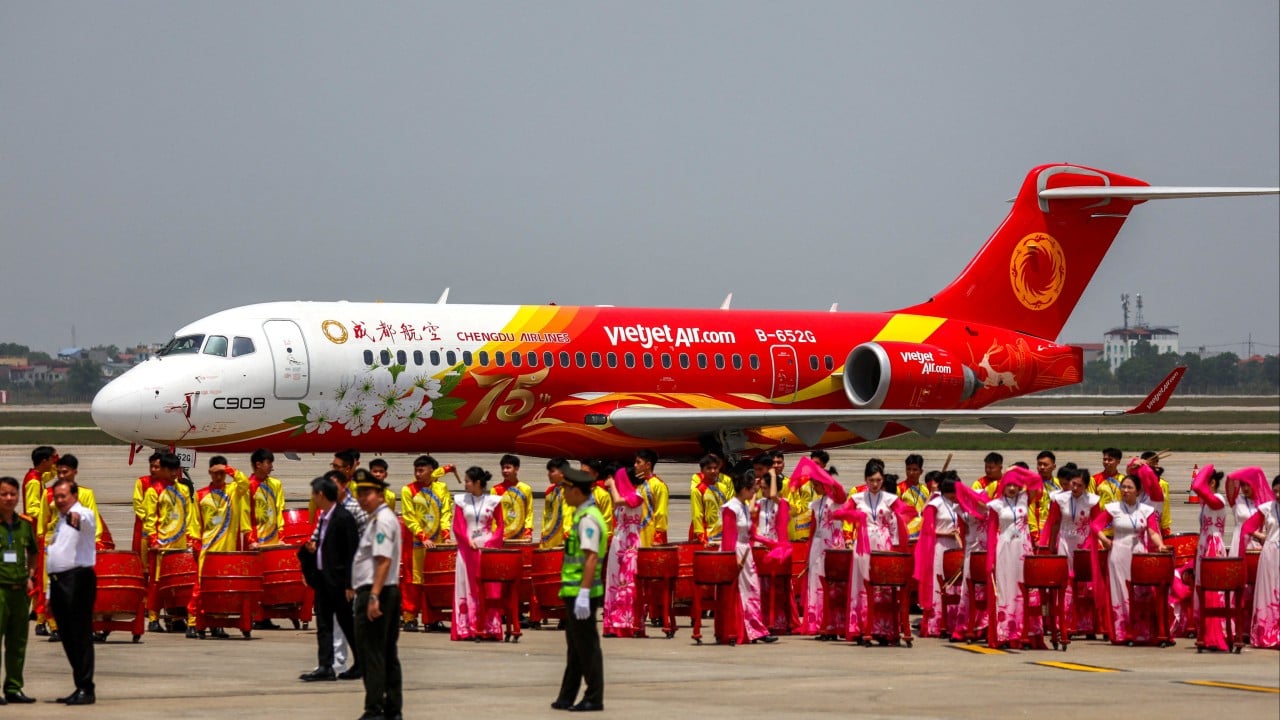
The asphalt on the runway at Tan Son Nhat International Airport doesn’t care about geopolitics. It only cares about weight, friction, and the relentless humidity of Ho Chi Minh City. But for the executives at Vietravel Airlines, the ground beneath their feet has shifted. They recently signed a deal to lease up to 10 COMAC C909 jets, a move that sounds like a dry line item on a balance sheet but feels more like a high-stakes gamble in a sky long dominated by a Western duopoly.
For decades, the sound of a commercial takeoff was the sound of Seattle or Toulouse. Boeing or Airbus. There was a comfort in that predictability. When you stepped onto a plane, you saw the familiar curved winglets or the specific strobe of the navigation lights. Now, a new silhouette is entering the Vietnamese clouds. The C909, formerly known as the ARJ21, is the vanguard of China’s ambition to rewrite the rules of who gets to move the world.
The Weight of a Decision
Imagine a regional manager named Minh. He isn't real, but his problems are. Minh oversees a fleet that must navigate the thin margins of a budget airline where a five-cent increase in fuel costs can erase a month’s profit. For years, Minh and his peers have been held hostage by a supply chain that is fraying at the edges. If a Boeing 737 Max is grounded or an Airbus A321neo delivery is delayed by eighteen months, Minh’s schedule collapses.
The decision to lease Chinese jets isn't born out of a sudden love for COMAC’s engineering over Embraer’s. It is born out of necessity. It is the tactical maneuver of a survivor. Vietnam’s aviation market is exploding, fueled by a middle class that wants to see the world—or at least see Da Nang for the weekend. To meet that demand, you need hulls. You need seats. And right now, the traditional manufacturers are asking airlines to wait in a line that stretches toward the end of the decade.
The C909 is a regional workhorse. It is designed for the short hops, the hour-long flights that connect the industrial hubs of the north to the tourist havens of the south. It seats about 90 people. It is loud, it is functional, and most importantly, it is available.
Breaking the Duopoly’s Grip
We have grown used to the idea that big planes come from the West and everything else is an outlier. This is a psychological barrier as much as a technical one. When the Soviet Union collapsed, the Sukhoi Superjet tried to fill this gap and largely failed to convince the global market of its reliability. China is playing a different game. They aren't just selling a plane; they are selling an ecosystem.
The lease agreement between Vietravel and a Chinese leasing entity isn't a simple "rent-to-own" arrangement. It is a bridge. By bringing these jets into Vietnam, COMAC secures a vital testing ground outside of its domestic borders. They need to prove that these machines can survive the brutal cycle of short-haul regional flying in tropical conditions. Salt air. Heavy rain. Constant cycles of pressurization and depressurization.
If the C909 fails in Vietnam, the dream of the larger C919—the true competitor to the Boeing 737—withers on the vine. The stakes are invisible but absolute. Every time a Vietnamese pilot pushes the throttles forward on a C909, they are conducting a live-fire stress test for the future of Chinese industrial pride.
The Geography of Trust
There is an inherent tension in this partnership. Vietnam and China have a complex history, one defined by centuries of friction and essential trade. In the boardroom, this history is replaced by the cold logic of the "China Plus One" strategy. However, in aviation, that logic flips. Instead of diversifying away from China, Vietravel is leaning in.
Why? Because the price of entry into the Western aviation club has become too high for emerging players. A new Airbus A220 is a masterpiece of carbon fiber and geared turbofans, but it comes with a price tag and a maintenance schedule that requires a level of capital many regional carriers simply cannot sustain without massive state backing.
The C909 represents a "good enough" philosophy. It uses older, proven engine technology—specifically General Electric CF34-10A engines. It isn't trying to reinvent the physics of flight. It is trying to be a reliable bus in the sky. For a traveler, the difference is negligible. The air conditioning still hums. The overhead bins still click shut. But for the airline, the difference is the ability to actually fly a route versus leaving it as a "coming soon" ghost on a website.
The Invisible Infrastructure
A plane is a useless hunk of aluminum without a trail of paper and spare parts. This is where the real human drama unfolds. Somewhere in an office in Hanoi, a logistics officer is currently wondering how quickly a replacement actuator can get from Shanghai to a hangar in Vietnam.
When an airline adopts a new manufacturer, they aren't just buying a vehicle; they are marrying a supply chain. They have to retrain every mechanic. They have to update every safety manual. They have to convince a skeptical public that "Made in China" is a badge of precision, not a warning sign.
Consider the cockpit. The pilots transitioning to the C909 are relearning their instincts. The ergonomics are different. The logic of the avionics has its own dialect. This transition is a quiet, grueling process of study and simulation. It is a human investment that binds the two nations' aviation sectors together more tightly than any diplomatic communique ever could.
The Economics of the Empty Seat
Every hour a plane sits on the ground is a disaster. The aviation industry is a monster that eats cash and breathes kerosene. For Vietravel, the 10 C909s represent a hedge against the unpredictability of the global market. If a trade war or a pandemic or a simple manufacturing defect cripples one side of the world’s production, they now have a foot in another camp.
This isn't just about Vietnam. It’s a signal to the rest of Southeast Asia. Indonesia has already taken the plunge with the same aircraft. Cambodia and Laos are watching closely. We are witnessing the birth of a regional aviation bloc that operates outside the gravitational pull of the Atlantic.
The skeptics point to the C909’s fuel burn. It isn't as efficient as the latest Western models. In a world obsessed with carbon footprints, that matters. But in a world obsessed with survival, availability trumps efficiency. You cannot be efficient if you do not have a plane to fly.
The First Flight
There will be a morning, soon, when the first of these ten jets pulls up to a gate in Da Nang. The passengers will look out the window at the terminal, perhaps noticing the slightly different shape of the nose or the unfamiliar logo on the tail. Most won't care. They will be thinking about their meetings, their families, or the beach.
But in the cockpit, the captain will be feeling the weight of the aircraft as it taxis. In the offices of COMAC, engineers will be watching the telemetry data like a heart monitor. And in the headquarters of Boeing and Airbus, a few people might finally stop looking at their own backlogs and start looking over their shoulders.
The duopoly isn't dead. Not yet. But the sky is getting crowded. The C909 is a small plane making a very loud noise. It is the sound of a country that decided it was tired of being a passenger in someone else’s technology.
Vietnam is the proving ground. The 1,000-mile journey of a thousand flights begins with a single lease agreement. The gamble is out in the open now, shimmering on the heat-soaked tarmac, waiting for the wheels to leave the earth.