In a workshop where the air smells perpetually of cured resin, solder smoke, and cold coffee, a technician wipes a line of sweat from his forehead. Outside, the night sky over eastern Ukraine is black and clear. That clarity is a curse. Clear skies mean optics work better, but they also mean the sound of an engine carries for miles across the sunflower fields.
On the workbench sits a frame made of lightweight carbon fiber and molded foam. A year ago, this machine was built to do one thing: fly toward a target, crash, and explode. It was a one-way trip. Cheap, effective, expendable.
Not anymore.
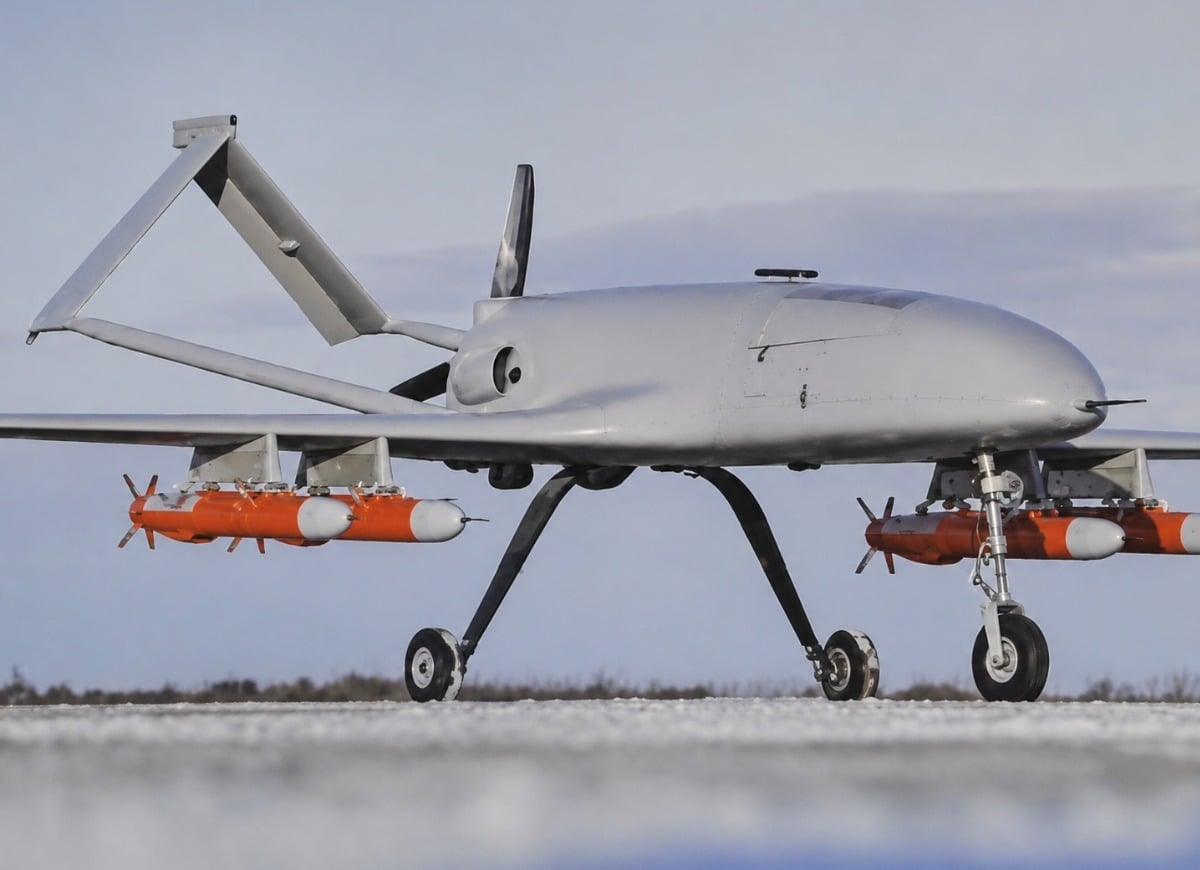
Tonight, the team isn't loading explosive paste directly into the drone's belly. Instead, they are mounting hardpoints under its long, straight wings. They are bolting lightweight, wire-guided missiles directly to the airframe. The kamikaze drone has evolved into a reusable missile carrier.
Warfare has always been an arms race of cost versus capability, but what is happening right now in the skies over Eastern Europe is a fundamental shift in how human beings project force. It is the story of how an desperate necessity forced a team of engineers to turn target practice into an airborne predator.
The Tyranny of the One-Way Ticket
To understand why this shift matters, you have to look at the brutal math of modern air defense.
For months, the low-cost attack drone dominated the battlespace. A thousand dollars' worth of commercial electronics, a lawnmower engine, and five kilograms of high explosives could destroy a tank worth three million dollars. It was an asymmetric victory.
Then the countermeasures caught up.
Signal jammers flooded the radio spectrum. Automated shotguns and thermal-scoped heavy machine guns began picking off the slow-moving craft as they made their final, direct approach. To strike a target, a suicide drone had to get close. To get close, it had to survive the lethal envelope of short-range air defenses. Most didn't. The survival rate plummeted.
Consider a hypothetical operator named Viktor, sitting in a dugout three miles behind the zero line. He puts on his virtual reality goggles, throttles up, and takes off. His target is an armored vehicle tucked behind a tree line. He spends twenty minutes navigating the treacherous electronic warfare environment, dodging invisible walls of radio noise.
He spots the target. He dives.
Three hundred feet above the ground, a blast of directional radio frequency snaps the video feed to snow. The drone loses lock, drifts off course, and plows uselessly into the dirt. Twenty minutes of tension, hundreds of hours of production, and a valuable window of opportunity evaporate in a flash of static.
The one-way model was failing. Ukraine needed a way to strike from outside the kill zone of short-range air defenses. They needed standoff capability.
Raising the Ceiling
Military engineers faced a seemingly impossible engineering puzzle. Traditional air-to-ground missiles require heavy platforms—jets, attack helicopters, or massive military-grade Unmanned Aerial Vehicles (UAVs) like the American MQ-9 Reaper. These platforms cost tens of millions of dollars. Ukraine couldn't afford to risk multi-million dollar platforms close to the front, where high-altitude air defense systems would swallow them whole.
The solution came from taking the existing, mass-produced long-range suicide drone and modifying its fundamental architecture.
By extending the wingspan and upgrading the propulsion system, engineers increased the payload capacity without turning the craft into a giant radar target. But the true leap wasn't the airframe. It was the weapons integration.
Rather than acting as the bomb, the drone became the launcher.
Imagine a small wooden boat equipped with an outboard motor. It was designed to run straight into an enemy ship and detonate. Now, picture the builders stepping back, looking at the craft, and instead mounting two ballistas on the sides. Suddenly, the boat doesn't have to die to kill its target. It can fire from a safe distance, turn around, and return home to reload.
This is precise standoff capability on a shoestring budget.
By mounting small, anti-tank guided missiles or custom-built precision munitions onto the long-range drone frame, operators can loiter outside the effective range of local machine guns and point-defense jammers. The drone tracks the target from two miles away. The operator verifies the coordinates. A thumb moves on a controller.
The missile releases.
A pulse of rocket motor illuminates the night sky. The munition streaks toward the target at high speed, far too fast for handheld jammers or small arms fire to react. Meanwhile, the mother drone pitches up, turns, and begins its journey back to a hidden airstrip.
The Human Reality in the Bunker
It is easy to get lost in the technical jargon of telemetry, payload-to-weight ratios, and optical guidance. But inside the field command centers, this technological leap changes everything for the human beings pulling the triggers.
The mental toll of operating suicide drones is a quiet weight. Operators know that every launch is a loss of hardware, a ticking clock where failure is the default outcome unless absolute precision is achieved.
Adding a return vector changes the psychological dynamic completely.
"When you fly a single-use rig, you are constantly anxious about the battery bar," one field team leader explained during a recent debrief near the front lines. "You're watching the percentage drop—thirty percent, twenty percent. You know if you don't find a target in sixty seconds, you've wasted the craft anyway. You make reckless decisions. You push too hard into jammer fields."
With a missile carrier, the operational rhythm cools down. The pilot can wait. They can circle high above the noise, observing the target, reading the movements of the crew below. There is patience. If the target moves into a dense civilian area or behind heavy cover, the pilot doesn't have to force a dangerous strike to avoid wasting the drone. They simply abort the run, hold orbit, or fly back to base.
It turns a frantic, high-stress gamble into a calculated, methodical process.
The Engineering Tightrope
Making this concept work in the mud and dust of a real warzone required solving a series of brutal physics problems.
First, there is the recoil problem. Firing a rocket or releasing a heavy weight from a lightweight carbon-fiber frame creates instant mechanical chaos. When a missile leaves the rail, the sudden loss of mass causes the drone's flight controller to panic. The nose pitches up violently. The center of gravity shifts instantly.
Early test flights ended in flat spins. The airframes literally shook themselves apart in mid-air when the munitions fired.
Software engineers had to write custom flight control algorithms capable of anticipating the exact millisecond of launch. The moment the firing command is sent, the drone's flight computer automatically adjusts the motor speeds and control surfaces to counter the sudden drop in weight and the backward push of the rocket blast.
Second, there is the connection issue. How do you guide a missile from a small drone when the surrounding airspace is thick with electronic interference?
The answer lies in hybrid guidance systems. Some of these micro-missiles use thin, microscopic strands of fiber-optic wire that unspool from the back of the missile as it flies. Because the control signal travels through physical glass wire rather than over the airwaves, radio jammers are completely useless against it. The operator sits miles away, looking through a crystal-clear video feed transmitted down a thread of glass, guiding the weapon directly into an engine intake or an open hatch.
The Changing Shape of the Sky
What we are witnessing is not just an update to a specific weapon system. It is the democratization of air power.
For nearly a century, air superiority was the exclusive domain of wealthy nation-states. If you wanted the ability to launch precision strikes from the air, you needed billions of dollars, vast training facilities, complex supply chains, and fleets of exquisite aircraft.
That wall has been broken down.
A small team in an abandoned garage, using off-the-shelf microcontrollers, custom 3D-printed parts, and smart aerodynamic engineering, can now deploy an air force that mimics the basic tactical capabilities of heavy military assets. They can launch, strike from standoff distances, gather reconnaissance, and return to launch again.
The implications ripple far beyond the current conflict. Military strategists around the world are watching the skies over Ukraine and rewriting their doctrine manuals in real time. The era of the expensive, irreplaceable weapon system is being challenged by fleets of modular, adaptable, and shockingly cheap aerial platforms.
Back in the eastern Ukrainian workshop, the technician finishes securing the final mounting pin on the wing rail. He taps the carbon-fiber frame twice with his knuckles, a quiet ritual before every mission.
The drone is carried out into the damp grass of the clearing. The electric motors spin up, their high-pitched whine rising until it cuts through the sound of the wind.
It lifts off smoothly into the blackness, carrying its small passengers under its wings, leaving behind the days when its only purpose was to die.


:max_bytes(150000):strip_icc():focal(749x0:751x2)/Arnold-Schwarzenegger-Joseph-Baena-032926-a90f8d3315fc44a6aebc6d7bb44bda01.jpg)