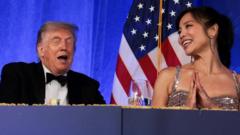
The media elite love a good roast. Every spring, Washington packs into a ballroom, trades their cheap shots for black tie, and pretends the cozy relationship between political reporters and the politicians they cover is anything other than a mutual protection racket. The lazy narrative from mainstream coverage always frames these nights as harmless fun or a rare moment of bipartisan levity. That is a sanitized fiction designed to keep the illusion of objective journalism alive.
When a president steps up to the dais and takes shots at the press, reporters laugh on cue. They clap. They tweet about the sharp delivery. Then they go back to the newsroom and file stories about how dangerous that exact politician is to democracy. You cannot dine with the wolf and pretend you are writing an expose on his dental hygiene.
The Myth of the Fourth Estate Punchline
We are told that public ribbing proves the health of our democracy. The logic goes that if a leader can stand up and take a joke, authoritarianism is miles away. This is a comforting delusion. Humor acts as a pressure valve, defusing actual accountability.
Think about the structural mechanics of access journalism. To get the scoop, a reporter needs sources inside the administration. To get invited to the inner circle, a publication needs to play ball. Turning power into a punchline for forty-five minutes does not diminish that power; it domesticates it. It humanizes figures who operate multi-billion-dollar apparatuses of state violence and domestic surveillance by making them look self-aware.
The real problem with the correspondents dinner is not that the jokes are mean or that feelings get hurt. The problem is the normalization. It tells the public that politics is a game played by a tight-knit club where everyone shares a private joke at your expense.
Access Journalism is Dead
The traditional model of political reporting relied on proximity. You had to be in the room, at the bar, at the dinner table. That proximity bred compromise. When your primary professional asset is your relationship with the subject, your reporting becomes an exercise in managed reputation.
We saw this play out for decades. Reporters traded flattering coverage for exclusive quotes. The public got a curated version of reality, polished until all the sharp edges of policy failures and corruption were sanded down into polite disagreements.
The internet broke that monopoly on information, and Washington panicked. Now, instead of adapting to an era where anyone can publish primary source documents or raw footage, the institutional press retreats deeper into tribal pageantry. The annual dinner is the ultimate manifestation of this retreat. It is a celebration of insider status at a time when institutional trust is at historic lows.
The Transactional Waltz
Let us look at the mechanics of the exchange.
- The Invitation: Media conglomerates buy tables. They host administration officials, cabinet members, and cable news stars.
- The Performance: The president delivers a speech written by comedy writers, mocking the reporters who cover them. The reporters laugh to prove they are good sports.
- The Aftermath: Everyone goes home with fresh social capital. The next morning, the news cycle dissects the delivery rather than the policies enacted that week.
This is not a confrontation of power. It is a joint public relations exercise.
When a journalist spends the evening mingling with the targets of their investigations, a psychological shift occurs. It becomes much harder to write a scathing, unsparing investigative piece about someone who just shared a table wine recommendation with you. Human empathy overrides professional detachment. That is a feature, not a bug, of the Washington social scene.
What Real Accountability Looks Like
Real watchdogs do not accept dinner invitations from the people they are supposed to bite. They do not laugh at their jokes, and they certainly do not validate their charm offensive.
If the press corps wanted to signal actual independence, they would boycott the ballroom. They would spend that evening combing through procurement logs, investigating lobbyist ties, or tracking unspent federal funds. They would treat the administration with the cold, unyielding skepticism that institutional power deserves.
Instead, they buy the tuxedos. They practice their forced smiles. They write think pieces about the punchlines while the machinery of government grinds on, insulated by a press corps that prefers the comfort of the cocktail circuit to the cold, lonely work of actual opposition.
Stop buying the tickets. Turn off the microphones. Cover the policy, ignore the performance.