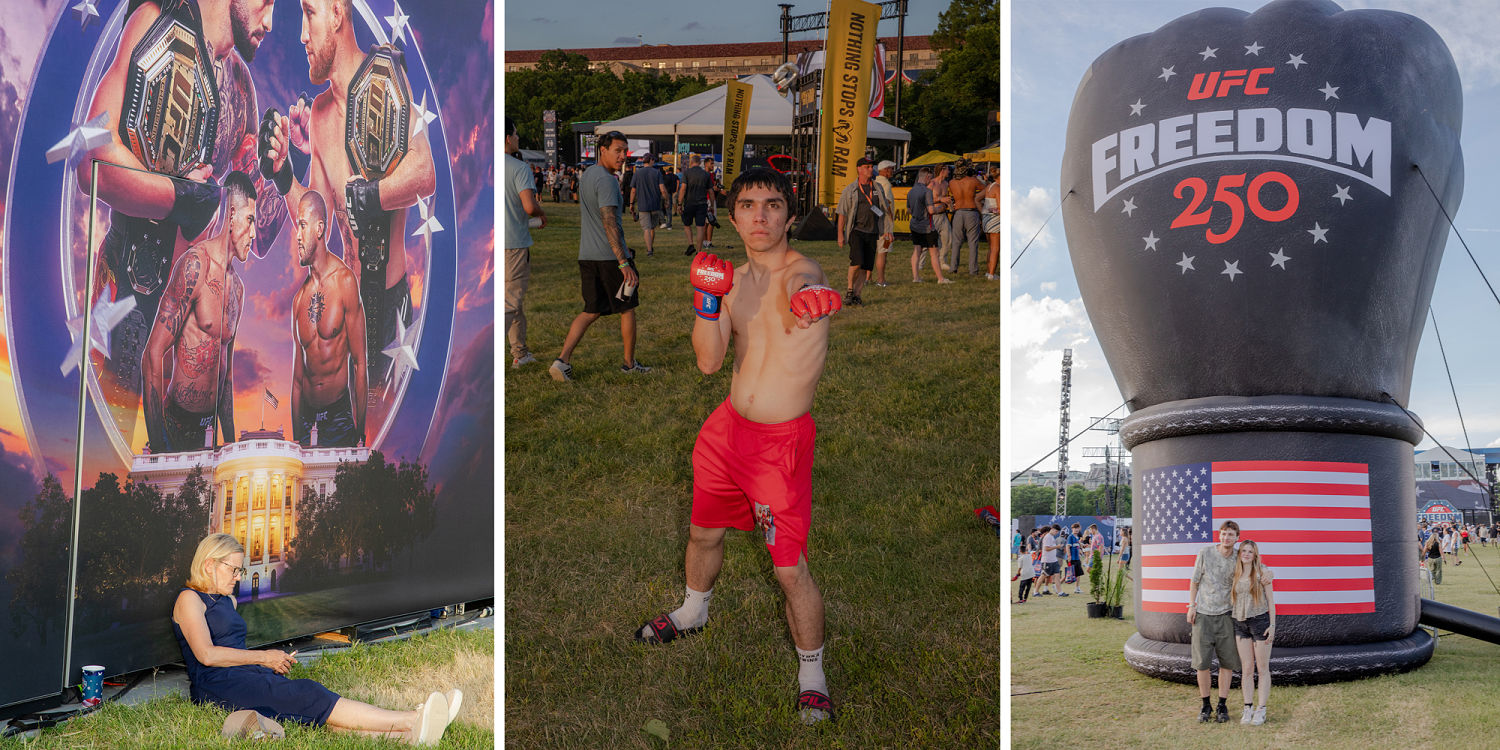
A 92-foot steel cage superstructure now towers over the South Lawn of the White House, permanently altering the iconic Washington skyline for a single weekend. This is "the Claw," a 600-ton engineering marvel imported from the Netherlands, trucked in from Pennsylvania, and erected on presidential turf to host UFC Freedom 250. Ostensibly designed to kick off the nation’s 250th anniversary, the event also serves a dual purpose as an unprecedented 80th birthday spectacle for President Donald Trump. Below the towering rigging, the UFC Freedom 250 Fan Fest has effectively converted the historic grounds and the adjacent Ellipse into a hyper-commercialized, corporate-sponsored carnival of modern populism.
For the premier mixed martial arts organization in the world, this is the ultimate manifestation of a decade-long strategy to merge combat sports with political identity. The event marks the first time a professional, for-profit sporting event has been staged at the executive residence, drawing an elite crowd of 4,500 invited guests to the South Lawn while over 50,000 spectators gather at the Ellipse to watch on massive digital screens. By moving away from traditional pay-per-view to stream the broadcast on Paramount+, the UFC is maximizing its cultural footprint, ensuring that its particular brand of patriotism reaches the widest possible audience.
Yet, beneath the surface of athlete meet-and-greets, soaring bald eagles, and a performance by the Zac Brown Band, lies a calculated corporate maneuver. This festival is not merely a celebration of American independence; it is a masterclass in modern sports marketing that weaponizes cultural alignment to cement brand loyalty.
The Machinery of the Pop-Up Colosseum
The sheer logistics of building a stadium on the President's backyard expose the vast capital and planning driving the corporate structure of modern MMA. UFC CEO Dana White revealed that the promotion burned through a massive portion of its $60 million event budget just to transport, build, and secure the temporary venue.
To understand the scale of the operation, consider the physical disruption to the executive mansion:
- The Claw: A 92-foot-high, 600-ton steel canopy engineered to protect the outdoor Octagon from summer thunderstorms.
- The Transit: Shipped via transatlantic containers, assembled in Pennsylvania, and hauled by a fleet of trailers directly onto the lawn.
- The Footprint: A 4,300-to-4,500 seat stadium covering the historic grass where foreign dignitaries are typically received.
This level of access has sparked intense legal and ethical blowback. Two Virginia residents filed a lawsuit attempting to halt the matches, arguing that a private, for-profit corporation was granted unlawful, unfettered access to public infrastructure for commercial branding. The legal challenge failed to stop the construction, but it highlighted a structural shift in how public space can be monetized.
The fighters themselves are integrated into this institutional theater. Instead of emerging from a standard arena tunnel, athletes like undefeated lightweight champion Ilia Topuria and interim titleholder Justin Gaethje will walk directly out of the Oval Office, past the West Wing, and down to the cage. This isn't just a walkout; it is a calculated visual alignment of political power and combat sports entertainment.
Separating Patriotism From the Political Apparatus
As the corporate lines blur, the talent caught in the middle of the spectacle has had to navigate an increasingly polarized public reaction. Country music star Zac Brown, who performed at the Fan Fest and signed on to sing the national anthem alongside the United States Marine Band, found himself defending his participation on national sports media.
Faced with criticism that the event serves as a tacit endorsement of the current administration, Brown attempted to draw a hard line between civic pride and partisan politics. He stated that his involvement was entirely about supporting active-duty military personnel, thousands of whom received invitations to fill the South Lawn seats. The narrative pushed by both the performers and the UFC executive suite is clear: this is an event about the semiquincentennial milestone of the United States, not the individual holding the keys to the building.
Dana White has echoed this sentiment, asserting that the production is designed to tell the story of America from the first preliminary fight to the main event. White argues that the spectacle transcends the traditional left-right political divide, pitching it as a unifying cultural moment.
However, maintaining that distinction is an uphill battle when the event timeline explicitly shifts to match the president's 80th birthday. The promotion originally eyed a traditional July 4th weekend date but pulled the schedule forward to June 14—Flag Day—coinciding exactly with the chief executive's birthday. This scheduling choice undercuts the messaging of pure, non-partisan patriotism, turning the Fan Fest into a complex hybrid of state-sanctioned celebration and personal tribute.
The Evolution of the Combat Sports Audience
The Fan Fest on the Ellipse demonstrates how effectively the UFC has cultivated a community that thrives on this exact blend of anti-establishment bravado and intense nationalism. The thousands of fans lining up for fighter autographs and buying overpriced merchandise represent a demographic that traditional sports leagues have spent years trying to decode.
For decades, major sports entities like the NFL or MLB sought broad, non-offensive appeal to safeguard corporate sponsorships. The UFC took the opposite trajectory. By leaning into controversy, embracing polarizing figures, and aligning its brand with raw, unapologetic Americana, the promotion built an insulated ecosystem where political polarization isn’t a liability—it is a feature that drives engagement.
The choice of broadcast platform further illustrates the strategy to capture mass attention. Moving the entire seven-fight main card away from the standard $80 pay-per-view model to a streaming service ensures the lowest possible barrier to entry. The goal for this specific card is not immediate pay-per-view revenue; it is long-term brand equity and cultural normalization.
By streaming the event live, the UFC turns a niche combat sport into a national primetime television event. It leverages the historic backdrop of the executive mansion to elevate the sport's prestige, aiming to convert casual onlookers into permanent members of the fan base.
The Competitive Reality Under the Spectacle
Strip away the political theater, the towering steel structures, and the concert stages, and the core product remains a highly volatile, elite athletic competition. The distractions surrounding UFC Freedom 250 are immense, yet the fighters involved are facing career-defining matchups that will proceed regardless of the unique venue.
The main event features a lightweight title unification bout that showcases the sport’s elite tactical evolution. Ilia Topuria enters the cage with a flawless 17-0 record, representing the modern, hyper-technical era of MMA characterized by disciplined boxing and elite grappling. His opponent, Justin Gaethje, is an established veteran known for enduring extreme physical damage while delivering highlight-reel knockouts.
In the co-main event, former light heavyweight champion Alex Pereira moves up to face Ciryl Gane for an interim heavyweight title, adding massive athletic stakes to an evening dominated by external narratives. The fighters spent weeks participating in promotional events, including an official meeting in the Oval Office, all while trying to maintain the strict training and weight-cutting regimens required for championship fights.
The contrast between the grueling, brutal reality of professional cage fighting and the polished corporate patriotism of the Fan Fest creates a strange tension. As cabinet members and high-ranking military officials take their premium ringside seats on the South Lawn, the athletes must block out the surrounding political circus. Once the cage door locks beneath the shadow of the White House, the external branding fades, leaving only the raw transaction of the fight itself. The legacy of the night will ultimately be split: historians will view it as a unprecedented convergence of political power and commercial sports entertainment, while the sports world will judge it by the blood spilled on the canvas of the South Lawn.