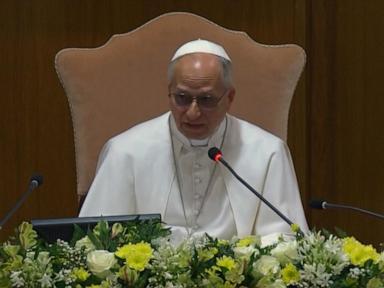
The marble floor of the Apostolic Palace is cold, even in the late spring. For centuries, these echoing hallways have played host to the heaviest questions of human existence. Kings have knelt here. Empires have been dissolved with the stroke of a pen. But on a recent afternoon, the air inside the Vatican felt different. It carried the distinct, low-humming tension of a confrontation with an invisible ghost.
Pope Francis sat before a gathering of scientists, ethicists, and tech executives. He did not look like a man trying to stop progress. He looked like a grandfather watching a toddler reach for a beautifully polished, razor-sharp knife.
When the Pope spoke, he did not use the dense, academic jargon of Silicon Valley. He did not talk about parameters, tokenization, or neural network architectures. Instead, he used a word that belonged in a treaty room at the end of a bloody global conflict.
Disarmed.
He warned that artificial intelligence needs to be disarmed. It was a jarring choice of vocabulary for a software tool, yet it struck the room with the force of a physical blow. We are accustomed to disarming missiles. We disarm landmines. We disarm rogue states. To suggest that we must disarm a line of computer code implies something terrifying: we have accidentally built a weapon, and we are currently inviting it into our living rooms.
Consider a hypothetical woman named Elena. She lives in a quiet suburb, works forty hours a week as a mid-level graphic designer, and spends her evenings managing the chaotic schedules of two young children. Elena is tired. When she discovers a new generative AI tool that can draft her client emails, organize her family budget, and even generate bedtime stories for her kids, she feels an overwhelming sense of relief. The tool feels like a gift. It is polite. It is infinitely patient. It never gets tired.
But Elena is participating in a grand, unscripted experiment. Every time she outsources a piece of her mind to the machine, the machine learns a little more about what it means to be Elena. It learns her vulnerabilities, her fears, her blind spots.
One evening, Elena asks the tool for advice on how to handle a difficult conversation with her aging mother. The AI responds instantly with a perfectly structured, empathetic script. Elena uses it. The conversation goes well. But as she hangs up the phone, a strange, hollow sensation settles in her chest. The words that healed her relationship did not come from her heart. They came from a server farm in Virginia.
This is the hidden front line of the war Pope Francis is talking about. The danger of AI is not a cinematic apocalypse featuring self-aware terminators marching across scorched earth. The real threat is much quieter, much more intimate. It is the gradual, willing surrender of the human spirit.
We are watching a tool evolve into an authority.
When we look back at the history of human technology, every major breakthrough has mirrored our physical limitations. The wheel extended our feet. The printing press extended our voice. The steam engine extended our muscles. We understood these tools because they were external to our consciousness. A hammer cannot think. A loom cannot judge.
AI breaks this historical lineage. It does not extend our muscles; it mimics our minds. It captures our language, copies our artistic expressions, and replicates our decision-making processes. Because it speaks like us, we naturally assume it thinks like us. We accord it a level of trust we would never grant to a traditional machine.
The Vatican's sudden urgency on this matter surprises people who view the Catholic Church as an ancient, slow-moving institution disconnected from modern tech hubs. That view misses the point. The Church has spent two millennia studying human nature, temptation, and the fragility of conscience. It knows exactly what happens when human beings are given a shortcut around suffering, thought, and moral responsibility.
The Pope’s warning centers on a profound philosophical truth: when you automate choice, you kill accountability.
Imagine a bank utilizing an algorithm to determine who qualifies for a home loan. The system processes millions of data points in milliseconds. It denies a loan to a young family. When the family asks why, the local branch manager shrugs. "The system made the decision," he says. He cannot explain the system’s reasoning because the algorithm is a black box, a proprietary secret buried beneath layers of deep learning.
Human bias did not vanish. It was simply laundered through mathematics. The manager is absolved of guilt. The bank is protected from scrutiny. The family is left staring at a screen that has judged them unworthy, without a single human being taking responsibility for the verdict.
Now, scale that cold autonomy up to the level of global geopolitics.
Autonomous weapons systems are no longer the stuff of science fiction. They exist. Drones capable of selecting and engaging targets without human intervention are already flying over conflict zones. The mathematical justification is always efficiency. A machine reacts faster than a human pilot. A machine does not panic. A machine does not feel fatigue.
But a machine also cannot feel mercy.
A computer program operates on binary logic. It sees a target or it does not. It calculates probability. It does not possess the capacity to hesitate at the sight of a child's toy left in a courtyard. It cannot experience the sudden, irrational wave of compassion that has caused soldiers throughout history to lower their weapons and grant quarter to an enemy.
When we remove the human element from the act of killing, we do not make war cleaner. We make it total. We remove the final friction point between malice and slaughter: the human conscience.
The pushback from tech corporations is predictable. They argue that regulation will stifle innovation. They promise that the next iteration of their model will include better guardrails, stricter alignment protocols, and safer datasets. They treat the problem as a temporary engineering glitch that can be patched in the next software update.
This is a dangerous delusion. You cannot patch a fundamental flaw in human nature with a software update.
The tech industry is locked in a classic prisoner's dilemma. If one company slows down to assess the ethical implications of its product, its competitor will leap ahead. If one nation pauses its military AI development, its rival will seize the advantage. The market rewards speed, not caution. It prioritizes engagement over truth, and profit over human dignity.
That is why an external, moral authority must step into the arena. The call to disarm AI is an insistence that there are certain domains of life that must remain fiercely, unalterably human.
We must ask ourselves what we are willing to lose in exchange for convenience. If we allow algorithms to write our poetry, paint our pictures, judge our criminals, and fight our wars, what is left for us to do? We risk becoming bystanders in our own civilization, consumers of a culture generated by machines that feel nothing, serving an economy managed by code that values nothing but optimization.
True human intelligence is not merely the ability to process data or predict the next word in a sentence. It is the capacity for wisdom. Wisdom requires suffering. It requires the memory of mistakes, the weight of regret, and the transcendent experience of love. A machine can simulate these things, but it can never possess them. A language model can write a beautiful essay on grief, but it has never wept over an empty grave.
The path forward is not a blanket rejection of technology. The Vatican itself uses digital tools to reach millions of people across the globe. The goal is not to smash the machines, but to reassert our sovereignty over them.
Disarming AI means stripping it of its false aura of infallibility. It means forcing the creators of these systems to legally account for the consequences of their creations. It means establishing international treaties, akin to the Geneva Convention, that draw a hard, unbreakable line around lethal autonomous weapons.
Most importantly, it means changing how we view ourselves.
We must stop treating efficiency as the highest human virtue. The most valuable aspects of our lives are often profoundly inefficient. It is inefficient to spend hours listening to a friend grieve. It is inefficient to paint a picture by hand when a prompt could generate it in four seconds. It is inefficient to struggle through a difficult book when a summary can be digested in two minutes.
Yet, it is precisely within those gaps of inefficiency that the human soul grows. That is where character is forged.
The sun set over Rome, casting long, dramatic shadows across the cobblestones of St. Peter’s Square. The tourists snapped photos on their smartphones, uploading them instantly to cloud servers, their movements tracked and analyzed by algorithms designed to predict their next purchase.
Inside the palace, the meeting concluded. The executives and scientists walked out into the evening air, leaving behind the old man in white. He had given them no technical directives, no policy whitepapers, no code snippets. He had simply held up a mirror to their own ambition.
The machine will continue to whisper. It will offer us easier choices, faster answers, and the seductive illusion of control. The question is not whether the machine can learn to think like a human. The question is whether we will continue to care enough to tell the difference.