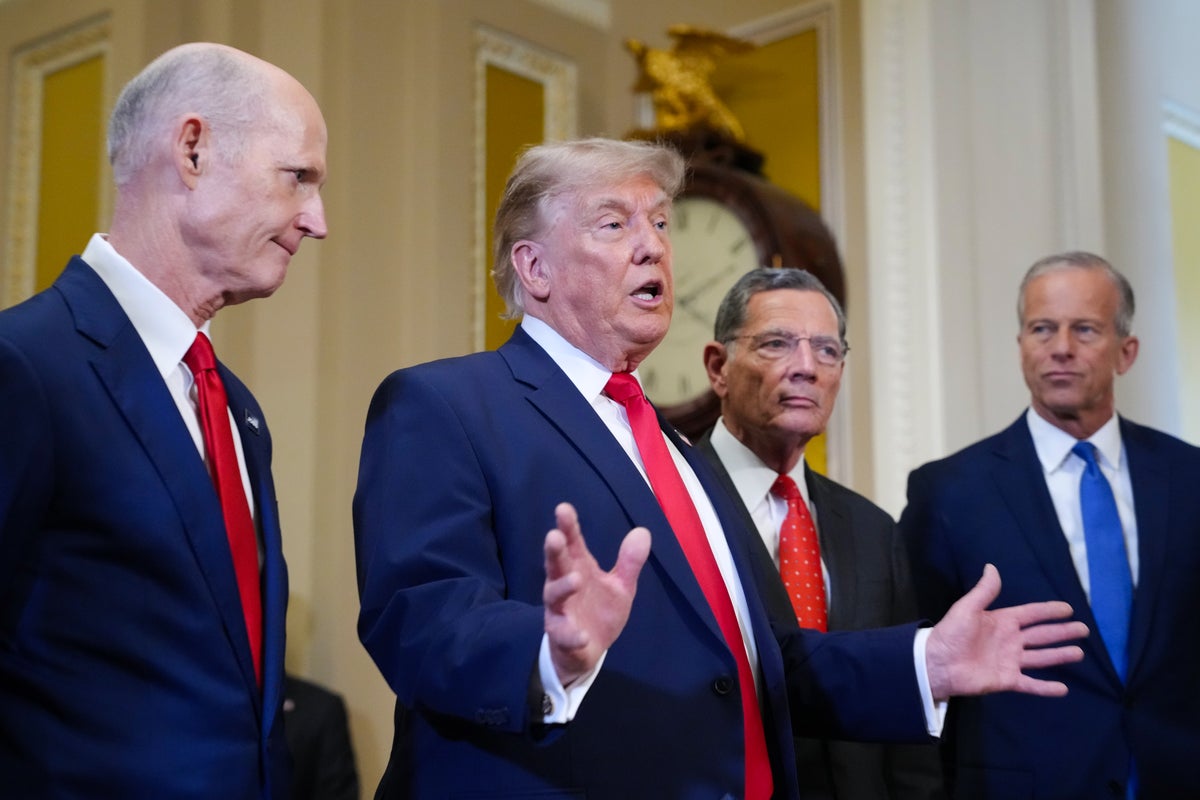
The marble floors of the United States Capitol have a way of amplifying sound. Every hurried footstep, every whispered conversation in a hidden alcove, echoes off the stone. But on days when the political temperature boils over, the loudest sound is the sudden, heavy silence that falls when an entire legislative body realizes it no longer holds the steering wheel.
Walk through the rotunda during a high-stakes standoff and you can feel the physical tension. It hangs in the air like the humidity before a summer storm. Members of Congress pace the corridors, their eyes glued to glowing smartphone screens. They are checking text messages, waiting for a signal from a private club down in Florida. This is the reality of modern governance. The formal constitutional power lines that supposedly run from the voters to their elected representatives have been rerouted. Now, they pass through a single living room in Mar-a-Lago.
The recent collapse of congressional defiance was not a slow drift. It was a sudden, violent snap. For weeks, a quiet rebellion had been brewing among lawmakers who believed, perhaps naively, that the institution of Congress could still assert its independence. They gave speeches. They huddled in secure committee rooms. They talked about institutional pride.
Then the phone rang.
To understand how a branch of government gets held hostage, you have to look past the cable news chyrons and focus on the raw human mechanics of political survival. Fear is a quiet companion in politics. It does not look like panic; it looks like a lawmaker quietly changing their vote on an amendment because they saw what happened to a colleague who stepped out of line. It looks like a politician deleting a tweet.
Consider the anatomy of a modern legislative rebellion. It usually begins with a small group of lawmakers who decide a specific bill or a policy direction is bad for the country. They build a coalition. They count heads. They feel a fleeting surge of collective strength. In the old days of Washington, the leadership would counter this by offering a new bridge in the lawmaker’s district, or a coveted committee assignment. It was a transaction.
Today, the leverage is entirely psychological. The threat is not that you will lose a committee seat; the threat is that your own voters will be told you are a traitor before you even finish your lunch. When Donald Trump intervened in the latest congressional standoff, he did not send a detailed policy memo. He issued a handful of public declarations that operated like a thermal camera, identifying the exact fault lines of vulnerability within the caucus.
The rebellion vanished within forty-eight hours. Lawmakers who had spent the previous week promising to stand their ground suddenly found reasons to be elsewhere. Some discovered pressing business back in their home states. Others discovered a newfound appreciation for the very proposals they had called disastrous just days earlier. The shift was so fast it gave observers whiplash.
This is how power operates when it is detached from institutional rules. It becomes personal. It becomes absolute. The Capitol building remains a magnificent structure, with its towering dome and historic paintings, but the actual machinery of decision-making has been outsourced.
The human cost of this dynamic is a pervasive sense of powerlessness among the people who are actually elected to run the country. Speak to staffers away from the microphones, in the dim light of Capitol Hill bars, and the exhaustion is palpable. They spend months drafting legislation, negotiating commas, and analyzing data, only to watch the entire structure evaporate because of a single post on social media.
The real casualty in this environment is not any single piece of legislation. It is the predictability of government itself. When an entire legislature can be frozen in place by the whims of one individual outside the building, the basic stability required to pass budgets, fund defense programs, and manage the nation’s affairs begins to erode.
The standoff has ended, the votes have been cast, and the Capitol has quieted down for the night. The tourists are gone, and the janitors are sweeping the marble floors. The rebellion was beaten back, not with a grand philosophical argument, but with the raw application of political gravity. The institution remains standing, but everyone inside knows who holds the keys.