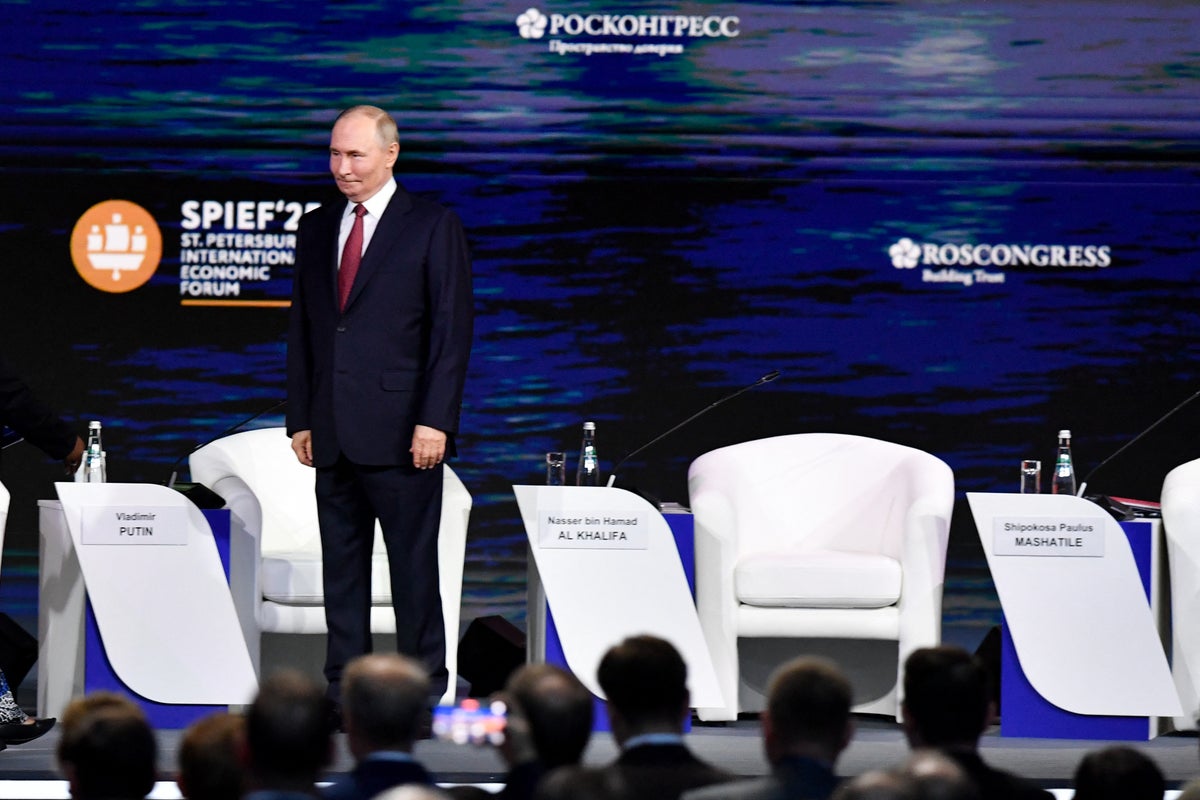
The Western press has found its favorite annual punching bag again. The St. Petersburg International Economic Forum (SPIEF) kicked off this week, and the headlines read like a bad tabloid. They scream about a circus of "fringe characters"—fixating entirely on the presence of Donald Trump's ballroom chief Rodney Mims Cook Jr., right-wing podcaster Candace Owens, the notorious Tate brothers, and a fading action star like Steven Seagal.
The mainstream media consensus is incredibly lazy. The narrative is always the same: SPIEF used to be a prestigious gathering of ExxonMobil executives, Goldman Sachs bankers, and European heads of state. Now, they claim, it has devolved into a desperate, isolated echo chamber of Western culture-war influencers and political outcasts.
This assessment is completely wrong. By focusing exclusively on the Westerners they love to hate, commentators are missing the actual mechanics of global economic realignment happening right under their noses. SPIEF is no longer trying to be the "Russian Davos" because Moscow has abandoned the idea that Davos is the center of the world. The event has transitioned from a Western investment courtship into something far more potent: a logistics hub for an alternative global economy.
The Flawed Premise of Russian Isolation
The core argument of the legacy press rests on a simple metric: the absence of Fortune 500 CEOs from New York, London, and Frankfurt equals total failure. This is an incredibly narrow, Eurocentric view of global trade. I have spent years tracking international trade flows, and if there is one thing the post-2022 economy has proven, it is that Western capital is no longer the only game in town.
While Western reporters are busy mocking Steven Seagal, they are ignoring the 20,000 participants from over 100 countries filling the halls in St. Petersburg. More importantly, they completely glossed over the fact that Saudi Arabia is the official "guest country" of SPIEF this year. The Saudi delegation is not led by internet influencers; it is led by Prince Abdulaziz bin Salman Al Saud, the Minister of Energy.
Think about the sheer economic weight in that room. When the world's top energy producers—Russia and Saudi Arabia—sit down alongside massive delegations from China, India, the UAE, and across Africa, they are not discussing Western culture wars. They are hammering out alternative financial settlement systems, insurance mechanisms for oil tankers that bypass Western syndicates, and the expansion of BRICS logistics networks.
To call an event "isolated" when it hosts the architectural core of OPEC+ and the expanding BRICS alliance is a delusion. The West did not isolate Russia; it isolated itself from Russia.
The Strategic Logic Behind the Influencer Circuit
The mainstream media views the invitation of figures like Candace Owens or the Tate brothers as a sign of Kremlin desperation. They assume Putin is starved for Western validation. This completely misinterprets how modern information warfare operates.
The Kremlin is not looking for validation from the West; it is looking for leverage points within the West.
By giving a massive international platform to figures who built their massive audiences by challenging Western institutional trust, Russia is executing a highly calculated geopolitical play. These influencers possess direct distribution lines to tens of millions of Western citizens who are already deeply skeptical of their own governments, the transatlantic security order, and mainstream economic policies.
When SPIEF hosts a session featuring Western commentators discussing alternative economic realities or social policies, it is not an attempt to attract capital. It is an exercise in narrative warfare. The goal is to project an image of Russia not as a pariah state, but as a sovereign, traditionalist alternative to a Western system that many within the West feel alienated by. Whether you agree with these influencers or find them abhorrent, treating their presence as a meaningless side-show misses the strategic utility they provide to Moscow's broader asymmetric strategy.
The Cultural Thaw Nobody Wants to Admit
The most significant event at SPIEF this week was not a political speech, but the formal return of an official US presence. The legacy media tried to downplay the attendance of Rodney Mims Cook Jr., the chairman of the US Commission of Fine Arts. They scrambled to report that he was not an "official" envoy appointed by the White House, despite his role overseeing federal arts projects.
But look at the mechanics of his visit. Cook openly stated that his participation was approved by the State Department. He sat on a panel titled "Russia–US: A Dialogue of Cultures" alongside Valery Gergiev, the director of the Bolshoi and Mariinsky theaters, and Mikhail Piotrovsky, the director of the Hermitage Museum.
This is the first time a US official at this level has attended the forum since 2018. Even Robert Agee, the president of the American Chamber of Commerce in Russia, noted that more American companies are quietly attending this year than in previous post-conflict editions.
There is a blatant disconnect between public political rhetoric and private pragmatic reality. Behind the scenes, the economic and cultural connective tissue between Washington and Moscow is quietly being re-tested. The West's maximum-pressure campaign has reached its point of diminishing returns, and pragmatism is starting to creep back into the margins.
The Real Shift is Structural, Not Ceremonial
The old SPIEF was about global integration—Russia trying to play by the rules of the liberal international order established by the West. The new SPIEF is about economic sovereignty and institutional replication.
Instead of trying to lure back Western investment funds that can be frozen at the whim of G7 regulators, the discussions in St. Petersburg are focused on building infrastructure that is completely immune to Western sanctions. This includes:
- De-dollarized trade mechanisms utilizing local currencies and alternative digital assets.
- Independent maritime insurance and reinsurance frameworks to completely bypass the G7 oil price cap.
- The development of the Northern Sea Route as a viable alternative to the Suez Canal, entirely within Russian sovereign waters.
If you judge the success of an economic forum by how many Wall Street banks attend, then SPIEF is a ghost town. But if you judge it by its ability to facilitate the rewiring of global trade routes toward the Global South and East, it is arguably more functional today than it was a decade ago.
The insistence of Western commentators to focus on the eccentricities of the guest list rather than the structural realignment of global commerce is a comforting coping mechanism. It allows the West to pretend that its financial and cultural hegemony remains absolute. But treating a fundamental shift in global trade networks as a low-rent celebrity circus is a massive analytical failure. The world is changing its economic plumbing, and the West is too busy laughing at the guests to notice the pipes being laid.